
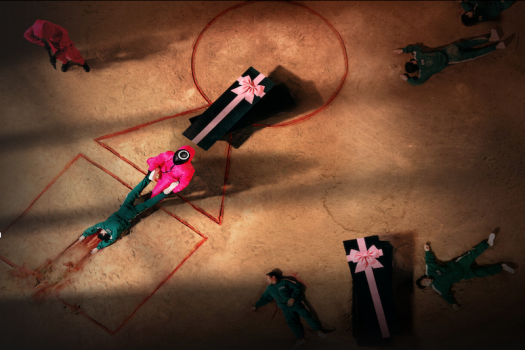
The Squid Game is just an outstanding and out-of-the-box TV series. The Korean drama is a global sensation — and the buzz shows no sign of slowing. Season 2, which arrived in late 2024, deepened the themes of the original: desperation, moral collapse, and the question of what extreme power asymmetry does to human behaviour. It would be fair to say that the hype is justified. Squid Game makes us wonder, think, imagine, and fear the worst that could happen to humans. But most of all, it raises the question of how dangerous it is to have billionaires and powerful people who could, presumably, take an action such as the Squid Game into reality.
Should Billionaires Exist?
In 2019, during the Democratic presidential debate, Bernie Sanders made an interesting comment saying that billionaires should not exist. Indeed, in a utopian world, we most likely wouldn’t want individuals with such enormous amounts of money. Just to remind you — as of 2025, Elon Musk has accumulated around $454 billion, and Jeff Bezos is worth slightly above $242 billion. There are now over 2,781 billionaires in the world. The combined wealth of the world’s billionaires exceeds the GDP of most countries.
On the one hand, if you believe in the free economy and the capitalistic system, then these people are, in fact, the driving force of the global economy and trade around the world. According to Adam Smith’s Wealth of Nations, we sort of need wealthy people to make things happen — to hire and employ people, innovate, and take the risk and burden of developing the economy. Tesla exists because Elon Musk bet his personal fortune on it. Amazon exists because Jeff Bezos risked everything on a bookstore that most people thought was a bad idea. SpaceX is launching rockets to orbit because one private individual decided governments were moving too slowly. The case for billionaires, honestly told, is not entirely without substance.
On the other side of the coin, we must agree that if an individual person has billions of dollars, it’s a risky business, right? They can do whatever they want — including creating a Squid Game scenario. That is a legitimate fear for ordinary people who can be actively controlled by rich and powerful people. And it’s not purely theoretical. Billionaires already own media companies that shape public opinion, fund political campaigns that determine election outcomes, and operate private intelligence and security apparatus that rival small states. The question isn’t just whether they would create a Squid Game — it’s whether the structural power they already hold is a kind of Squid Game played at a slower speed.
“The cost of running an operation like the Squid Game is maybe $500 million to $1 billion. Many billionaires wouldn’t notice the loss. The question is why anyone — rich or poor, good or evil — would want to.”
When Jeff Bezos Said He Wanted to Watch Squid Game
Quite recently, Amazon owner and the second richest person in the world, Jeff Bezos, said he wants to watch Squid Game. Guess what — people didn’t like it. The immediate reaction was: “what happens if he wants to do that?” After all, we don’t know Jeff Bezos, nor Elon Musk, or any of the 2,781 billionaires who live in the world. The reaction reveals something important: it is not that people genuinely believe Jeff Bezos is going to construct a death game. It is that the show has surfaced an anxiety that already existed — the feeling that extreme power differentials create a kind of moral hazard that even well-intentioned rich people cannot fully escape.
The Numbers Behind the Anxiety
The wealth concentration that Squid Game dramatises is not an exaggeration — it is, in some ways, an understatement of what has actually happened to the global distribution of resources.
In 1987, there were 140 billionaires in the world. By 2000, there were 470. By 2010, 1,011. By 2025, 2,781. The pace of billionaire creation has outrun economic growth, population growth, and virtually every other measure of how broadly prosperity is distributed. Meanwhile, the bottom half of the global population — roughly 4 billion people — holds less than 1% of global wealth. The Squid Game’s contestants are not a fantasy. They are a stylised version of something real: desperate people with no good options, willing to take extraordinary risks for a chance at financial survival.
What has driven this concentration? A complex mix of factors — technological leverage (a few engineers can build products used by billions), globalisation (capital moves freely, labour doesn’t), the declining power of trade unions, the rise of winner-take-all digital markets, and tax regimes that have consistently moved in favour of capital over the past four decades. None of this is the result of individual malice. It is the accumulated output of systems that were designed, maintained, and reformed — or not reformed — by choices that societies made or failed to make.
“In 1987, there were 140 billionaires in the world. In 2025, there are 2,781. No society voted for this. It happened through a thousand smaller decisions.”
What Squid Game Actually Shows Us About Human Nature
After watching Squid Game, I wouldn’t say billionaires are the enemy. It’s not fair to say that. After all, billionaires are ordinary people with money, and the reality is that Squid Game also shows us disturbing human behaviour and the complexity of human nature. Money versus morals. Me against the world. Are we individuals or part of a social group?
The show is not primarily about the VIPs — the masked billionaires who bet on contestants’ lives from their observation deck. It is about the contestants themselves. About how quickly cooperation breaks down under pressure. About how the promise of enough money can make ordinary, decent people do monstrous things to each other. About how the game’s real cruelty is not the violence itself but the structure that makes the violence feel rational, even necessary.
This is what Black Mirror, The Hunger Games, and Squid Game share as a genre: they are not prophecies about what the rich will do to the poor. They are mirrors held up to what ordinary humans do to each other when the conditions are right — or rather, when the conditions are engineered to be wrong.
Season 2 of Squid Game deepened this. The returning player — now on the inside, trying to dismantle the game from within — discovers that the system is not sustained by a single evil architect. It is sustained by the participation of people who have reasons, mostly comprehensible ones, for continuing to participate. The horror is not the monster at the top. It is how far down the complicity goes.
The Biggest Lesson
But make no mistake — there are two ways in which evil things like the Squid Game might happen: governments and rich people. And for that reason, humans continue and will continue to oppose government control and economic inequality. This is the greatest lesson, in my opinion, to be taken from this TV series.
The show is not an argument for revolution or for tearing down the economic system. It is an argument for paying attention. For recognising that systems which make extreme outcomes possible — whether extreme poverty or extreme wealth — are not natural phenomena. They are human constructions. They were built. They can be reformed. The question is whether the people inside those systems have the clarity, the courage, and the political organisation to do so before the game gets worse.
Why do we react the way we do to Squid Game? Because it holds up a mirror to the world we have built, and asks whether we are comfortable with what we see. Most of us are not. That discomfort is not a bug — it is the point.