
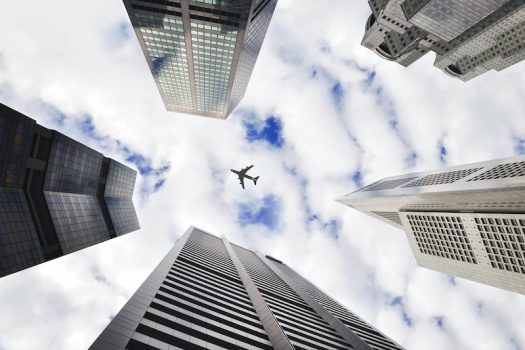
Since my two-year-old son has started spotting airplanes, it has become some kind of a riddle for me to know how many airplanes are actually flying in the air at any given moment. I found myself constantly shouting to him: “here’s another airplane and another airplane”. The sky is full of airplanes, and inside these machines, there are lots of people who are literally sitting in the air any moment you’d look at the sky.
The big question for those who love numbers and stats is how many airplanes are flying in the sky right now?
So, How Many Airplanes Are in the Sky Right Now?
So, what’s the number, right? Hard to say. Knowing the exact number is nearly impossible as there are many military airplanes and small private ones, ones that are not registered and, thus, can be counted.
Still, as of 2026, it is estimated that there are somewhere between 8,000–10,000 airplanes in the air at any given moment. During peak times, you’ll see the number rising to as high as 15,000. But on average, it is very likely that there are between 8,000 to 10,000 commercial planes in the air at any given moment these days.
If you need evidence, there’s a very cool website that shows you how many planes are being tracked in the sky in real-time — FlightRadar24, live air traffic. So, for example, right now, I can see there are 9,182 airplanes in the sky.
But, this data includes commercial flights only. So, we can roughly estimate that, including small planes and military, the number is higher at around 15,000 to 20,000 airplanes in the sky at any given second.
See how many planes are in the sky right now — updated in real time.
How Many People Are in the Sky Right Now?
Now, we have another question to wonder about. If there are so many airplanes in the sky and inside these airplanes, there are quite a lot of people, so, how many people are actually in the sky at any given moment???
So, assuming that the average number of passengers per flight – domestically and internationally – stands somewhere between 100–120 (very difficult to find accurate data, BTW). That gives us an estimation of between 1 million and 1.2 million in the air at any given time. Quite an outstanding number. But remember, once again, the data does not include other non-commercial flights, so the number of people in the air at any given time is even higher and may reach up to 2 million people.
Where in the World Are They Flying?
The sky is not evenly crowded. Air traffic is heavily concentrated over a handful of regions, with the busiest corridors following the world’s most economically active zones.
North America is the world’s busiest airspace. The US alone handles over 45,000 flights per day managed by the FAA. The New York–London transatlantic corridor is one of the most heavily trafficked international routes on earth.
Europe is the most densely packed airspace by geographic area. EUROCONTROL, which manages European air traffic, handles around 35,000 flights per day at peak periods. The London Heathrow–New York JFK route is consistently among the busiest international routes in the world.
Asia-Pacific has seen the fastest growth in aviation over the past decade. China’s domestic aviation market is now the largest in the world by number of passengers, and routes between major Asian hubs — Tokyo, Seoul, Singapore, Hong Kong — generate enormous traffic volumes.
| Region | Daily flights (approx.) | Busiest route |
|---|---|---|
| North America | ~45,000 | New York – Los Angeles |
| Europe | ~35,000 | London – Amsterdam |
| Asia-Pacific | ~30,000 | Seoul – Tokyo |
| Middle East | ~8,000 | Dubai – London |
| Latin America | ~6,000 | São Paulo – Buenos Aires |
| Africa | ~3,000 | Johannesburg – Nairobi |
What About Cargo Flights?
Most people think about passengers when they imagine the sky full of planes. But a significant share of those aircraft are carrying freight, not people. FedEx, UPS, Amazon Air, DHL, and dozens of cargo carriers operate dedicated fleets that are largely invisible to the casual observer — they fly mostly at night, during off-peak hours, on routes optimised for logistics rather than convenience.
FedEx alone operates over 700 aircraft, making it one of the world’s largest airlines by fleet size. UPS operates around 600. Amazon Air, which didn’t exist before 2016, now operates over 100 aircraft and is growing rapidly. Combined with the cargo holds of passenger aircraft — which carry a substantial portion of global air freight — the total freight moving through the sky at any moment is enormous.
Global air cargo handled approximately 65 million tonnes of freight in 2024. To put that in perspective, air freight accounts for less than 1% of global trade by volume but around 35% by value — it’s the method of choice for high-value, time-sensitive goods like electronics, pharmaceuticals, and fresh produce.
“The sky you see is mostly passenger planes. The sky you don’t see — flying overnight, below the radar of casual attention — is the cargo network that keeps global supply chains moving.”
How Does 2026 Compare to the Past?
The number of planes in the sky has changed dramatically over the decades — and the COVID-19 pandemic created the most dramatic single disruption in aviation history.
| Year | Global daily flights (approx.) | Context |
|---|---|---|
| 2000 | ~50,000 | Pre-9/11 peak |
| 2010 | ~75,000 | Post-GFC recovery |
| 2019 | ~102,000 | Pre-COVID record high |
| 2020 | ~25,000 | COVID-19 collapse |
| 2023 | ~95,000 | Near-full recovery |
| 2026 | ~105,000 | New record high |
The collapse in 2020 was staggering — global aviation lost roughly 75% of its traffic almost overnight. Airlines grounded thousands of aircraft, parked them in deserts, and laid off hundreds of thousands of workers. The recovery has been faster than most analysts predicted, and by 2026 the industry has surpassed pre-pandemic records.
What’s the Environmental Cost?
With 100,000+ flights per day and 1+ million people in the sky at any moment, it’s worth asking what all of this costs the atmosphere. Aviation accounts for approximately 2.5% of global CO2 emissions — a figure that understates its full climate impact, since aircraft also emit nitrogen oxides and water vapour at altitude, which have warming effects beyond CO2 alone. The IPCC estimates aviation’s total climate forcing may be 2–4 times its CO2 contribution alone.
The industry is under significant pressure to decarbonise. Sustainable aviation fuel (SAF) — made from agricultural waste, municipal solid waste, or synthetic production — is the most credible near-term solution, but current SAF production covers less than 1% of aviation’s fuel needs. Electric and hydrogen aircraft are being developed for short-haul routes but are decades away from meaningful scale.
For now, every time you look up and count the contrails, you’re watching one of the world’s most carbon-intensive industries at work — one that also connects the world in ways that would have seemed miraculous to anyone alive a century ago.
The Bottom Line
Some people find those riddles quite interesting. After all, the planet is our home, and you may wonder how ruined it is already. I mean, we know that there are so many satellites orbiting the earth, and airplanes are just another line of traffic for human beings.
So, yes, the sky is full of stars, but also airplanes, satellites, and people.