
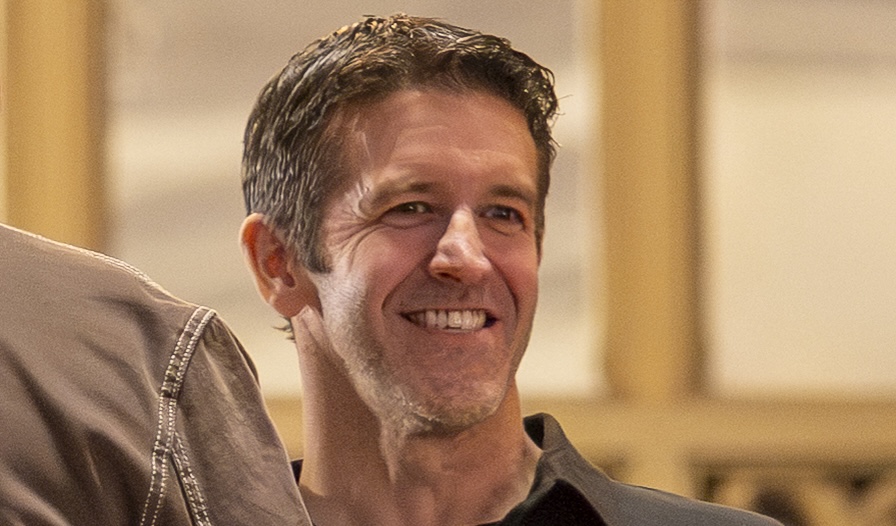
John Ternus once told a room of younger Apple employees that when he started at the company, he wasn’t sure he belonged. It’s an unusual thing for the incoming chief executive of the most valuable company on earth to admit out loud — but it’s also, in hindsight, the most honest way to describe what just happened. A 25-year Apple lifer who spent his entire career a few rungs removed from the spotlight, quietly running the teams that actually build the iPhone, the Mac, and the Apple Watch, has now stepped into the seat Steve Jobs and Tim Cook once held. As of September 1, he’s Apple’s CEO. The question the market is now trying to answer isn’t really about Ternus the person — it’s what an engineer’s era at the top actually means for the stock.
“John Ternus has the mind of an engineer, the soul of an innovator, and the heart to lead with integrity and honor.”
— Tim Cook, on naming John Ternus Apple’s next CEOYou can track AAPL alongside the rest of the market in real time in our Markets Today dashboard.
Who Is John Ternus? The Engineer Apple Kept Promoting
Ternus joined Apple’s product design team in 2001, fresh out of a mechanical engineering degree at the University of Pennsylvania, after a brief stint at Virtual Research Systems. For most of the next two decades he wasn’t a public figure at all — he was the person actually responsible for the hardware inside the products Apple sells. By 2021 he’d been promoted to Senior Vice President of Hardware Engineering, overseeing the iPhone, Mac, and Apple Watch lines directly. If you’ve picked up an iPhone 18 — which we reviewed here — the hardware in your hands passed through the group he built and ran.
That’s part of what makes this transition read differently than a typical CEO handoff. Ternus wasn’t a public-facing executive being groomed for the spotlight; by his own admission, and by outside reporting, he was “relatively unknown” outside of hardware circles right up until Apple’s board named him. He’s also been candid about the self-doubt that came with the job, at one point telling younger employees at the company that the mindset that got him through it was simple: “never assume you know as much as others.” Coming from the person now running the most valuable company in the world, that’s a notably humble thing to have said.
The board’s own language on the pick was equally direct. Arthur Levinson, who moves into the role of lead independent director as part of the transition, said the board believes “John is the best possible leader to succeed Tim and his love of Apple will help lead Apple to an extraordinary future.” Cook, for his part, isn’t leaving outright — he’s stepping up to Executive Chairman, focused on the company’s relationships with policymakers globally, in what both sides have described as a long-planned, unanimously approved succession rather than an abrupt exit.
What History Says Happens When Tech Giants Change CEOs
This isn’t the first time a major tech company has handed the keys to a long-tenured internal executive instead of bringing in an outsider, and the track record of those transitions is worth looking at directly — because it complicates the instinct to treat a new CEO as either a green light or a red flag on its own.
| Transition | Year | Stock, First 12 Months |
|---|---|---|
| Steve Jobs → Tim Cook (Apple) | 2011 | ~+76% |
| Sundar Pichai → Alphabet CEO | 2019 | ~+41% |
| Steve Ballmer → Satya Nadella (Microsoft) | 2014 | ~+15% |
| Jeff Bezos → Andy Jassy (Amazon) | 2021 | ~-38% |
Average that out and you get roughly +24% across the four — a genuinely good number, on its face. But the more useful lesson, as The Motley Fool’s analysis of these handoffs points out, is that the transitions themselves didn’t drive the returns; the valuation and the business cycle each company was in when the new CEO took over did. Cook and Nadella both inherited stocks trading at reasonable multiples with real growth still ahead of them. Jassy took over Amazon at roughly 70 times earnings, just as pandemic-era growth was stalling — and the stock paid for that starting point.
Apple’s starting point under Ternus sits closer to the expensive end of that range: around 36 times earnings, more than double the multiple Cook inherited from Jobs in 2011, after the stock’s market cap climbed roughly 30% over the past year. That doesn’t mean the setup is bad — Apple is nowhere near Amazon’s 70x — but it does mean a meaningful amount of optimism about this transition is already priced in before Ternus has made a single major decision as CEO. History’s blunter conclusion: the handoff itself will probably be a non-event. What happens next is about the business, not the announcement.
Apple Just Walked Away From a Policy It Held for Seven Years
The more consequential news buried inside this transition isn’t the org chart — it’s a quiet change to how Apple manages its own balance sheet, and it’s worth being precise about who actually made that call, since it happened before Ternus was CEO at all. On Apple’s Q2 earnings call back in early May — with Cook still firmly in charge — CFO Kevan Parekh announced Apple was dropping the self-imposed “net cash neutral” target it had held since 2018, a policy that had effectively capped how much cash the company held by directing the excess toward buybacks and dividends. This wasn’t Ternus’s decision to make. But it was explicitly framed as preparation for his arrival: Parekh said Apple would “independently evaluate cash and debt” going forward, and Ternus himself confirmed on that same call that he and Parekh intend to carry that approach forward once he takes over. Read together, it looks less like a Ternus initiative and more like Cook deliberately handing his successor more room to maneuver than Cook himself ever had — including, potentially, tapping the debt markets the way other tech giants increasingly have.
The spending numbers tell a similar story about timing. Apple’s R&D spending rose 32% year-over-year in fiscal Q3, reported July 30 — also before Ternus’s official start date — to $11.7 billion, with total operating expenses reaching $19.1 billion. That’s Cook-era spending, not something Ternus himself drove, but it’s the runway he’s inheriting, and where he chooses to point it next is the more meaningful thing to watch than the number itself. For context, it’s still modest next to a hyperscaler: Amazon alone spent roughly $54 billion on capital expenditures over a comparable stretch, mostly building out AI infrastructure. Apple isn’t matching that dollar-for-dollar — it’s using the flexibility of an enormous cash pile without touching the buybacks and dividends investors have come to expect.
What Ternus’s Era Could Mean for Apple Stock
Put the pieces together and Wall Street’s current read is cautiously constructive rather than euphoric. The analyst consensus sits at a moderate buy — 16 buy ratings, 12 holds, and 4 sells across 32 analysts — with an average 12-month price target around $336, implying roughly 5% upside from current levels. That’s a real but unspectacular number, which lines up with the historical pattern above: Apple isn’t inheriting Jassy’s overpriced setup, but it also isn’t inheriting Cook’s cheap one either.
| Firm | Rating | Price Target | As Of |
|---|---|---|---|
| TD Cowen | Buy | $400 | 9/10/26 |
| Maxim Group | Buy | $380 | 9/10/26 |
| Bank of America | Buy | $370 | 9/14/26 |
| HSBC | Buy | $366 | 9/8/26 |
| Citi | Buy | $365 | 9/9/26 |
| Morgan Stanley | Overweight | $360 | 9/10/26 |
| Rosenblatt Securities | Neutral | $303 | 9/10/26 |
| Barclays | Underweight | $245 | 9/10/26 |
The product calendar gives Ternus his first real chances to move that number. The iPhone 18 Pro and Pro Max are already in the market, built under his own hardware organization before he ever became CEO. What’s next is more telling: Apple’s first-ever foldable device, widely expected to ship as an “iPhone Ultra,” would be the clearest signal yet of whether an engineer running the company translates into a faster, bolder product cadence than the Cook era’s more incremental releases. Pair that with the redirected R&D spending, and the next two to three quarters should show fairly clearly whether the AI catch-up is real or still mostly rhetoric. For a closer look at how AAPL’s technicals and fundamentals are trending right now, our AI stock analysis tool tracks both alongside the broader analyst picture.
The optimism around Ternus looks earned rather than manufactured — 25 years inside the company, direct ownership of the products that actually generate Apple’s revenue, and a unanimous board endorsement. That’s about as clean a leadership transition as a company this size can execute.
But “clean transition” and “obvious buy” aren’t the same thing. Apple is stepping into this era at roughly 36 times earnings, a materially more expensive starting point than the last time this playbook worked this well, and the abandoned cash policy is as much an admission of AI pressure as it is a statement of confidence. The moderate-buy consensus and modest implied upside reflect that tension accurately: real respect for Ternus, tempered by a valuation that already assumes a fair amount goes right.
The things actually worth watching aren’t the leadership headlines — they’re the foldable device launch, whether the R&D increase shows up in shipped AI features rather than just the income statement, and whether the next couple of earnings reports show margin or growth improvement that isn’t just a continuation of the Cook-era trend. That’s the real scorecard for whether an engineer’s era at the top changes Apple’s trajectory, or just changes who signs the earnings call transcript.
This article was researched and written by the AllinAllSpace editorial team, with AI tools used to assist in drafting and analysis. This article is for informational and educational purposes only and does not constitute financial or investment advice. AAPL is a widely held, closely covered stock, and analyst estimates and price targets cited here are subject to change as new information emerges. Data and quotes sourced from Apple’s official newsroom, CNBC, The Motley Fool, TipRanks, MarketBeat, Fortune, TheNextWeb, Yahoo Finance, and BusinessToday. Figures accurate as of September 15, 2026 and subject to change as analyst ratings and price targets are updated.