

Something odd is happening in the bond market this year. The five biggest technology companies in the world — the ones sitting on more cash than most countries’ central banks — are borrowing money like they need it. Alphabet, Amazon, Meta, Microsoft and Oracle have sold roughly $220 billion in bonds since the start of 2026, more than almost any group of companies has raised in a comparable stretch of market history. Wall Street already has a name for it: the AI borrowing boom.
It is a strange kind of borrowing. These are not distressed companies looking for a lifeline. Meta generated tens of billions of dollars in free cash flow last year alone. Google could, in theory, write a check for a large chunk of its capital spending plan without touching a bank. And yet all five have issued more debt in the first five months of this year than they raised, combined, across the previous five years.
The reason comes down to one number: roughly $750 billion. That is what Alphabet, Amazon, Meta, Microsoft and Oracle plan to spend building AI infrastructure in 2026 alone — data centres, chips, and the power plants needed to run them. Even for the richest companies on Earth, that is a lot to fund entirely out of pocket. For the fuller picture on where that spending is going, see our State of AI Q4 2026 report.
Why Are Yields Rising in the First Place?
Zoom out for a second, because this doesn’t exist in a vacuum — it is happening inside a much bigger shift in global bond markets. Government bond yields have been climbing worldwide for three main reasons: renewed geopolitical tension, most notably a fresh flare-up in the US-Iran conflict; inflation that keeps proving “sticky” and refuses to fully cool off, keeping the door open for central banks to raise rates further rather than cut them; and the unrelenting growth of the US national debt itself, which has now crossed $40 trillion for the first time in history. (We cover what is specifically driving Treasury yields higher in our US bond yields analysis.)
Normally, that would be the whole story: politicians, deficits, central banks. This time it isn’t. The AI buildout has created, almost from nothing, a brand-new competitor to government bonds for investors’ money — the technology giants themselves. Ronen Kaploto, chief investment officer at Harel Finance, frames the shift simply: these companies used to run entirely on free cash flow, and now that they actually need outside funding for the first time in years, they have arrived at the point of issuing debt to get it.
The scale backs him up. According to data from LSEG, Alphabet, Amazon, Meta, Microsoft and Oracle have issued roughly $220 billion in bonds between them since the start of the year. And it is not only the household names. The AI buildout is pulling in companies further down the supply chain too — Ireland’s Kingspan, a building-materials group, raised €850 million in its debut green bond in early September — oversubscribed five times over — partly to fund its push into data-centre construction materials.
Put simply: when investors are choosing between lending to heavily-indebted governments or to some of the most profitable companies on the planet — companies with excellent credit ratings offering yields north of 6% — it is not hard to see why the money is following the tech giants.
The New Bond Market Nobody Saw Coming
The scale of this is easiest to see in the pace. In the first five months of 2026, the same five companies issued about $159 billion in bonds — more than their combined borrowing across the entire 2020-2024 period. Oracle has been the most aggressive of the group, raising $43 billion since last September with another $40 billion reportedly planned. Morgan Stanley now expects AI-related debt issuance across the sector to top $570 billion for 2026 as a whole, more than double any previous year on record.
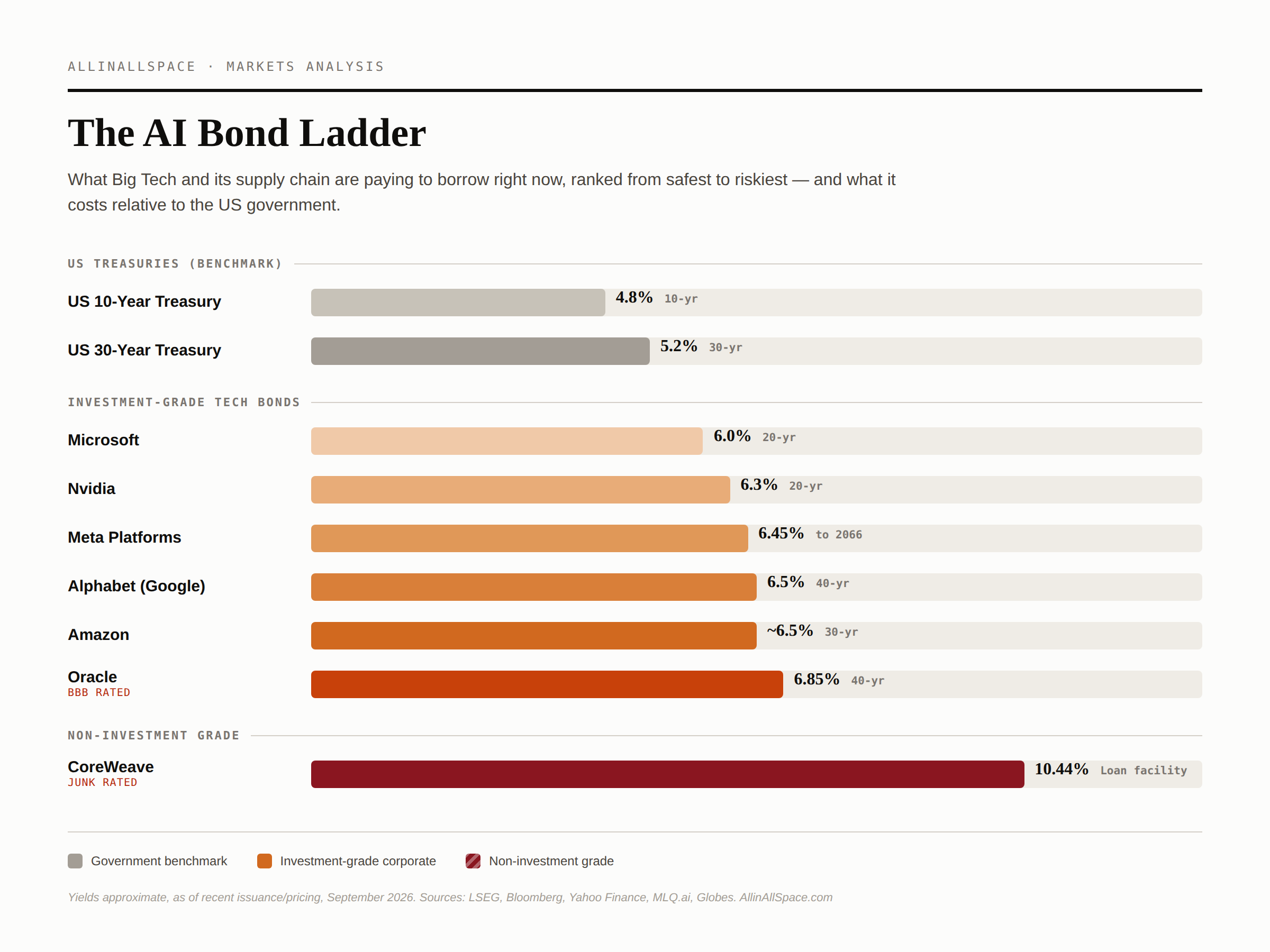
Here is what some of that debt actually costs them:
| Issuer | Bond term | Yield | Note |
|---|---|---|---|
| Meta Platforms | 5–40 year (6 tranches) | 4.55%–6.45% | Longest tranche matures in 2066 |
| Microsoft | 20-year | ~6.0% | |
| Nvidia | 20-year | ~6.3% | |
| Alphabet (Google) | 40-year | ~6.5% | |
| Amazon | 30-year | ~6.5% | Part of an 8-tranche, $25B+ raise spanning 3–40 years |
| Oracle | 40-year (2066) | 6.85% | Rated BBB — priced wider than a typical BBB peer |
| CoreWeave (non-investment grade) | Loan facility | 10.44% | Priced up after investors pushed back on the original terms |
| US 10-Year Treasury | 10-year | ~4.8% | For comparison |
| US 30-Year Treasury | 30-year | ~5.2% | For comparison |
Notice what that table is really saying. Some of the biggest names on it are paying yields close to, or above, what the US government pays to borrow — despite balance sheets that are, by most measures, stronger than Washington’s. That is a genuinely new dynamic in markets, and it is a big part of why this trend has a name. Oracle is the exception worth noting: it carries a BBB credit rating, a full tier or more below Microsoft, Alphabet or Meta, and its February bond sale priced wider than the typical BBB peer — a reminder that even within the hyperscaler group, not every borrower is judged equally. And look further down the risk ladder too: CoreWeave, one of the smaller AI infrastructure players riding the same boom, had to pay more than 10% on a recent loan after investors demanded better terms than it first offered — a reminder that “AI debt” is not one single, uniform trade.
Some of the richest companies on the planet are paying yields once reserved for far riskier borrowers — to raise money they could technically write a cheque for.
Why Borrow When You’re Sitting on a Cash Mountain?
The simple answer: because the math still works in their favour. Borrowing $10 billion at 6% only makes sense if you expect what you build with it to earn more than 6% over the life of the debt — and right now, these companies believe their AI infrastructure will. Debt is also faster and less disruptive than the alternative. Raising the same money by issuing new shares would dilute existing shareholders and could rattle a stock price that, for most of these names, is already doing a lot of the heavy lifting in the market.
There is a timing element too. Locking in a 20 or 40-year rate now protects a company from the risk that borrowing gets even more expensive later. For a business planning multi-decade infrastructure, that certainty is worth something on its own, separate from the cash-on-hand question entirely.
An Anomaly: Bond Yields Are Spiking, But Stocks Aren’t Flinching — Yet
Here is what should, in theory, be happening right now. Geopolitical tension is supposed to send investors running to the safety of government bonds, pushing bond prices up and yields down. Instead, the opposite is happening: government bond yields are climbing even as tensions escalate, and stocks have barely blinked. That is a genuine anomaly, and it is largely explained by the same trust-in-tech-companies dynamic driving the borrowing boom itself. Credit spreads on American corporate debt have actually narrowed even as government yields rise — the market’s way of saying it trusts a Google or a Microsoft balance sheet as much as, in some cases more than, it trusts Washington’s.
That leaves government debt and corporate debt effectively competing with each other for the same limited pool of global savings, rather than corporate debt simply riding on the coattails of government yields the way it usually would.
So has any of this hit the stock market? Not in any meaningful way, not yet. Credit spreads and government yields have moved; broad equity indices largely haven’t. That does not mean they won’t. Credit spreads — the extra yield investors demand to lend to a company rather than a government — are one of the earliest warning gauges in markets, because bond investors tend to be more risk-averse than stock investors and typically price in trouble sooner. Spreads on hyperscaler debt have already widened this year: short-dated spreads have moved from roughly 30 to 40 basis points, and long-dated spreads from around 108 to 118. Neither move is alarming in isolation. But if the government-versus-corporate borrowing competition keeps intensifying, or that $40 trillion (and rising) deficit eventually forces Treasury yields even higher, the pressure could spill into equities — starting with the same rate-sensitive growth and tech names currently leading the market. Bond markets have a long history of sounding the alarm months before stock markets start listening.
The Warning Signs
Not everyone is comfortable with how fast this has moved. The ten largest AI-related companies are on pace to issue more than $120 billion in bonds this year — a figure that, adjusted for inflation, is larger than anything seen even at the peak of the dot-com era. And there is early evidence that bond investors are getting a little nervier than they were a few months ago: of the 91 hyperscaler bonds issued so far in 2026, 78 were trading at higher yields in late July than when they were first sold, a sign that buyers now want more compensation to hold this debt than they did at issuance.
Where the Rest of the Money Is Going
Tech bonds are just one piece of a bigger reshuffling of global capital right now. As the dollar has softened — partly a side effect of heavy US buyback activity — investors have leaned harder into carry trades: borrowing in a cheap currency to invest in higher-yielding assets elsewhere.
Emerging markets are a major beneficiary. Robin Brooks, a senior fellow at the Brookings Institution, expects a large wave of that money to land in emerging markets. Brazil (a 14% policy rate against roughly 4.2% inflation) and Turkey (a 37% one-week repo rate, with inflation still running near 32%) stand out for the sheer size of the gap between what they pay and what it costs to fund the trade. Colombia has become a favourite for a different reason: its peso is already up around 20% this year, rewarding carry traders on the currency move alone, on top of the yield. Gold has climbed too — Ray Dalio has been publicly urging investors toward it as geopolitical tension builds, and Deutsche Bank now forecasts prices climbing toward $6,000 an ounce in 2026.
The common thread across all of it — tech bonds, emerging-market carry trades, gold — is the same one. When yields on the “safe” asset, US government debt, keep climbing without dragging equities down with them, money does not sit still. It looks for the next best place to earn a return, wherever that happens to be.
The Opportunity — and the Catch — for Everyday Investors
For ordinary investors, this environment is genuinely tempting on the government-bond side alone: it is currently possible to lock in an annual yield of over 5% on 30-year US Treasuries, a level that has not been on offer for most of the past two decades. For context, yields like these are well above what even the best high-yield savings accounts currently pay — though the two are not directly comparable, since a savings account carries none of a bond’s price or duration risk. Saar Weintraub, deputy chief investment officer for pension and provident funds at Altshuler Shaham, argues the public should not ignore it — government bonds have become genuinely competitive against both corporate debt and equities, and deserve a place in ordinary portfolios rather than being treated as an afterthought. His broader point is a fair one: plenty of investors have gotten used to a multi-year run of strong stock returns and are assuming it simply continues, when a period of several years with structurally higher yields across the board is at least as plausible.
The catch is real too, and it applies whether you are buying a government bond or one of the tech bonds discussed above. The yields on offer are nominal, not real — if inflation stays as sticky as the current backdrop suggests, part of that return gets quietly eroded over the life of the bond. And if you are not investing in dollars to begin with, you are also taking on currency risk on top of the bond’s own risk: a move in the dollar against your home currency can add to your return or wipe out a chunk of it, before trading costs and any management fees are even factored in.
Specific to the tech bonds at the centre of this piece, the trade-off looks a little different again. The benefit is real: investment-grade companies with enormous cash flow, offering yields well above what you would get from a government bond of similar quality. The risk is that many of these are very long-dated bonds — 20, 30, even 40 years — and a bond’s price moves opposite to interest rates over that kind of horizon. If yields keep climbing from here, the market price of a bond you bought today can fall well before it matures, even though the company backing it never misses a payment. It is a genuine opportunity, not a risk-free one.
How to Invest in Big Tech Bonds
For most retail investors, buying a company’s bonds directly is a less familiar move than buying its stock — but it is more accessible than most people realise. Corporate bonds typically trade in $1,000 face-value units, and a small number of brokers now give everyday investors the same direct access to these issues that institutions have.
If you already trade at some size and want the lowest possible cost, Interactive Brokers gives access to more than a million bonds globally, including issues like these, with transparent commissions (around 0.10% on the first $10,000 of face value) and no dealer mark-up built into the price. Our full Interactive Brokers review covers the details.
If you would rather start smaller, Exante offers fractional bonds, meaning you do not need the full $1,000 minimum to get exposure to a specific issue, with fees starting from as little as $0.50. That makes it a more approachable way to buy your first bond rather than your first share. See our Exante review to see if it fits how you invest.
If you are building toward a specific income target, bond coupons are one of the more predictable pieces of that puzzle — our guide to building $5,000 in passive income walks through how income-generating assets like these fit alongside dividends and other sources.
Whichever route you take, remember a bond is not a stock. You are not betting on the company’s share price — you are lending it money for a fixed return, and the price of that bond will move in the meantime, mostly in response to interest rates rather than the company’s quarterly earnings. It is a different kind of risk, not automatically a safer one.
We do not think five of the most profitable companies in the world taking on more debt is, by itself, a red flag — and the same goes for the wider rotation into emerging markets and gold. Investors chasing yield wherever it appears is a rational response to a world where the traditionally “safe” asset keeps getting less attractive, not a sign that something has broken.
What we are watching is the gap between bond markets and stock markets. Right now credit spreads are widening and government yields are climbing while equities barely react — an unusual combination that historically does not last indefinitely. If that gap keeps widening while AI revenue growth does not keep pace with the spending behind it, it is the kind of thing that tends to show up in credit and currency markets well before it shows up in the Nasdaq.
This article represents the editorial view of AllinAllSpace and is based on publicly available information, including company bond filings and reporting from Reuters, Yahoo Finance, Fortune, MarketScreener, MLQ.ai, LSEG, the Brookings Institution and Globes, as of September 2026. It does not constitute investment advice. All figures cited are publicly reported and subject to change.