
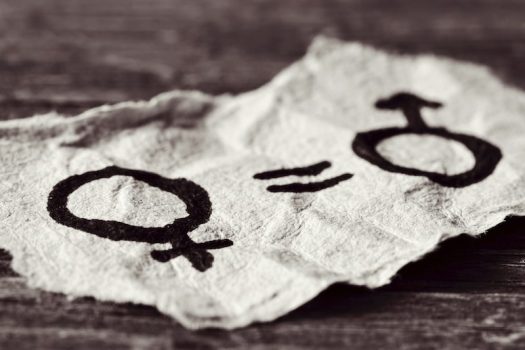
Anti-feminism is one of the most controversial topics these days. We’re still terrified of the (other) F-word and its intimidating implications. But why? What is actually anti-feminism? As a matter of fact, what is feminism nowadays? Let’s dig in to understand it a bit more. First, it’s not about taking a side but rather being familiar with all the opinions and ideologies. Luckily and proudly, we can confirm that our global social system, at least in developed societies, acknowledges equal rights for women — though there is a long way ahead of us — and those who reject gender equality are the bad apples in a good system.
So, What Is Anti-Feminism?
To put it simply, anti-feminism is an opposition to the principles and ideas of feminism. As the feminist movement has changed since its foundation, the principles and interests of anti-feminism have also changed over the course of history. Anti-feminists may oppose feminism for a variety of reasons, such as claiming it differentiates gender and promotes hostility toward men.
Women and men alike can be anti-feminists. As a matter of fact, some of the most prominent anti-feminists have been female.
Feminist, Non-Feminist — What Am I?
The notion of a person who can strongly believe in the principles of feminism as well as anti-feminism is proof of the confusion made by categorising and defining individuals. We tend to believe that men are anti-feminists and women are feminists — the sex war framing. However, this is partly misleading. Some of those who define themselves as anti-feminist are females who support gender equality and at the same time reject the feminist movement as an institution.
Watch this video — maybe it will help. And honestly, even if you can’t decide, it’s all good. There’s no need to label yourself or anyone else.
One thing is true: the feminist movement has changed from its original definition. Feminism in our modern society represents a very different type of ideology than the original one of the women in the 19th century who established this movement. Regardless, their interests should not be ignored and should be addressed. Perhaps a united movement can benefit gender equality. A new movement? Genderism, maybe?
The Manosphere — Anti-Feminism in 2026
Since this article was first written in 2019, the cultural landscape around gender politics has shifted dramatically — and the anti-feminist movement has evolved in ways that would have been difficult to predict. The rise of the “manosphere” — a loose collection of online communities united by opposition to feminism, from the relatively moderate “men’s rights activists” to the more extreme “red pill” and “incel” communities — has brought anti-feminist ideas from the fringes of the internet into mainstream political debate.
The most prominent figure in this space in recent years has been Andrew Tate — a former kickboxer who became, for a period, the most searched person on the internet through a combination of anti-feminist rhetoric, social media virality, and genuine controversy. Whatever one thinks of his views, Tate’s reach — particularly among teenage boys — has raised serious questions about the role of social media algorithms in amplifying anti-feminist content and the absence of competing positive male role models in mainstream culture.
“The gender gap in voting has never been wider. Young men are moving right. Young women are moving left. This is not a coincidence — and it is not just about feminism.”
The political consequences have been measurable. In the 2024 US election, there was a significant gender gap in voting patterns among young people — young men shifted notably toward Trump, while young women shifted toward Harris. Similar patterns emerged in South Korea, Germany, and the UK. Analysts have called this the largest gender divergence in political preferences since polling began. It is tempting to reduce this to a simple feminist vs anti-feminist story, but the reality is more complex — it reflects genuine grievances around economic opportunity, social status, and identity that the political mainstream has not fully addressed.
The Legitimate Grievances — and the Bad Faith Arguments
The honest observer has to acknowledge that there are legitimate questions within the anti-feminist critique — and distinguish them from the bad faith arguments that dominate much of the online conversation.
Legitimate questions include: Are men disadvantaged in certain areas — education, mental health support, family court outcomes, suicide rates — that receive insufficient attention? Are there aspects of fourth-wave feminism that have become counterproductive to the goal of gender equality? Is it possible to support equal rights for women without endorsing every position of contemporary feminist discourse?
The answer to all three is yes. And the fact that asking these questions is sometimes treated as anti-feminist by parts of the left, and that genuine misogyny is sometimes dressed up as legitimate grievance by parts of the right, is precisely the confusion that makes this debate so difficult to have honestly.
The bad faith arguments are easier to identify: claims that women’s rights have “gone too far” and that men are now disadvantaged compared to women in any overall sense (they are not — on virtually every major economic and political metric, men still hold structural advantages in most societies), or that feminism is fundamentally anti-male (it isn’t — the core feminist argument is that gender equality benefits everyone, including men who are constrained by traditional masculinity norms).
“You can support gender equality and reject specific aspects of how a movement pursues it. Holding both positions is not contradiction — it is nuance.”
The Bottom Line
The debate between feminism and anti-feminism is not going away — in 2026 it is more active, more politically consequential, and more algorithmically amplified than at any previous point. The honest approach to it is not to take a side in the tribal sense, but to ask what is actually true — where are women genuinely disadvantaged, where are men genuinely disadvantaged, and what would a society look like that took both seriously?
Feminism in its original form — the radical proposition that women are people and should be treated as such under law and social norm — is not remotely controversial. Every serious person agrees with it. The debate is about what that means in practice, in 2026, in a world where gender relations, work, family structure, and identity are all in active flux.
There’s no need to label yourself or anyone else. The questions are worth asking honestly. That’s enough.