
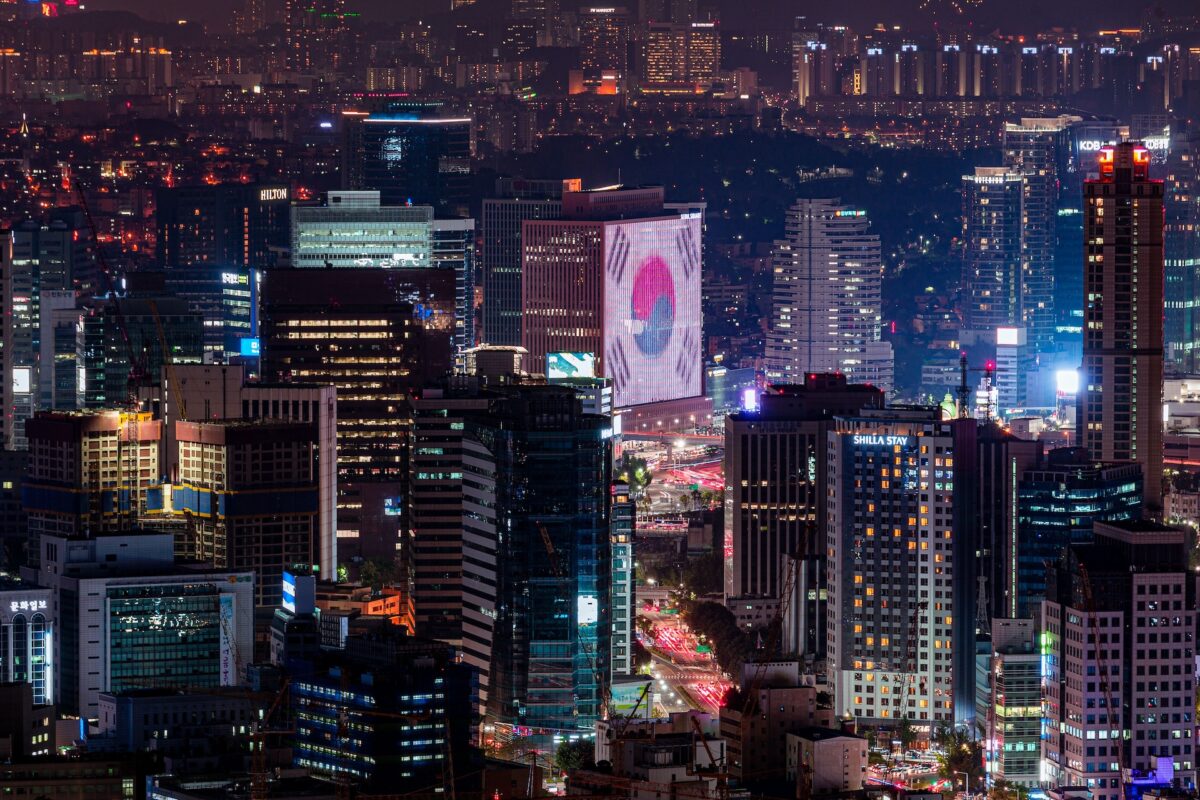
On Monday, June 22, 2026, South Korea’s KOSPI hit a record high of 9,385 points. Twenty-four hours later, it shed 910 points — the largest single-day points collapse in the index’s history — and triggered a market-wide circuit breaker for the first time in years. By the time Seoul closed on Tuesday, the KOSPI was down 9.99%. SK Hynix and Samsung, its two largest components, had each fallen more than 12%.
Within hours, the selloff had crossed every ocean. Japan’s Nikkei fell 3.6%. European semiconductor stocks shed 3.2%. The Nasdaq 100 dropped more than 2%. Micron fell 13%. Sandisk fell 13%. The VanEck Semiconductor ETF collapsed 7%.
One index in Seoul had, in effect, given the entire global AI trade a 24-hour warning that nobody was quite ready for. And if you weren’t watching the KOSPI, you didn’t see it coming.
What the KOSPI Actually Is — And Why Most Western Investors Ignore It
The KOSPI — Korea Composite Stock Price Index — is South Korea’s main stock exchange benchmark, tracking all common stocks listed on the Korea Exchange. It was launched in 1980 with a base value of 100. It sat below 2,500 as recently as December 2024. Today, even after Tuesday’s historic crash, it trades around 8,471.
Most Western investors have spent the last decade treating South Korea as a mid-tier emerging market — a place with interesting companies but persistent governance discounts, a volatile currency, and the perennial frustration of near-misses on MSCI Developed Market inclusion. The KOSPI rarely appeared in the same sentence as the S&P 500 or the Nasdaq 100 in serious investment conversations. It was a footnote.
That changed in 2025. And in 2026, it became something else entirely.
The Numbers That Make the Case
The KOSPI’s performance over the past two years is one of the most extraordinary runs in modern equity market history. To put it in context:
| Index | 2025 Return | 2026 YTD (pre-crash) | Combined |
|---|---|---|---|
| KOSPI (South Korea) | +75% | +95%+ | +230%+ |
| Nasdaq 100 (US) | +28% | +22% | +56% |
| S&P 500 (US) | +23% | +18% | +45% |
| Nikkei 225 (Japan) | +19% | +12% | +33% |
| DAX (Germany) | +18% | +26% | +49% |
The KOSPI’s 2025 performance of +75% was its strongest annual gain since 1999. For full context on how it compares to every other major global index this year, see our State of Markets Q3 2026 report which includes the complete global equity league table. It then proceeded to more than double that pace in 2026. Even after Tuesday’s crash — the fifth-largest single-day percentage decline in the index’s history — the KOSPI remains up approximately 95% for the year. No other major global index is even close.
SK Hynix alone has gained 347% in 2026. Samsung Electronics has gained 192%. Together they now represent nearly 47% of the entire KOSPI’s market capitalisation. That concentration is not a design flaw. It is the entire point.
Why the KOSPI Is Really the AI Hardware Index
To understand the KOSPI in 2025 and 2026, you have to understand High Bandwidth Memory — HBM. Every serious AI system requires it. Nvidia’s H100 and H200 GPUs, Google’s Tensor Processing Units, Amazon’s Trainium chips — none of them function at scale without HBM. It is the critical bottleneck in the entire AI infrastructure buildout. And Samsung and SK Hynix together control approximately 80% of the global HBM market.
SK Hynix specifically commands 61% of global HBM supply, according to TrendForce data. For a deeper look at the AI infrastructure buildout driving this demand, see our State of AI Q3 2026 report. That is not a position you arrive at by accident. The company spent years and billions developing the technology while most of the investment world was focused on Nvidia’s GPU dominance. By the time the AI capex cycle exploded in 2024, SK Hynix was the only company that could actually supply what the hyperscalers needed at scale.
Samsung and SK Hynix don’t just participate in the AI trade. They are the physical infrastructure that makes the AI trade possible. The KOSPI is not a proxy for AI sentiment. It is the AI hardware market, priced in real time.
The financial results confirm the story. SK Hynix posted record revenue of 97 trillion won — roughly $63 billion — for 2025. Net profit hit 42.9 trillion won, approximately $28 billion. Samsung’s first-quarter 2026 operating profit jumped 756% year-over-year. These are not AI-adjacent companies reporting tangential benefits. They are the companies that the entire AI buildout runs on.
The result is an index that has effectively become the world’s most liquid, most accessible instrument for tracking the real-time health of AI hardware demand. When hyperscalers are spending aggressively on infrastructure, the KOSPI goes up. When anything casts doubt on that spending — a guidance miss, a valuation concern, a macro shock — the KOSPI goes down first, fastest, and hardest. The same AI infrastructure boom that is lifting hardware is simultaneously disrupting software — a tension we explored in our piece on why the SaaSpocalypse remains a real threat.
The Three Crashes That Prove the Pattern
June 23 was not the first time in 2026 that the KOSPI gave global markets an early warning signal. It was the third. The pattern is now well established enough to be tradeable.
| Date | KOSPI Move | Trigger | Global Impact |
|---|---|---|---|
| June 5, 2026 | -6% | Broadcom AI chip guidance miss — $16B vs $17.2B expected | Nasdaq -2.1%, Philadelphia Semiconductor -5.45% |
| June 8, 2026 | -8.3% | Foreign investor outflows, MSCI DM exclusion fears | Asia-wide selloff, circuit breaker triggered |
| June 23, 2026 | -9.99% | MSCI DM exclusion confirmed, unrealised gains tax, valuation stretch | Nikkei -3.6%, Nasdaq -2.2%, Micron -13%, VanEck SMH -7% |
In each case, the KOSPI moved before the US market did. The Seoul session closes hours before Wall Street opens. By the time New York traders logged in on the morning of June 23, the KOSPI had already told them everything they needed to know: the AI trade was being unwound, the semiconductor names were in serious trouble, and the day was going to be ugly. Bloomberg reported that the Korea Exchange triggered a 20-minute trading suspension after intraday losses breached the circuit breaker threshold.
This is not coincidence. It is structural. The KOSPI’s concentration in AI hardware means it has zero diversification to cushion semiconductor-specific shocks. When the AI trade goes wrong, the KOSPI goes wrong immediately, completely, and visibly. It is a pure signal in a world full of noise.
What Caused the June 23 Crash Specifically
Tuesday’s crash had three distinct catalysts layered on top of each other, which is why it was so severe.
First, the MSCI Developed Markets exclusion. South Korea has been trying to gain MSCI DM status for years. Inclusion would have triggered billions of dollars of passive fund inflows from index-tracking ETFs and pension funds globally. The exclusion — announced at the MSCI review — removed that anticipated catalyst, forcing investors who had bought Korean equities specifically in anticipation of DM inclusion to reassess their positions immediately.
Second, an unrealised gains tax proposal. South Korea’s ruling Democratic Forum proposed comprehensive taxation that would treat unrealised gains on stocks and real estate as taxable income before the asset is sold. For investors sitting on 200-300% gains in SK Hynix and Samsung, the prospect of paying tax on paper profits they hadn’t crystallised was an immediate trigger to sell.
Third, the broader AI valuation question. June 23 followed a three-day selloff on US markets driven by concern that hyperscaler AI capex spending cannot continue at its current pace without clearer revenue justification. As Steve Sosnick of Interactive Brokers put it: “When you have markets that go up in a straight line, they tend to experience sharp moves in the opposite direction at unpredictable times. This is what happens when markets get stretched.”
The combination of these three factors hit an index that had risen 95% in six months, with nearly half its weight in two stocks that had each risen 200-300%. The result was inevitable once selling started — a self-reinforcing collapse that triggered circuit breakers and wiped 910 points off the index in a single session.
The Recovery — And What It Tells You
On Wednesday June 24, the KOSPI recovered 3.26%, closing at 8,471. Samsung gained 9.1%. SK Hynix gained 2.74%. The catalyst was Samsung’s announcement of a 90 trillion won ($58.6 billion) share buyback programme — one of the largest in Korean corporate history. The fundamental story had not changed. The AI memory demand had not changed. What had changed was positioning, leverage, and the removal of the MSCI catalyst. Once those pressures cleared, buyers returned.
This rapid recovery is itself instructive. The KOSPI is not telling you that the AI trade is over. It is telling you that the AI trade is real, concentrated, volatile, and sensitive to anything that threatens the spending cycle. It is the most responsive instrument in global markets for tracking that sensitivity.
The investors who were watching the KOSPI on the morning of June 23 had several hours of warning before Wall Street opened. The investors who were only watching the Nasdaq 100 got no warning at all — they woke up to the damage already done. That asymmetry of information is the argument for treating the KOSPI as a primary indicator rather than a regional curiosity.
How to Track the KOSPI
You cannot invest in the KOSPI directly. But you can track it and use it as a leading indicator. The most accessible instruments for Western investors:
ETFs: The iShares MSCI South Korea ETF (EWY) and the Franklin FTSE Korea ETF (FLKR) both provide direct exposure, with Samsung and SK Hynix as their top holdings at roughly 20-21% each. Both track KOSPI performance closely enough to be useful proxies.
Individual stocks: SK Hynix trades as an ADR in the US and is planning a formal ADR listing in H2 2026. Samsung Electronics trades as a US-listed ADR (SSNLF). Both are accessible through most major brokers.
As a leading indicator: The most valuable use of the KOSPI for most global investors is simply as a morning signal. Seoul closes before New York opens. If the KOSPI is down 5% when you wake up, the Nasdaq is probably not going to open well. If it is up 4%, AI and semiconductor stocks are likely to have a good day. The correlation is not perfect, but it is consistent enough to be genuinely useful.
The KOSPI used to be something only Korea specialists cared about. In a world where AI hardware is the most important investment theme of the decade, that is no longer true. If you want to understand where the AI trade is going, you need to start your morning in Seoul.
The most accessible route for most retail investors is through an ETF. EWY (iShares MSCI South Korea ETF) and FLKR (Franklin FTSE Korea ETF) both track Korean equities with Samsung and SK Hynix as top holdings. For direct access to Korean-listed stocks, Interactive Brokers is the only major retail broker offering direct Korea Exchange (KRX) trading. eToro, Saxo Bank, and Trading 212 all offer EWY.
See our full broker reviews — including Interactive Brokers, eToro, and Saxo Bank — to find the right platform for your needs.
This article represents the editorial opinion of AllinAllSpace and does not constitute financial or investment advice. Data sourced from Bloomberg, Trading Economics, Yahoo Finance, FX News Group, KED Global, BigGo Finance, and TradingView. Accurate as of June 24, 2026.