
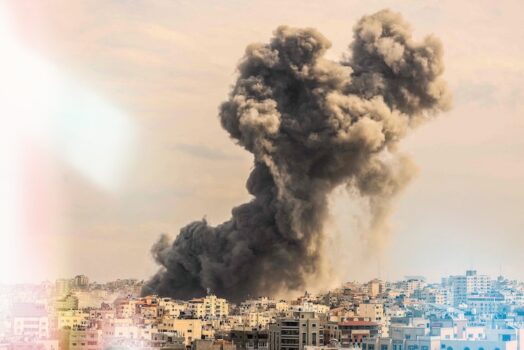
Full disclosure: I’m Israeli. I wrote the first version of this article in November 2023, about seven weeks after the October 7th massacre. At the time, I said that the two-state solution I had believed in for years was no longer something I could hold onto. A lot has happened since then. The war in Gaza, the campaign against Hezbollah, the confrontation with Iran, the displacement of hundreds of thousands of people. And yet, two and a half years later, the fundamental questions remain exactly where they were — unanswered, and in some ways harder to answer than before.
So let me try to lay out where things actually stand. Not where anyone wants them to be. Where they are.
Gaza: The Question Nobody Has Answered
The military campaign in Gaza has achieved most of what a military campaign can achieve. Hamas’s military infrastructure has been severely degraded. Most of its senior leadership has been killed. The tunnel network that ran beneath Gaza has been extensively destroyed. The organisation can no longer operate as a functioning military force in the way it did before October 7th.
But here is the problem that was always going to follow the military phase, and that nobody has honestly resolved: who governs Gaza now?
Israel does not want to govern Gaza. The Israeli government has said this clearly and repeatedly. The Israeli public, which has no appetite for a permanent occupation of a territory with two million people, agrees. The Palestinian Authority — the Ramallah-based government that nominally controls parts of the West Bank — has been floated as a potential governing body, but this runs into several severe problems. The PA is widely seen by Gazans as corrupt and illegitimate. Its leader, Mahmoud Abbas, is 88 years old and has not held an election since 2006. Imposing the PA on Gaza on the back of an Israeli military operation would not produce legitimate governance — it would produce resentment and instability.
Arab states — Egypt, Jordan, the UAE, Saudi Arabia — have been asked if they would contribute to a post-war governance arrangement in Gaza. None of them want to. And it is worth understanding why: no Arab government wants to be seen as administering a Palestinian territory on behalf of Israel. The domestic political costs would be enormous. The security risks would be real.
So we have a situation where Gaza has been militarily devastated, Hamas has lost the capacity to govern effectively, and no credible alternative governance structure exists or is being constructed. That is not a stable situation. It is a vacuum — and vacuums in the Middle East tend to be filled by whoever is most organised and most ruthless. Which, historically, has not been the moderate pro-peace faction.
“Gaza’s military phase is largely over. The political phase — who governs, who rebuilds, who is accountable to two million people — has barely begun.”
The West Bank Is a Different Story
One of the things that has become clearer since October 7th is that Gaza and the West Bank are not the same place, do not have the same politics, and cannot be treated as a single unit in any realistic discussion of Palestinian futures.
Hamas and Fatah — the dominant political force in the West Bank — have been rivals, sometimes violently, since the 2007 split that left Hamas in control of Gaza and the PA in control of the West Bank. The idea that October 7th created some kind of unified Palestinian political moment is not supported by the evidence. Polls conducted in the West Bank after October 7th showed complicated and shifting attitudes — some support for Hamas’s “resistance,” significant fear of Israeli military escalation, but also resentment toward Hamas for the consequences its actions brought on Palestinian civilians.
The West Bank has its own serious and growing crisis that tends to get less attention than Gaza. Israeli settlement expansion has accelerated dramatically in recent years. The settler population in the West Bank now exceeds 500,000 people, living in communities that are deeply integrated into Israeli infrastructure — roads, utilities, security arrangements. Any future negotiation about a Palestinian state in the West Bank has to contend with a physical reality on the ground that has been systematically constructed to make partition harder.
Violence in the West Bank has also increased significantly — both settler violence against Palestinian communities, which has reached levels that even the Israeli military has at times described as unacceptable, and Palestinian militant activity, with armed groups in Jenin and Nablus that the PA has struggled to control. The West Bank is not stable. It is not on a trajectory toward anything good.
The Trump Plan That Isn’t Moving
The Trump administration arrived in early 2025 with what was presented as a bold new approach to the Israeli-Palestinian conflict. The plan — involving the voluntary relocation of Palestinians from Gaza to Egypt and Jordan, American investment in reconstruction, and a reconfigured regional security arrangement — was announced with considerable fanfare and has gone essentially nowhere.
Egypt and Jordan both rejected the relocation proposal immediately and firmly. For Egypt, accepting a large Palestinian population in Sinai would mean taking on an enormous security and economic burden, potentially destabilising a region already struggling with jihadist activity, and making the Palestinian refugee problem a permanent Egyptian problem rather than a temporary one. For Jordan, where Palestinians already make up a significant share of the population, further large-scale Palestinian migration raises existential questions about the kingdom’s demographic and political identity.
The Gulf states — Saudi Arabia, the UAE, Qatar — have their own interests in the conflict that don’t align neatly with either the Israeli government’s position or the Trump plan. Saudi Arabia had been moving toward normalisation with Israel before October 7th interrupted that process. The price for resuming it has always been understood to include some credible pathway toward Palestinian statehood — which the current Israeli government is not prepared to offer.
So the Trump plan sits. It has not been formally abandoned, but it is not moving. What has replaced it, in practical terms, is the status quo — which is to say, continued military operations, continued blockade, continued displacement, and no political horizon.
What I Think Is Actually Going to Happen
I want to be honest here, because I think a lot of commentary on this conflict defaults to either optimism that isn’t warranted or despair that isn’t useful. So here is my honest assessment of where this goes.
In Gaza, the most likely outcome in the near term is a fragmented, unstable situation in which Israel maintains military freedom of operation, some form of international or Arab-supported civilian administration attempts to manage basic services, and Hamas or Hamas-successor organisations retain a political presence that Israel cannot fully eliminate. This is not a solution. It is a managed continuation of the problem.
In the West Bank, the trajectory is toward further fragmentation and violence unless something changes in Israeli settlement policy — which the current government has no intention of changing. The PA’s legitimacy continues to erode. The risk of a broader West Bank escalation, which Israeli security officials have warned about privately for years, remains real.
On the broader peace process — the two-state solution, the normalisation track, the regional architecture — I think the honest answer is that it is not happening in the near term. Not because peace is impossible in principle, but because none of the actors with the power to make it happen are currently in a political position to do so. The Israeli government’s coalition depends on parties that are ideologically opposed to Palestinian statehood. The Palestinian political system is fractured between Gaza and the West Bank. The Arab states that could play a constructive role are balancing their own domestic pressures. And the United States, under the current administration, has put forward a plan that the region has rejected without replacing it with anything else.
“The two-state solution is not dead because peace is impossible. It is stalled because none of the people with the power to make it happen are currently willing to pay the political price.”
What I do believe — and this hasn’t changed since I wrote the original version of this article — is that the current situation is not sustainable for anyone. Not for Israelis, who cannot live permanently with the threat of October 7th-scale violence, and who are paying an enormous diplomatic and social cost for the conduct of this war. Not for Palestinians in Gaza, who are living through a humanitarian catastrophe. Not for Palestinians in the West Bank, whose daily lives are increasingly constrained by settlement expansion and security operations. Not for the region, which came closer to a broader war in 2024 and 2025 than at any point since 1973.
Something will change. The question is whether it changes through politics or through more violence. Right now, the political path is blocked. That is a dangerous situation, and pretending otherwise doesn’t help anyone.
This is an opinion piece reflecting the personal views of the author. AllinAllSpace covers this conflict as part of its broader political analysis. We aim to present multiple perspectives on contested issues.