
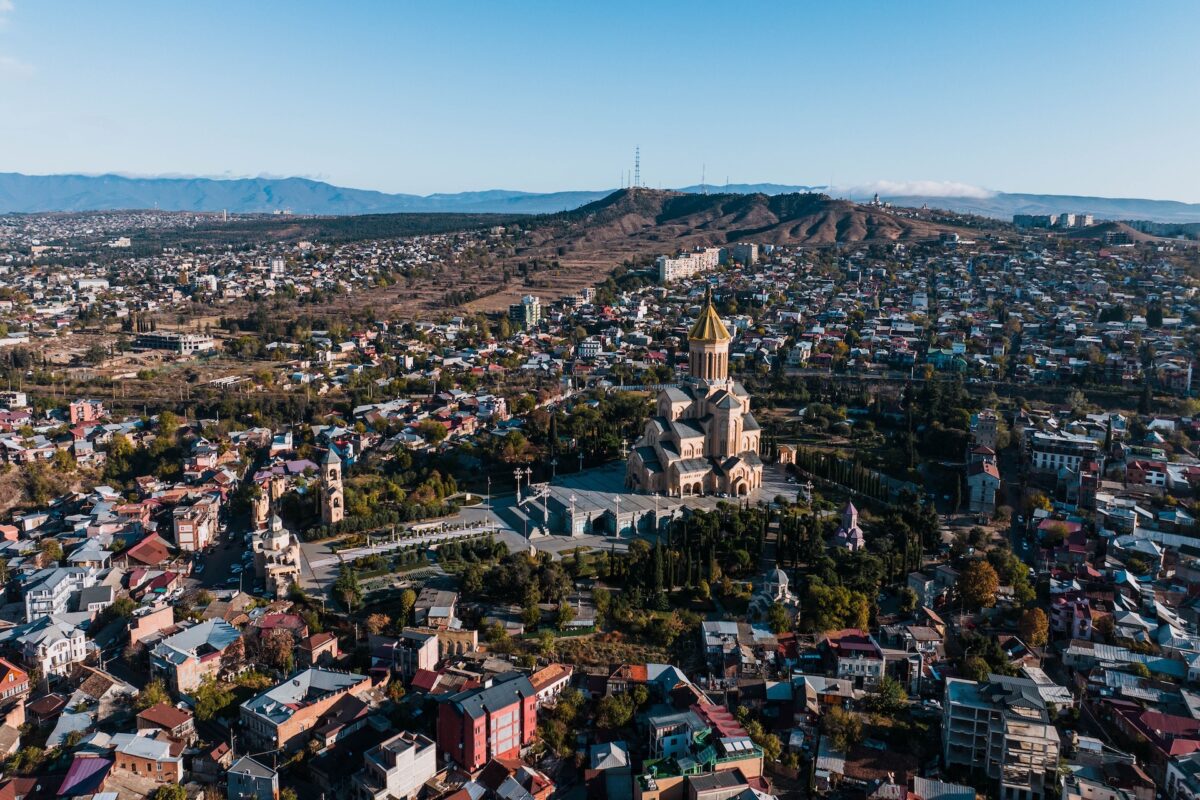
Most people, asked to name the fastest-growing economy in Europe, would guess Ireland. Or Poland. Perhaps Estonia. Probably not a landlocked Caucasus nation of 3.7 million people that most Westerners could not place on a map without help. And yet Georgia — the country, not the US state — has been quietly outgrowing almost everyone on the continent for the better part of a decade. In 2024 its economy expanded by 9.4%. In 2022, by 11%. Over the past decade, it has averaged 5.5% annual growth. Forecasts for 2026 point to 8%.
These are not the numbers of a country scraping along. Something deliberate is happening in Georgia, and it deserves more attention than it typically receives in Western financial media.
The Country That Rebuilt Itself
Georgia’s modern economic story begins in chaos. After independence from the Soviet Union in 1991, the country went through civil war, the loss of two breakaway regions — South Ossetia and Abkhazia — and near-complete economic collapse. By the mid-1990s, Georgia was one of the poorest and most corrupt countries in the post-Soviet space. Electricity worked a few hours a day. The state barely functioned.
The turning point came with the Rose Revolution of 2003, which brought Mikheil Saakashvili to power. What followed was one of the more aggressive economic reform programmes of the post-Soviet era. His government slashed the number of taxes from 22 to 6, flattened the income tax rate to 20%, stripped out licencing requirements, and fired most of the notoriously corrupt traffic police in a single day, replacing them almost overnight. The results were measurable. Georgia shot up the World Bank’s Ease of Doing Business rankings, eventually reaching 7th globally — above France, Germany, and Japan.
The political legacy of Saakashvili is contested — he died in a Georgian prison last year, a figure of both admiration and condemnation. But the economic infrastructure his reforms built is not. Georgia today has one of the simplest tax codes in the world, a fiscal deficit consistently below 3% of GDP, public debt at a manageable 35% of GDP, and a reputation for institutional reliability that is unusual for its region.
A country that was effectively a failed state in the 1990s now ranks among the fastest-growing economies in Europe. It did it by getting the basics right — and then leaving them alone.
Why People Are Moving Here
If you ask a digital nomad, remote worker, or independent entrepreneur why they chose Tbilisi, the answer is almost always the same: tax.
Georgia operates a territorial tax system — it only taxes income earned inside Georgia. Foreign-sourced income, for most residents, is not taxed at all. For registered Individual Entrepreneurs, there is a Small Business Status regime that taxes annual turnover up to roughly $180,000 at just 1% of gross revenue. Not 1% of profit. 1% of total income. Citizens of over 90 countries can stay in Georgia for a full year without a visa — no application, no income requirements, no paperwork.
In a world where self-employed workers in the UK, Germany, or France pay combined rates of 40% to 50% or more, the gap is staggering. A freelance developer earning $80,000 a year from international clients, living in Tbilisi, pays roughly $800 in Georgian tax. The same person in London might pay $25,000 or more. The maths has not been lost on mobile professionals.
This influx accelerated sharply after February 2022, when Russia’s invasion of Ukraine triggered a large wave of Russian and Ukrainian relocation. Tens of thousands of Russians — many of them in tech and finance — moved to Tbilisi and Batumi. They brought income, spending power, and skills. They opened businesses, hired locals, and paid rent. The EBRD estimates this wave contributed materially to Georgia’s exceptional 2022 and 2023 growth numbers, though those inflows have since moderated as some relocated further west or returned.
$4.4bn tourism revenue — roughly 13% of GDP
7.4 million international visitors — double the country’s population
1.1% average inflation in 2024 — well below the National Bank’s 3% target
35% public debt as a share of GDP
Tourism: The Engine Nobody Expected
Georgia attracted 7.4 million international visitors in 2024 — a record, and roughly double the country’s entire population. Tourism revenue reached approximately $4.4 billion, equivalent to around 13% of GDP. In 2025, that figure grew a further 5.1%, with $3.6 billion coming in through the first nine months alone.
This is not happening by accident. Georgia has three things tourists want and cannot easily find together at the same price: extraordinary natural diversity, a genuinely distinctive food and wine culture, and very low costs compared to Western Europe. The mountains in Svaneti and Kazbegi are world-class hiking destinations largely unknown to mass tourism. The Black Sea coast at Batumi offers beaches at a fraction of Adriatic prices. And then there is the wine.
Georgia claims to be the birthplace of wine, with a winemaking tradition going back 8,000 years — a claim supported by archaeological evidence of ancient clay fermentation vessels called qvevri found in the Caucasus dating to 6,000 BC. In 2024, Georgia exported 95 million litres of wine, generating $276 million in revenue. Export volumes to the UAE grew 80% last year. To the UK, 42%. Wine is now the country’s second-largest export sector — and it has become the backbone of a cultural tourism offer that serious food and travel media have started to notice.
The Unglamorous Revenue Pillar
Georgia’s single largest export category is not wine. It is not minerals or agricultural produce. It is cars — specifically, the re-export of vehicles that transit through Georgia to neighbouring Central Asian markets.
In 2024, vehicles accounted for 32.8% of Georgia’s total exports by value. Georgia imports used vehicles — primarily from the US, South Korea, and Europe — and re-exports them to Kazakhstan, Kyrgyzstan, Azerbaijan, and Armenia, which face import restrictions or higher tariffs on direct imports. Sitting at the crossroads of trade routes between Europe, Russia, Central Asia, and the Middle East, Georgia has positioned itself as a logistics hub for this flow.
It is unglamorous and rarely features in the country narratives being written about Georgia, but it is economically significant. US tariffs on imported vehicles introduced in April 2025 may reduce the flow of American second-hand cars through this channel — a genuine near-term risk that the Asian Development Bank has flagged explicitly in its most recent forecasts.
Not All Roses
Georgia’s growth story is genuine, but an honest assessment cannot omit the caveats.
The most significant is political. Since late 2024, the country has been convulsed by turmoil. The ruling Georgian Dream party — which has grown increasingly authoritarian in its second decade in power — claimed a disputed election victory and announced an indefinite suspension of Georgia’s EU membership aspirations. What followed were months of mass protests met with riot police and crackdowns. The geopolitical positioning of a small country between Russia and the West, with a government that appears to be tilting east, creates real uncertainty for foreign investors and the EU-oriented business community.
The EBRD explicitly flagged political uncertainty as a meaningful drag on its 2025 and 2026 forecasts. Lower FDI and weaker tourism revenues resulting from the unrest are already visible in some data series. Growth projections for 2026, while still strong at around 8%, come with wider error bars than they did a year ago.
The trade deficit is also striking. Georgia imported $16.98 billion in goods in 2024 against $6.56 billion in exports — a deficit of over $10 billion, partially offset by tourism revenues and remittances but structurally large. An economy growing at 9% with a trade deficit of 30% of GDP is doing well partly because capital and people are flowing in. If that sentiment changes, the numbers change quickly.
This tension — between genuinely impressive economic fundamentals and a political class that risks undermining them — is not unique to Georgia. As we explored in our piece on the state of the global economy in Q3 2026, the divergence between economic performance and political stability is one of the defining features of the current moment across emerging markets. And as the case of Nigeria illustrates — a country with comparable ambitions but far more chaotic execution, as we examined in our analysis of Nigeria’s economic challenges — getting the institutional basics right is a prerequisite that cannot be skipped.
The Georgia Blueprint
What makes Georgia interesting is not just the growth numbers. It is what those numbers represent: a deliberate, consistent, and in many ways counterintuitive economic strategy. Georgia chose simplicity over complexity. A flat tax at a low rate. Minimal business registration friction. Visa liberalism. Openness to capital. At a time when most developed economies have moved toward complexity — more rules, more compliance, more friction — Georgia went the other direction and held the line.
That strategy has produced real results. A country that was effectively a failed state in the 1990s now has cities that work, infrastructure that functions, food and wine that are increasingly recognised internationally, and a growing community of internationally mobile professionals who bring spending and skills. The 5.5% average annual growth over the past decade is not statistical noise. It is compounding.
None of this resolves the political risk. None of it makes the trade deficit disappear. And the question of whether Georgian Dream’s authoritarian drift will undo the economic openness that built this story is entirely legitimate. Countries have reversed course before.
But as a case study in what a small country with few natural resources can achieve by getting the institutional basics right and leaving them alone, Georgia remains one of the more instructive stories in contemporary economics. The fact that it is not more widely discussed says more about the limits of Western financial media’s geography than it does about Georgia’s significance.
GDP and growth data sourced from the EBRD, Asian Development Bank, and World Bank. Tourism revenue figures from the National Bank of Georgia via Galt & Taggart. Trade data from UN COMTRADE. This article represents editorial analysis and does not constitute financial or investment advice.