
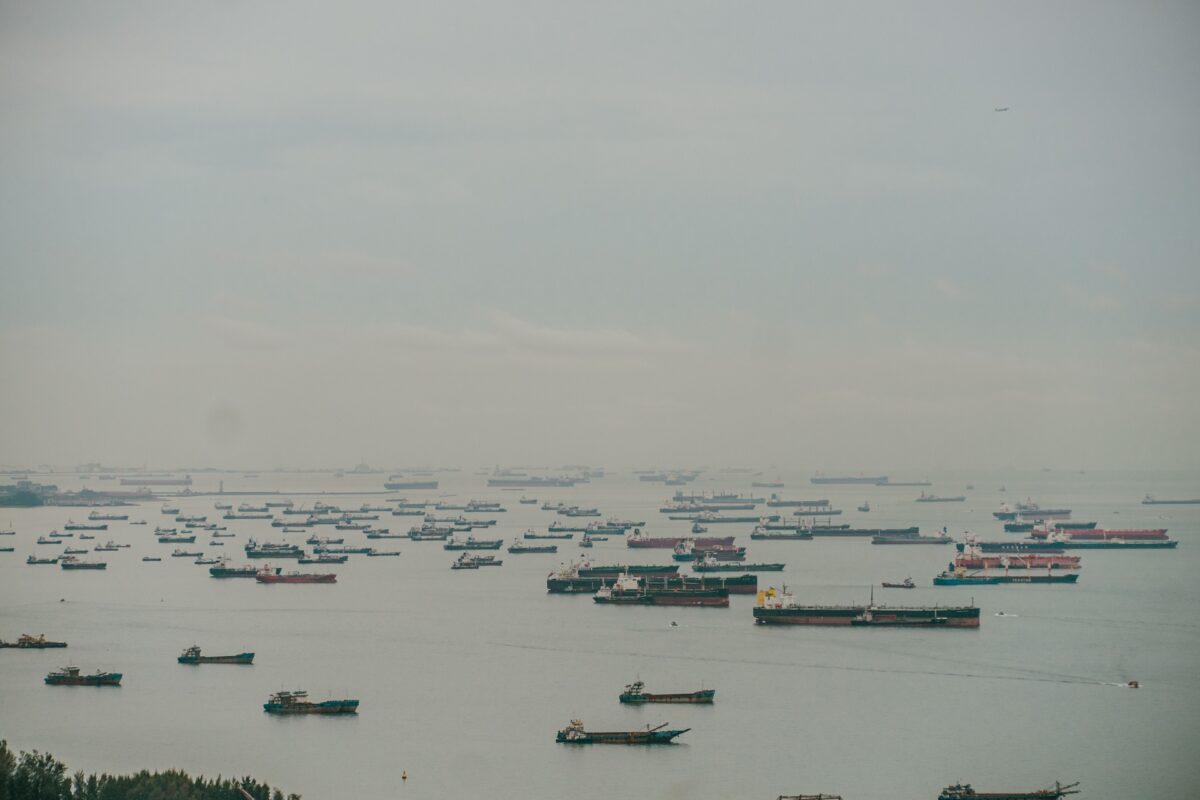
The Strait of Hormuz is 21 miles wide at its narrowest point. Through it passes roughly 20% of the world’s oil supply — about 17 million barrels per day. It connects the Persian Gulf to the Gulf of Oman and from there to the world’s refineries. There is no practical alternative route. If it closes, or even partially restricts, the impact on global energy markets is immediate and severe.
In early 2026, it did exactly that. The US-Iran conflict brought tanker traffic to a near-halt through the strait, war-risk insurance premiums for vessels entering the Persian Gulf surged over 1,000%, and crude oil spiked toward $84 per barrel. The companies that own the tankers that carry that oil had one of the best first quarters in their history.
A ceasefire has since been signed and the strait has partially reopened. But Trump has already accused Iran of acting in bad faith, drone incidents continue, and the US Navy is still escorting tankers when “militarily possible.” The risk is not gone — it has just paused. That pause is exactly when it makes sense to understand which energy stocks benefit most when Hormuz risk rises, before the next escalation rather than during it. For a deeper look at the geopolitics, see our analysis: Can the US Take Over the Strait of Hormuz?
Why Tankers Are the Purest Hormuz Trade
When most investors think about Middle East energy risk, they think about oil majors like ExxonMobil or Chevron. That is understandable but imprecise. The majors benefit from higher oil prices, but they are also exposed to production disruption, refining economics, and global demand dynamics. Their sensitivity to Hormuz specifically is diluted by the complexity of their operations.
Tanker companies are different. They do not produce oil. They do not refine it. They transport it. And their economics depend on two things that Hormuz disruption makes very good simultaneously: shipping rates and voyage length.
When the strait restricts, tankers are rerouted around the Cape of Good Hope — adding roughly 3,500 nautical miles and 7-10 days to each voyage. More days at sea means higher revenue per voyage. Simultaneously, tighter supply of available ships drives spot charter rates up. It is a compounding tailwind: more revenue per ship, higher rates, and often higher oil prices underpinning stronger charter rate negotiations. Frontline, DHT, and Nordic American Tankers all posted year-to-date gains between 59% and 63% by March 2026 — among the best-performing groups in the entire market.
When Hormuz disrupts, tankers don’t lose cargo — they just travel further to deliver it. Every extra mile is revenue.
1. Frontline — NYSE: FRO
Frontline is the largest crude tanker pure play in the market — a Cyprus-headquartered operator founded in 1985, dual-listed on the NYSE and Oslo Stock Exchange, with a fleet expanding to 79 Very Large Crude Carriers by 2027. VLCCs are the workhorses of long-haul crude transport: each one carries approximately 2 million barrels per voyage. When 100+ of them were transiting the Strait of Hormuz daily before the conflict, Frontline was deeply embedded in that trade.
Q1 2026 delivered record profits for Frontline, driven by Middle East disruptions and robust tanker demand. Revenue grew 67% year-over-year, with more than 80% of VLCC days already booked for Q2 when results were reported. The stock ran from $21.82 at year-end 2025 to $38+ by mid-year, making it one of the best-performing stocks in any sector during the first half of 2026.
There is an important nuance worth noting: Frontline trades at 1.3x NAV, supported by strong cash and no major debt maturities until 2030. At current prices above NAV, you are paying a premium for the earnings power and the Hormuz optionality. BTIG raised its price target to $45 while Evercore ISI has since downgraded to In Line, citing valuation. CEO Lars Barstad said tanker traffic through Hormuz should increase quickly if the US and Iran reach a credible deal — which is both a positive catalyst for oil flows and a risk to the elevated charter rates that have driven recent profits.
2. DHT Holdings — NYSE: DHT
DHT Holdings is a Bermuda-based VLCC operator with one of the cleanest balance sheets in the tanker sector. Its VLCCs have some of the lowest breakevens in the industry at around $15,000 per day, and the company carries almost no debt — rare for a shipper. That combination — low costs, low leverage — means DHT generates significant free cash flow even in soft rate environments, and exceptional cash flow when rates spike.
Despite having more than 50 VLCCs trapped in the Strait of Hormuz in Q1 2026, DHT still reported year-over-year revenue growth of nearly 135%. That figure — 135% growth with half your fleet stuck — tells you something about the strength of charter rates in the non-Hormuz market during peak disruption. The fleet reroutes, the rates spike, and DHT collects.
The 14.75% dividend yield is the headline number that attracts income investors — but it comes with a meaningful caveat. DHT is currently paying out more in dividends than it earns in net income, with a payout ratio of 124%. That is sustainable only while elevated charter rates persist. If rates normalise post-ceasefire, the dividend will likely be cut. Income investors should model a lower payout before building a position around the yield.
3. International Seaways — NYSE: INSW
International Seaways is the most diversified of the three — it operates both crude tankers and product carriers, giving it exposure to both crude oil and refined petroleum product transport. That dual mandate makes it less of a pure Hormuz play than Frontline or DHT, but also less volatile and more defensible in a normalised rate environment.
INSW reported Q1 2026 EPS of $3.90, beating estimates of $2.64 by 47.7%. In the same quarter of the prior year, EPS was $0.80 — a near fivefold improvement year-over-year. Jefferies raised its price target to $100 after the strong Q1, while BTIG also moved its target to $100 from $90. The stock’s 52-week low of $33.90 and high of $90.91 illustrates exactly how much Hormuz risk is embedded in the price.
At a forward P/E of approximately 7x — compared to the US market average of around 8.5x and the industry average of nearly 20x — INSW is the cheapest of the three on an earnings basis despite having the broadest fleet and the strongest Q1 beat. Pareto downgraded to Hold at $88 citing valuation after the rally, but Jefferies and BTIG remain constructive at $100.
Price Performance — FRO, DHT & INSW
More Names Worth Watching
The three stocks above are the most liquid and most directly exposed to the Hormuz trade. But the tanker and energy infrastructure universe is broader, and several other names move sharply when Hormuz risk rises.
The Risk: What Happens When Hormuz Reopens
The bull case for tanker stocks is straightforward. The risk is equally clear.
Tanker stocks are a geopolitical trade, not a fundamental one. Their extraordinary recent returns are a function of disruption — and disruption, by definition, does not last forever. When the ceasefire was announced, FRO and DHT gave back a significant portion of their gains almost immediately. That is the nature of the trade. When Hormuz risk rises, these stocks move fast and move hard. When it subsides, they give back gains just as quickly. For investors looking to hedge the downside or position for a Hormuz de-escalation, our guide on how to short sell crude oil and natural gas covers the main instruments available.
For context on how energy is performing relative to other sectors right now, our Sector Rotation Tracker shows real-time performance across S&P 500 sectors including energy. And for tracking where FRO, DHT, and INSW sit relative to their 52-week ranges as the situation evolves, the 52-Week High/Low Scanner covers all three.
This article is for informational purposes only and does not constitute financial or investment advice. AllinAllSpace is not a registered investment advisor. Tanker stocks are highly cyclical and volatile. All data sourced from StockAnalysis, WallStreetZen, Seeking Alpha, BTIG, Jefferies, and company filings, correct as of July 2026. Always conduct your own research before making investment decisions.