
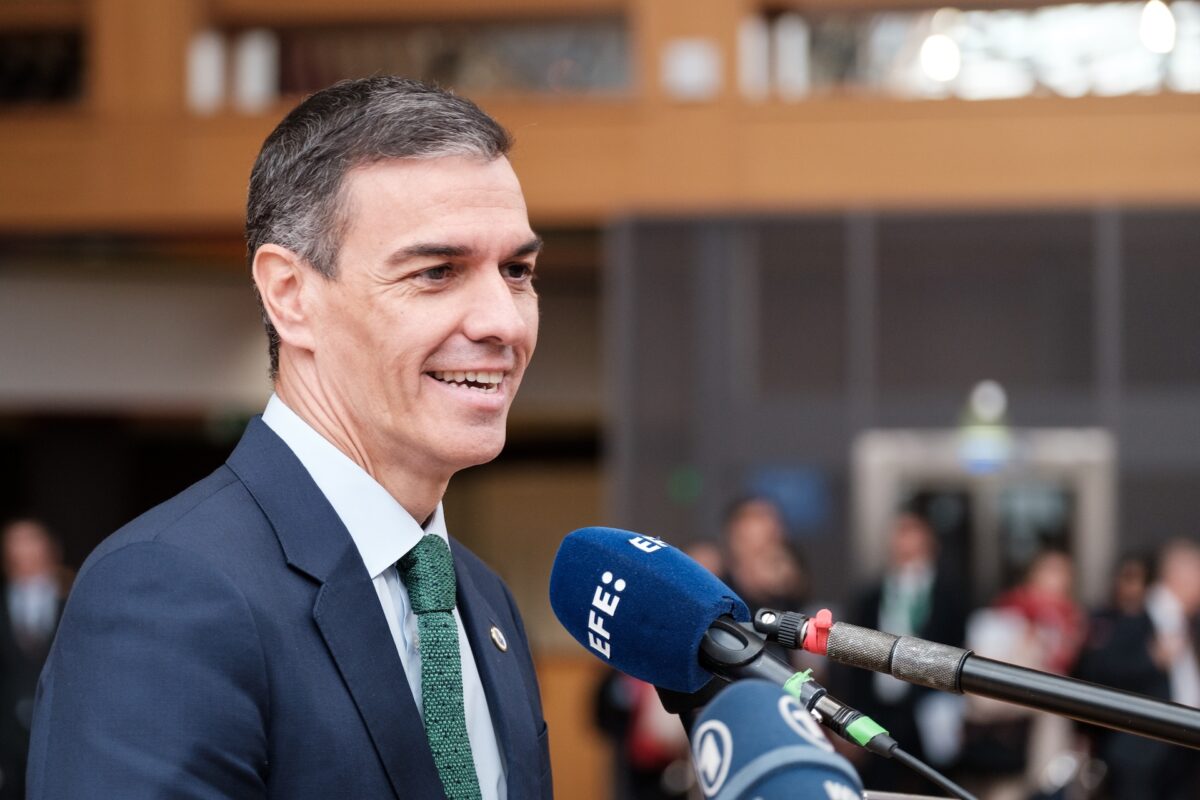
When Donald Trump handed the World Cup trophy to Spain’s players in New Jersey last week, Pedro Sanchez was somewhere in the stands — separated from the US president by a row of royals and protocol, their brief handshake captured through glass by photographers. The awkwardness was fitting. Few leaders in Europe have gone further out of their way to antagonise the White House than Spain’s prime minister. And few have had more compelling domestic reasons to do so.
Trump’s patience with Sanchez has been running thin for months. At NATO’s annual summit earlier this month, he singled Spain out for particular hostility. “I don’t want any trade with them. Do it immediately. Don’t even talk to them,” he told reporters. “They’re hopeless. They make so much money off us, and we’re going to make sure they make a lot less.” It was the most explicit in a series of threats directed at Madrid — though Spain’s trade with the US falls under EU jurisdiction, which substantially undercuts the leverage.
The proximate cause of Trump’s frustration is that Sanchez has made himself, deliberately and methodically, into Europe’s most prominent anti-Trump voice. The policy positions have piled up. Spain granted residency to nearly a million undocumented migrants while the US was deporting them. Sanchez refused to allow American military aircraft to use Spanish bases in connection with operations in Iran. He publicly opposed the US-backed strikes on Tehran, becoming the first European leader to say so clearly. He is the only leader among NATO’s 32 members to refuse publicly to meet Trump’s 5% of GDP defence spending target. His government cancelled defence contracts with Israeli companies, called Israel’s government “genocidal,” and pushed to suspend EU free trade with Israel.
The result is that Sanchez has become something of a symbol for the European left. The Times of London ran a cover feature on him. Politico called him proof that “you can stand up to Trump and be the moral compass of Europe.” The Economist labelled him “the leader of the anti-Trump resistance.” His portrait appears at anti-American demonstrations in Barcelona.
The Domestic Calculus
None of this, analysts are quick to point out, is primarily about foreign policy.
“Sánchez is doing Sánchez a favour when he attacks Trump,” says Dr Daniel Weiner, a senior lecturer in international relations at the Hebrew University and a researcher of populism in foreign policy. “He needs the radical left to survive politically, and so he adopts foreign policy positions that speak to that support base. Even if this policy doesn’t convince the broader public, it’s enough to maintain support from the base that keeps him in power.”
That base is a product of the 2023 election, which Sanchez won but couldn’t translate into a stable government without building one of the most fragile coalitions in modern Spanish politics — dependent on Basque nationalists, Catalan independence parties, former communists, and radical left populists including the Sumar alliance. Every one of these parties can threaten to bring him down. Each extracts its price.
Sanchez’s anti-Trump positioning is not ideological conviction so much as political maintenance. The louder the noise abroad, the less attention fixed on the fires at home.
“What we are seeing in Spain is how Sánchez has gradually transformed from the leader of a traditional social democratic party into the head of a coalition with populist characteristics,” Weiner adds. “The dependence on the populist left pushes him to adopt increasingly sharp positions towards Israel and the US, because anti-establishment discourse reinforces his support base.” The geometry is familiar from other European contexts: the more polarised the political landscape, the stronger the incentive to feed that polarisation.
This dynamic fits into a broader pattern playing out across the continent. As we examined in our piece on what Trump wants from Europe, Washington’s pressure on NATO allies to spend more and align more closely with US foreign policy is forcing European governments into difficult domestic calculations. For most, the response has been quiet compliance. Sanchez has chosen the opposite route.
Corruption Closing In
There is another pressure bearing on Sanchez that helps explain why he has become so visible on the international stage in recent months. His domestic position is not just coalition-dependent. It is corruption-adjacent.
Two of the most senior figures in his party, long considered close allies, have faced charges of rigging public tenders. One is already in prison. Another awaits sentencing on bribery charges related to government contracts. His brother, David Sanchez, was convicted this month of abusing his position through political appointments and is barred from public office for nine years. His wife, Begona Gomez, is under investigation for influence-peddling and abuse of power — her passport was temporarily confiscated by a court last month amid concerns she might flee, though it has since been returned.
Jose Luis Rodriguez Zapatero, the former party leader who has remained influential in shaping its direction, has emerged as a further complication. It was revealed that he received millions for “brokering” a government bailout of a Venezuelan airline during the pandemic. That investigation continues.
For a prime minister who came to power eight years ago explicitly promising to clean up Spanish politics — exploiting public disgust at corruption scandals in the then-ruling conservative party — the reversal is stark. His approval is now negative among 63% of Spaniards, according to a recent YouGov poll. Sustained prominence on the international stage functions, in this context, as political displacement. The louder the noise abroad, the less attention fixed on the fires at home.
The Limits of Defiance
The strategic logic has worked, up to a point. Spain’s trade exposure to direct US retaliation is partially insulated by EU membership. Trump cannot unilaterally impose trade restrictions on a eurozone member without running into Brussels, and European leaders have consistently stood behind Spain when Washington has threatened. This is the same structural reality we explored in our analysis of why NATO’s citizens don’t trust the alliance even as governments rely on it — the institutions hold, but the political foundations underneath them are shifting.
Spain also emerged from the post-COVID EU recovery fund with north of €100 billion in grants and low-interest loans — the second-largest allocation of any member state after Italy — which has given Sanchez fiscal room that some of his European peers lack.
But the coalition remains fragile. A government this dependent on so many small parties with conflicting demands has a structurally short horizon. Sanchez has said he intends to govern until next summer and beyond, and he is pushing judicial reform while claiming political persecution by the courts. Whether the anti-Trump posture holds its domestic value long enough to see him through is the question his strategists are quietly working on.
For now, the posture remains. Spain refuses to increase defence spending to NATO’s target. The bases stay closed to American aircraft. The criticism of Israel continues. And when a journalist caught Sanchez before the World Cup final and asked what he thought of Trump’s plan to personally hand over the trophy, he smiled and said: “I think that’s the usual approach when we’re talking about Trump.”
He knew the cameras were on him. They always are, these days. That is precisely the point.
Pedro Sanchez, 54, has led Spain’s Socialist Workers’ Party since 2014 and has served as Prime Minister since 2018. Quotes from Dr Daniel Weiner and former Israeli Ambassador to Spain Rodica Radian-Gordon were sourced from Globes. This article represents editorial analysis and does not constitute political advice.