
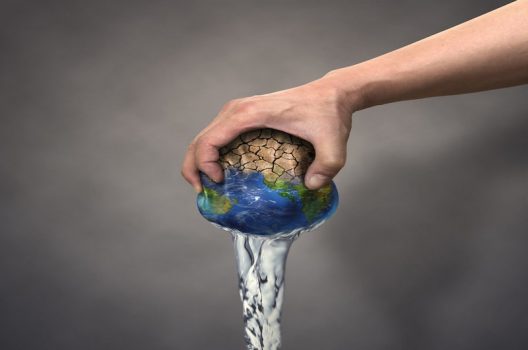
Water covers 71% of the Earth’s surface. Only 4% of it is freshwater. And only 0.5% of that freshwater is accessible for human consumption — the rest is locked in glaciers, ice caps, or deep underground aquifers. On a planet that is overwhelmingly water, we are running out of the kind we can actually use.
The United Nations now considers water scarcity one of the defining global risks of the 21st century. 2.3 billion people currently live in water-stressed countries. By 2040, global water demand is projected to exceed supply by 40%. Climate change is accelerating the depletion of glaciers and snowpacks that millions of people depend on for freshwater. The Middle East and North Africa — already among the world’s driest regions — are projected to experience significant further rainfall reductions.
There is one technology that can address this problem at scale: desalination. The conversion of seawater into freshwater is not new — it has existed in various forms for decades — but the economics have changed so dramatically in the past twenty years that it is now becoming central to water security strategy for dozens of countries. And Israel, a desert nation of 9 million people, has built the most advanced desalination infrastructure in the world and turned water scarcity into water abundance.
How Desalination Works
There are two main methods of desalination, and they work in fundamentally different ways.
Reverse Osmosis (RO) — the dominant modern method — forces seawater through a semi-permeable membrane under high pressure. Salt ions are too large to pass through the membrane; water molecules are not. The result is freshwater on one side, a concentrated brine solution on the other. RO is energy-intensive but has become dramatically more efficient over the past two decades — the energy required to desalinate a cubic metre of seawater has fallen from around 20 kilowatt-hours in the 1970s to under 3 kilowatt-hours today. The cost of desalinated water has fallen correspondingly, from over $1 per cubic metre to under $0.50 at the world’s most advanced plants.
Multi-Stage Flash Distillation (MSF) — the older method — heats seawater to produce steam, which is then condensed into freshwater. MSF is less energy-efficient than RO but produces very high-quality water and is still widely used in the Gulf states, where cheap energy historically made the economics acceptable. As energy prices have risen and RO technology has improved, MSF’s share of new capacity is declining.
“The cost of desalinating water has fallen 90% in fifty years. It is now cheaper to desalinate seawater in Israel than to pump water from the Sea of Galilee. That is a remarkable technological achievement.”
The Israel Story — How a Desert Nation Solved Its Water Problem
Israel’s relationship with water scarcity is as old as the state itself. The country sits in a semi-arid climate, receives most of its rain in a short winter season, and has historically been dependent on the Sea of Galilee (Lake Kinneret) and underground aquifers for freshwater. By the early 2000s, a series of drought years had driven the Sea of Galilee to critically low levels and the aquifers were being depleted faster than they could recharge. Israel was facing a genuine water crisis.
The response was systematic and ambitious. Israel built five large-scale reverse osmosis desalination plants along its Mediterranean coastline — the Sorek, Hadera, Ashkelon, Palmachim, and Ashdod plants. The Sorek plant, built with a partnership between IDE Technologies and a private consortium, became the world’s largest seawater desalination plant when it opened in 2013, producing 627,000 cubic metres of freshwater per day. A second Sorek plant — Sorek B — is now operational, producing an additional 200 million cubic metres per year.
The results have been extraordinary. Israel now desalinates over 85% of its domestic freshwater consumption. The Sea of Galilee has recovered to healthy levels. Israel has become a water exporter — selling freshwater to Jordan under a treaty arrangement and supplying water to Palestinian communities in the West Bank. A country that faced water crisis twenty years ago now has water surplus. The technology solved the problem.
“Israel went from water crisis to water exporter in twenty years. The same technology that saved Israel is now being built across the Middle East, California, Australia, and Southern Europe.”
The Countries Leading the Way
Saudi Arabia produces over 20% of the world’s total desalinated water, making it the single largest producer globally. The country has virtually no natural freshwater and is entirely dependent on desalination and groundwater. The energy-intensive process is powered by oil — creating a dependency that Saudi Arabia’s Vision 2030 plan aims to address with solar-powered desalination.
The United Arab Emirates desalinates approximately 98% of its drinking water — among the highest ratios in the world. Dubai and Abu Dhabi have built world-class desalination infrastructure and are actively investing in solar-powered plants to reduce the enormous energy footprint of the process.
Australia built major desalination plants during the Millennium Drought of 1997–2009 in Perth, Sydney, Melbourne, and Adelaide. Perth’s Kwinana plant now supplies about 20% of the city’s water. With climate change increasing drought frequency, Australian desalination capacity is expanding again after years of underuse during wetter periods.
The Carlsbad desalination plant in California — the largest in the Western Hemisphere — opened in 2015 and supplies about 10% of San Diego County’s water. With California facing persistent drought and groundwater depletion, multiple new projects are in development. Water-scarce states including Arizona, Nevada, and Texas are all evaluating large-scale desalination programmes.
The Problems — Energy, Brine, and Cost
- Provides drought-proof freshwater supply independent of rainfall
- Technology costs have fallen 90% in 50 years — still improving
- Can be powered by renewable energy, eliminating carbon footprint
- Has demonstrably solved water crises — Israel is the proof
- Scalable — from small island systems to city-scale plants
- Water quality is typically very high — better than many groundwater sources
- Energy-intensive — still requires significant power even with improvements
- Brine disposal — concentrated salt solution is harmful to marine ecosystems if poorly managed
- High capital cost — large plants cost hundreds of millions to build
- Not suitable for inland areas far from the coast
- Removes beneficial minerals alongside salt — remineralisation required
- Vulnerable to red tide and algal blooms that can shut down intake
The brine problem is the most significant environmental concern. For every litre of freshwater produced, approximately 1.5 litres of highly concentrated brine is discharged — typically back into the sea. Poorly managed brine disposal can damage marine ecosystems near discharge points. The industry has developed more sophisticated diffusion systems and brine management techniques, but it remains an area requiring careful regulation and ongoing research.
The energy problem is being addressed by pairing desalination plants with renewable energy. Solar-powered desalination is increasingly common in the Gulf states and North Africa — the regions with the highest solar irradiance and the greatest water stress tend to overlap, creating a natural synergy. The NEOM project in Saudi Arabia includes a solar-powered desalination facility designed to supply the entire city entirely from renewable-energy-powered seawater.
Water as an Investment — Stocks and ETFs
The water scarcity crisis creates a compelling long-term investment thesis. Clean water infrastructure, treatment technology, and desalination capacity will require enormous capital investment over the coming decades — and the companies providing that infrastructure stand to benefit from structural, policy-driven demand that is largely independent of economic cycles.
| Name | Ticker | Type | Relevance |
|---|---|---|---|
| Xylem Inc | XYL | Stock | Water technology, analytics, and treatment — one of the most comprehensive water infrastructure companies globally |
| Veolia Environnement | VIE (Paris) | Stock | World’s largest water services company — manages water and wastewater for municipalities and industry globally |
| Pentair | PNR | Stock | Water treatment and filtration systems — residential, commercial, and industrial |
| IDE Technologies | Private | Private | Israeli company behind Sorek plants — world leader in desalination technology, not yet publicly listed |
| Invesco Water Resources ETF | PHO | ETF | Tracks companies focused on water conservation and purification — one of the longest-established water ETFs |
| First Trust Water ETF | FIW | ETF | US-focused water utilities and infrastructure companies — includes treatment, distribution, and conservation |
| iShares Global Water ETF | IH2O (London) | ETF | Global exposure to water utilities and infrastructure — available on European exchanges |
Water ETFs have historically shown lower volatility than broader equity markets — water utilities are regulated, dividend-paying businesses with predictable cash flows. They are not high-growth investments, but they provide exposure to one of the most essential infrastructure themes of the coming decades with relatively defensive characteristics.
The Bottom Line
Water is not optional. It is not substitutable. And it is running out in the places where a growing proportion of the world’s population lives. Desalination is not a perfect solution — it is expensive, energy-intensive, and has environmental side effects that require careful management. But it is a proven solution. Israel proved it. Saudi Arabia proved it. Australia is proving it.
The question is not whether the world will build more desalination capacity. Given the trajectory of climate change and population growth, it has no choice. The question is how quickly costs continue to fall, how successfully the technology can be powered by renewable energy, and whether the investment and political will exist to build the infrastructure before the crisis becomes acute rather than merely urgent.
Water is the new oil — not as a metaphor, but as a literal description of a scarce resource that economies and militaries organise themselves around controlling. The countries and companies that solve the water problem will have an extraordinary geopolitical and commercial advantage in the decades to come.
Sources include the UN World Water Development Report, IDE Technologies, Water Technology journal, Israeli Water Authority, and Bloomberg Intelligence. Stock and ETF information is for informational purposes only and does not constitute financial advice.