
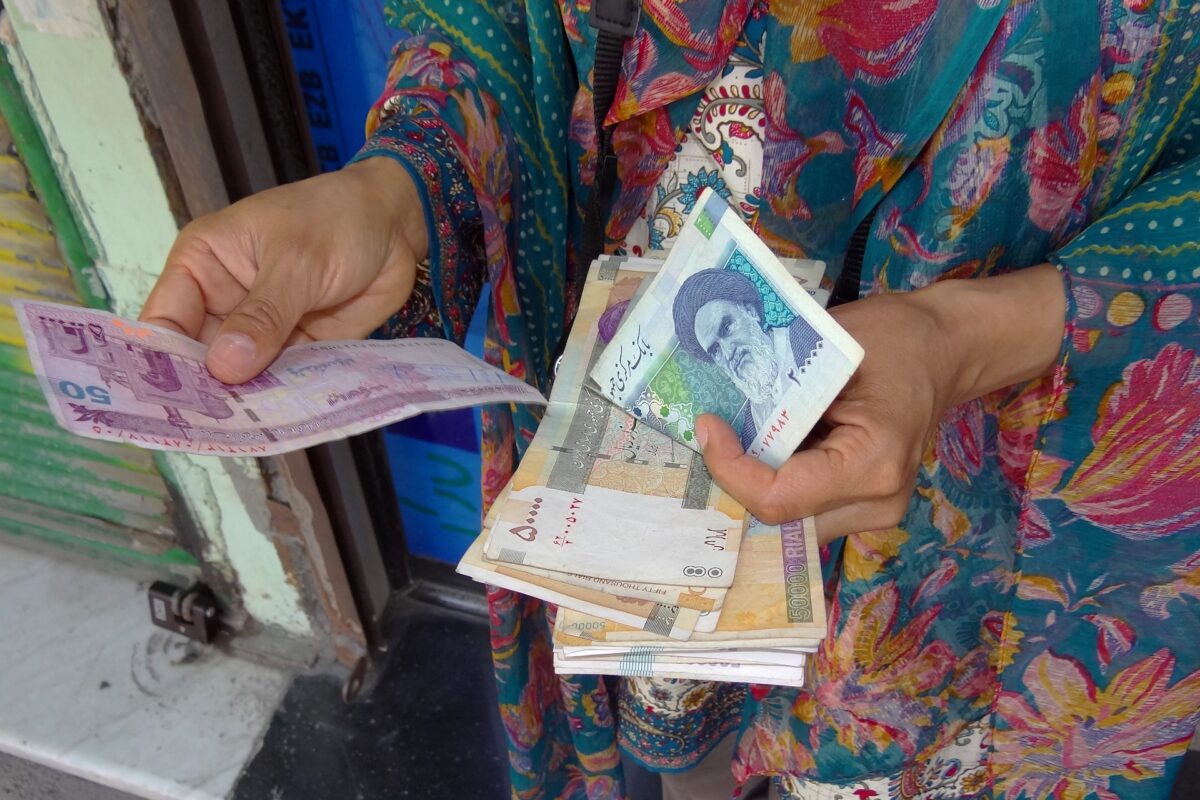
On September 2, 2026, the US dollar broke through 2.2 million Iranian rials on Tehran’s free market — roughly 220,000 tomans, and a fresh record low. It has kept sliding since. The rial has now lost more than 96% of its value against the dollar over the long run, and roughly 60% of that decline has landed since March 2026 alone, as the country’s war with Israel escalated into a full naval blockade.
“Basically worthless” is not really an exaggeration at this point. It is still legal tender — wages are paid in it, subsidised bread is priced in it, taxis still take it — but as a way to store value or plan more than a few weeks ahead, the rial has stopped doing the one job a currency is supposed to do. So what does that actually mean, in practice, for the government that issues it and the roughly 90 million people who have no choice but to use it?
How a Currency Gets Here
Iran’s currency crisis did not start in 2026. It is the latest, sharpest chapter of a decline that runs back through the reimposition of US sanctions in 2018, years of double-digit inflation, and a dual exchange-rate system that has quietly told Iranians for over a decade that their government’s own official dollar rate isn’t the real one. The free-market rate — the one that actually determines what imported goods, medicine, and foreign travel cost — has for years traded at a steep premium to whatever rate the central bank publishes.
That gap is itself a signal worth reading. When a government’s own official exchange rate diverges sharply from what people actually pay on the street, it is effectively an admission that official statistics can’t be trusted at face value — a theme that recurs throughout this crisis, from the currency to the inflation numbers below.
Iran’s isolation isn’t only a story about Washington, either. It also sits on the losing side of the region’s other major fault line — its decades-long rivalry with Saudi Arabia for leadership of the Muslim world, which has kept many of the Gulf financial and trade relationships that might otherwise offer Iran a cushion largely closed off. A country with fewer regional doors open to it has fewer places to turn when Western ones close too.
The War That Broke What Was Left
The immediate trigger for 2026’s collapse was military, not just economic. US-Israeli strikes on February 28 escalated an already-tense standoff into open conflict. Officially, the fighting centered on Iran’s nuclear program — though the deeper stakes look wider than that, running through oil, the Strait of Hormuz, and control of the arteries of the global economy. By July, the US had imposed a naval blockade on Iranian ports, choking off trade routes and oil shipments. Around the same time, the US Treasury cut off Iran’s access to correspondent banks in the region — severing one of the country’s few remaining channels for actually accessing foreign currency, even when it manages to earn some.
Free-market rate, record low
Since March 2026 alone
At its February 2026 peak
The central bank’s own response has been to talk the problem down. Governor Abdolnaser Hemmati attributed the latest slide mainly to “psychological factors” rather than economic fundamentals, while pledging a $2 billion currency injection and claiming more than $18 billion had already been funnelled toward essential imports since March. Whatever the cause, the free-market rate now trades at more than double the official one — a gap wide enough that “psychological” is a hard sell to anyone actually changing money in Tehran.
The Paradox in Iran’s Own Budget
Here is the part that rarely makes the headlines: a collapsing rial is not straightforwardly bad news for the government’s own finances. Iran’s oil — still the state’s main source of hard currency — is priced and sold in dollars, overwhelmingly to China, which now takes more than 90% of Iran’s crude through a sanctions-evading “shadow fleet” of tankers, at a discount of roughly $10–20 a barrel to Brent. Every one of those dollars converts into more and more rials as the currency weakens, which mechanically cushions a budget that leans heavily on oil income — even as it does nothing for anyone who only ever gets paid in rials.
A collapsing rial is a mechanical cushion for a government that earns in dollars and spends in rials — and a slow-motion emergency for everyone who only ever sees the rial side of that trade.
That cushion has real limits, though. Physical oil export volumes fell sharply as the war escalated — down 45% month-over-month at one point in early 2026, to around 1.14 million barrels a day, well below Iran’s roughly 1.1–1.9 million bpd pre-war range. Then July’s naval blockade choked off shipping routes further, and the loss of correspondent-banking access made it harder for Iran to actually access and repatriate whatever dollars it does earn. The government is being squeezed from a different direction than ordinary Iranians — but it is being squeezed all the same, which is presumably why an insider warned Reuters that authorities could have trouble making payroll without sanctions relief or access to frozen overseas assets.
What a Weak Rial Means for Iran’s Other Exporters
Oil isn’t the only export this affects, and the story for everyone else selling Iranian goods abroad is messier. In theory, a weaker rial should be good news for non-oil exporters — petrochemicals, pistachios, saffron, minerals, and industrial goods, a sector Iran has leaned on harder precisely because oil is so exposed to sanctions and the blockade, and one that brought in close to $58 billion in the last full Iranian calendar year. A cheaper currency makes those goods cheaper for foreign buyers.
In practice, Iran’s own currency bureaucracy has undercut a lot of that advantage. Exporters are required to convert much of their foreign earnings back into rials through the central bank’s official NIMA platform, at rates well below what the same dollars would fetch on the free market — effectively a tax on the act of exporting. The distortion has gotten severe enough that Iranian authorities themselves estimate businesses have accumulated more than $100 billion in earnings kept abroad or simply undeclared, specifically to avoid handing them over at the unfavourable official rate.
Tellingly, the government’s response hasn’t been to fix the rate. It’s been to route around it: the central bank has started tolerating crypto, easing scrutiny of exchanges so exporters can repatriate earnings in bitcoin or USDT instead of rials at the bad NIMA conversion, according to Financial Times reporting. It’s the same tool ordinary Iranians are reaching for to escape the rial, for a completely different reason — more on that below.
What It Actually Means for Ordinary People
For most Iranians, the story isn’t the exchange rate itself — it’s what it does to the price of everything. Overall inflation was already running at 47.5% before the war even began. Food inflation, which hits household budgets hardest and fastest, accelerated to 105% by February, up from 64% just four months earlier. Rial-denominated savings have lost roughly half their real purchasing power in under six months.
Here, too, there’s an official-versus-real gap worth noting. Iran’s central bank reported prices rising just 6% in the six weeks after the war started — but Tehran residents told Reuters that some prices had jumped around 40% over that same stretch. It’s the same pattern as the exchange rate: an official number and a lived reality that increasingly don’t describe the same country.
Those aren’t just abstract percentages. In Tehran’s Grand Bazaar, one shopkeeper described the absurdity of trading at these levels bluntly: “With the dollar at 2,000,000 rials, what kind of situation is this?” Others have described similar arithmetic to reporters this year: a retired teacher in Kerman who used to buy two 10-kilogram bags of rice at a time now struggles to buy one; a fast-food shop owner near Tehran said his revenue looks higher only because prices are inflated, while his real margin has been cut in half and his customer count has dropped by roughly the same amount; an energy-company employee in Tehran said a grocery budget that comfortably covered a month of chicken, meat, and basic hygiene products two months earlier no longer comes close. A shopkeeper in Shiraz, watching his rent roughly triple over a matter of months, put it more starkly still — that this is the end of the road, and it can’t continue.
| Date | USD/IRR (free market) | Context |
|---|---|---|
| January 2026 | ~1.47 million | Pre-war baseline; already a record at the time |
| March 2026 | ~1.35 million | Brief stabilisation just before the war’s economic impact hit in full |
| Feb 28, 2026 | — | US-Israeli strikes; conflict escalates sharply |
| July 2026 | — | US naval blockade on Iranian ports; correspondent-banking access cut |
| September 2, 2026 | ~2.2 million | Fresh record low; euro tops 2.55 million, sterling nearly 3 million |
Beyond prices, there’s a physical dimension too: war damage to factories, energy facilities, bridges, and railways has pushed unemployment up in its own right, on top of the inflation squeeze. None of this is happening in a vacuum — economic strain from the currency and inflation crisis had already triggered mass protests, and a harsh crackdown, before the war even began.
What Can Iran’s Central Bank Actually Do About It?
Economists who study Iran’s economy generally point to the same short list of textbook fixes, and the central bank has avoided most of them. The biggest is currency unification — merging the official NIMA rate with the free-market rate, which would remove exporters’ incentive to hide earnings abroad in the first place. It’s been recommended for years and consistently avoided, because it would make the real scale of inflation visible overnight in a way the current multi-rate system currently obscures. Raising interest rates on rial deposits is the other classic lever, but it runs into a hard limit here: no realistic deposit rate competes with inflation running above 40–100% and a currency people already expect to keep falling.
What the central bank has actually done looks more like triage than reform: the $2 billion injection and import-financing figures Governor Hemmati cited, reported plans to intervene directly in unofficial currency trading in Tehran and Dubai to relieve pressure on the rate, and — as covered above — quietly tolerating crypto as a release valve for exporters rather than fixing the exchange system itself. These read as the moves of an institution managing a symptom it can’t address at the source.
The one lever that would actually move the needle isn’t monetary policy at all: sanctions relief and access to Iran’s frozen overseas assets, which is a political and diplomatic outcome, not something the central bank can produce on its own. Whether that becomes possible depends heavily on how the wider conflict resolves — a question we’ve examined in more detail here.
Are Iranians Already Looking Past the Rial?
Given all that — and given that exporters are already being quietly waved toward crypto, as we just saw — it’s a fair question, and the honest answer is: partly, and in more places than most outsiders would expect.
The most traditional escape route is the oldest one: gold and physical dollars. Gold prices inside Iran have climbed above 225.7 million rials per gram, with gold coins trading north of 2.26 billion rials — both classic signs of a population trying to hold value in anything other than the local currency.
The more striking shift is crypto — and it’s happening on two levels at once. At the state level, Iran has leaned on bitcoin mining and stablecoins as a way to move money around the financial isolation described above: mining converts cheap electricity into an asset that settles internationally without touching the dollar-based banking system the US has cut Iran off from, and the central bank’s own USDT holdings serve a similar purpose. At the citizen level, ordinary Iranians have used crypto more defensively — during recent protests and internet blackouts, withdrawals from local exchanges to personal wallets spiked, as people moved savings into bitcoin specifically to get it away from a currency in freefall.
Where This Leaves Iran
None of this adds up to Iran quietly replacing the rial with crypto. Gold and physical dollars remain far more widespread stores of value for ordinary Iranians than digital assets, which require internet access and technical familiarity that isn’t universal — and the same government relying on crypto to route money around sanctions has, at points, restricted ordinary citizens’ access to exchanges. Crypto here looks less like a replacement currency and more like a release valve: something people and institutions reach for specifically when the official system stops working, rather than something anyone would choose if the rial were actually stable.
What the 2026 crisis mostly did was accelerate a decline that was already decades in the making, and expose the gap — in the exchange rate, in the inflation numbers, in the government’s own explanations — between what Iran’s institutions say and what its people actually experience. The government is fighting that gap on two fronts at once: trying to prop up a rial that fewer people trust by the week, while quietly building and relying on the same digital workarounds that let its own citizens, and in some cases its own military, stop needing the rial at all.
For live USD/IRR and other FX data, visit the AllinAllSpace Market Watchlist, or browse more Forex Analysis.
This article is an economic and market analysis, not a political statement, and does not constitute financial or investment advice. AllinAllSpace is not a registered investment advisor. Iran’s currency and economic situation is tied to an active, fast-moving conflict and sanctions regime — figures cited here are sourced as of September 2026 and can change quickly; verify current data before relying on it for any decision.