
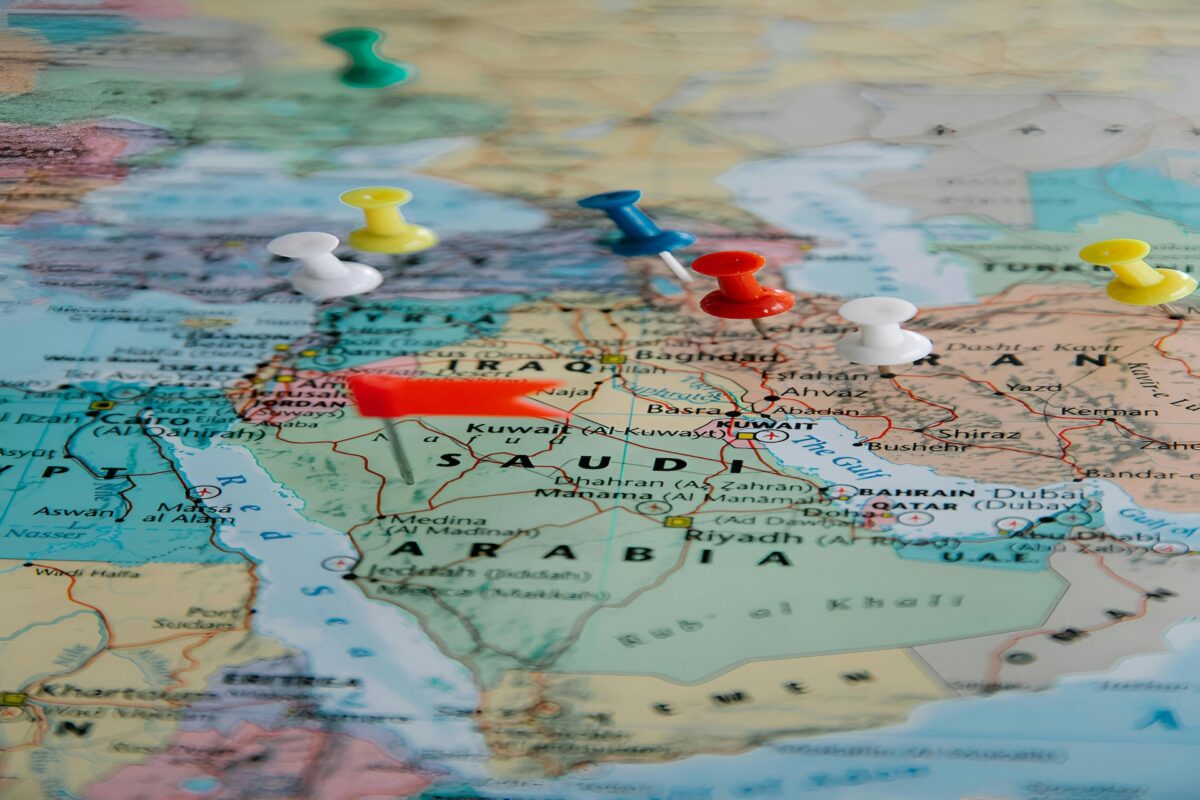
Picture two men who both believe they should be running the same institution. Both are qualified, both are ambitious, both have legitimate claims — and both despise each other with a fervour that goes beyond politics into something much older and much harder to resolve. That, in rough terms, is the relationship between Iran and Saudi Arabia. Except the institution in question is not a company or a political party. It is Islam — the second-largest religion on earth, with 1.9 billion followers.
Iran wants to lead the Muslim world. So does Saudi Arabia. One controls Islam’s two holiest cities. The other controls a revolutionary idea. Both have oil money, both have regional ambitions, and neither has ever been willing to concede the argument.
Most geopolitical conflicts are about land, resources, or power. The Iran-Saudi rivalry has all of those elements, but underneath them runs something that makes it uniquely intractable: a religious dispute that is 1,400 years old, rooted in a succession crisis that erupted within years of the Prophet Muhammad’s death, and still very much alive in the way both countries organise their societies, conduct their foreign policy, and view each other.
This is not an article about who is right. It is an attempt to explain why this particular conflict is so difficult to resolve, why it matters beyond the Middle East, and whether the latest geopolitical shifts — including the Abraham Accords and the possibility of Saudi-Israeli normalisation — are changing the equation in ways that neither Tehran nor Riyadh fully anticipated.
Why Saudi Arabia and Iran Have a Never-Ending Conflict
Strip away the headlines and the rivalry comes down to a handful of durable drivers that never really go away. There is the theological split itself — Sunni versus Shia, dating to 632 CE, with each side convinced it holds the legitimate claim to Islamic leadership. There is geography: Saudi Arabia physically controls Mecca and Medina, a religious trump card Iran can never acquire. There is ideology: Iran’s 1979 revolution was built to export itself across the Muslim world, which put it on a collision course with every conservative monarchy in the Gulf, Saudi Arabia first among them. And there is proxy competition across Lebanon, Syria, Yemen, and Iraq, where each side has spent decades funding the other’s enemies. In 2026, that competition briefly went direct, with missile strikes and covert retaliation crossing both borders for the first known time. None of these drivers has been resolved — which is why, diplomatic thaws aside, the conflict keeps resetting rather than ending.
The Holy Cities Problem — Saudi Arabia’s Unbeatable Card
Start with geography, because it is the most concrete advantage Saudi Arabia holds in this rivalry. Within its borders sit Mecca and Medina — the two holiest cities in Islam. Mecca is the birthplace of Muhammad, the site of the Kaaba, and the destination of the Hajj pilgrimage that every Muslim who is physically and financially able is required to complete at least once in their lifetime. Medina is where Muhammad built the first Muslim community and where he is buried.
This is not a minor detail. It is structurally transformative. Saudi Arabia does not just claim religious authority — it custodies the physical sites that are the spiritual centre of gravity for 1.9 billion people worldwide. The King of Saudi Arabia holds the official title “Custodian of the Two Holy Mosques.” That title was introduced by King Fahd in 1986 and it was a deliberate repositioning: not just a political leader, but a religious guardian.
Iran’s problem — and it is a real one — is that it cannot match this. The Islamic Republic controls no site of comparable religious significance to Sunni Muslims, who make up roughly 85-90% of the global Muslim population. Iran is predominantly Shia, which puts it in the theological minority of a religion it nonetheless claims to lead.
The Shia-Sunni split traces back to 632 CE and the death of Muhammad, who left no unambiguous instructions about his successor. A faction believed leadership should pass to Muhammad’s cousin and son-in-law Ali. Another believed it should be decided by the community’s elders. The first group became the Shia — from “Shiat Ali,” the party of Ali. The second became the Sunni. Ali eventually did become Caliph, but was assassinated. His son Hussein was killed at the Battle of Karbala in 680 CE — a massacre that became the foundational trauma of Shia Islam, commemorated annually in the festival of Ashura.
Fourteen centuries later, that split continues to structure the geopolitics of a region that sits on top of a significant portion of the world’s oil reserves.
The Iranian Revolution Changed Everything
For most of the 20th century, the Iran-Saudi relationship was complicated but manageable. Both countries were monarchies. Both were broadly aligned with the United States during the Cold War. The religious dimension existed but was not the primary driver of their relationship.
Then came 1979.
The Iranian Revolution was not just a political event — it was a theological one. Ayatollah Khomeini did not merely overthrow the Shah. He articulated a new concept: Velayat-e Faqih, or “Guardianship of the Islamic Jurist” — the idea that a senior Islamic scholar should hold supreme political authority, because only someone deeply versed in divine law could govern a truly Islamic state. This was revolutionary in the most literal sense. It overturned 1,400 years of Shia tradition, which had generally kept religious scholars out of direct political rule while the Imam was absent.
Khomeini did not just want to run Iran. He wanted to export the revolution — to every Muslim country, including Saudi Arabia.
Khomeini’s vision was explicitly universalist. He argued that the Islamic Republic was not a Shia project but an Islamic one — a model for all Muslim-majority countries to follow. He called on Muslims everywhere to rise against their governments, which he characterised as corrupt, US-backed, and un-Islamic. This was aimed directly at Saudi Arabia, which was everything Khomeini’s movement stood against: a monarchy, a close US ally, and the guardian of a Sunni religious establishment that had no interest in revolutionary politics.
Saudi Arabia’s response was to double down on its own religious credentials. In November 1979 — the same year as the Iranian Revolution — a group of Sunni militants seized the Grand Mosque in Mecca in a violent uprising against the Saudi government. The siege lasted two weeks and was eventually ended with French special forces assistance. It was a wake-up call. The Saudi establishment responded by dramatically increasing its investment in Wahhabi religious institutions — the conservative Sunni tradition that would be exported around the world through Saudi-funded mosques, schools, and religious organisations over the following decades.
Two competing visions of Islamic leadership, both energised by the events of 1979, both flush with oil money, and both determined to outmanoeuvre the other. The proxy wars that followed were almost inevitable.
The Proxy Wars — A Map of Competing Influence
For decades, what made the Iran-Saudi rivalry unusual among geopolitical conflicts was that neither country fought the other directly. Instead, they fought through proxies — funding, arming, and supporting local actors across the Middle East and beyond in a competition for regional influence that has left a trail of destabilised countries in its wake. That changed in 2026. After the US and Israel struck Iranian targets beginning February 28, Tehran retaliated with missile strikes that hit Saudi soil, including oil infrastructure, and Saudi Arabia reportedly carried out secret strikes on Iranian drone and missile-launch sites in response — the first known direct Saudi military action on Iranian territory. A ceasefire in early April quieted the direct exchanges, though Iran-backed proxies kept operating. For the first time in the history of this rivalry, the two countries hit each other’s territory directly, even if briefly. We covered what that war left behind in more detail in the US-Iran war aftermath.
| Metric | Iran | Saudi Arabia |
|---|---|---|
| Population | ≈ 93.2 million | ≈ 35.2 million |
| Land area | 1,648,195 km² | 2,149,690 km² |
| Active military personnel | ≈ 610,000 | ≈ 257,000 |
| Annual defence budget | ≈ $9.5 billion | ≈ $88 billion |
Lebanon — Hezbollah, the Shia militant group and political party, is Iran’s most powerful and longest-standing proxy. Founded in the early 1980s with Iranian support, Hezbollah now commands a military force that rivals the Lebanese state army and holds seats in the Lebanese parliament. Saudi Arabia has backed various Sunni factions in Lebanon over the years, most notably the Future Movement of the Hariri family.
Syria — When civil war broke out in 2011, Iran backed Assad’s Alawite government (Alawites are a Shia offshoot) with money, weapons, advisors, and Hezbollah fighters. Saudi Arabia backed Sunni rebel groups. The result was a catastrophic war that killed hundreds of thousands of people and produced one of the worst refugee crises in modern history.
Yemen — The ongoing conflict in Yemen is perhaps the most direct expression of the Iran-Saudi proxy war. The Houthi movement — Zaydi Shia rebels in northern Yemen — has received Iranian support. Saudi Arabia, along with a coalition of Arab states, has been fighting the Houthis since 2015. The war has produced a humanitarian catastrophe while resolving almost nothing militarily.
Iraq — After the US invasion in 2003 removed Saddam Hussein’s Sunni-dominated government, Iraq became a battleground for Iranian and Saudi influence. Iran’s relationship with Shia political parties and militias in Iraq has given it significant leverage over a country that shares a long border. Saudi Arabia has struggled to build comparable influence among Iraq’s Sunni minority. That leverage turned kinetic in July 2026: Iran-backed militias launched more than 30 drone attacks from Iraqi territory at Saudi energy infrastructure over 72 hours, and Saudi Arabia and US CENTCOM responded with strikes on militia sites across eastern Iraq, killing dozens of Popular Mobilisation Forces fighters.
The US, Israel, and the Abraham Accords — Iran’s Worst Nightmare
Iran’s narrative about Saudi Arabia has always included a crucial third element: the United States. In Khomeini’s worldview — and in the worldview of the Islamic Republic that has governed Iran ever since — Saudi Arabia is not just a religious rival. It is an agent of American imperialism in the Muslim world. A country that allows US military bases on the Arabian Peninsula, the land of the two holy mosques. A country that sells its oil to the West and uses the proceeds to maintain a monarchy that suppresses its own people.
This narrative had genuine resonance among many Muslims — including many Sunni Muslims — who were uncomfortable with American military presence in the region and Saudi Arabia’s close alignment with Washington. It was one of the factors that gave Osama bin Laden his initial base of support: he, too, was outraged by American troops in Saudi Arabia, though his solution was very different from Iran’s.
Israel sits at the centre of this third element, and the enmity runs deep enough that we gave it its own dedicated piece: Iran and Israel: the full story.
The Abraham Accords of 2020, brokered by the Trump administration, represented a major shift in this regional architecture. The UAE, Bahrain, Sudan, and Morocco formally normalised relations with Israel — breaking with decades of Arab League consensus (a consensus rooted in the broader, and often overstated, notion of Arab unity we unpack in what’s the idea of one Arab nation) that normalisation with Israel would only come after the establishment of a Palestinian state. For Iran, this was alarming. Israel had always been the other great enemy in the Islamic Republic’s worldview — “the Zionist entity” that must be eliminated. To see Arab countries normalising with Israel while the Palestinian question remained unresolved was, from Tehran’s perspective, a betrayal of Islamic solidarity.
The question of whether Saudi Arabia will join the Abraham Accords is one of the most consequential geopolitical questions of the coming decade.
Saudi Arabia did not join the Abraham Accords in 2020. But the question of whether it eventually will is one of the most consequential geopolitical questions of the coming decade. Crown Prince Mohammed bin Salman has made clear that Saudi-Israeli normalisation is possible in principle — if the right conditions are met, which include credible movement toward Palestinian statehood and significant US security guarantees for Saudi Arabia.
For Iran, Saudi-Israeli normalisation would be a strategic catastrophe. It would mean the most powerful Arab state, custodian of Islam’s holy cities, formally at peace with the country Iran has designated as an existential enemy. It would undermine Iran’s claim to represent authentic Islamic resistance to Israel. It would deepen the alignment between the Gulf states and Israel in ways that would further isolate Iran regionally.
This is almost certainly one of the reasons Iran has been actively working to complicate the normalisation process — including through its support for Hamas, whose October 7, 2023 attacks on Israel sent a shock through the entire Middle East and significantly complicated the normalisation timeline.
Will Saudi Arabia Join the Abraham Accords?
This is the question that hangs over the region. The honest answer is: probably eventually, but not soon, and not without conditions that may prove difficult to meet.
The incentives for Saudi Arabia are real. An alliance with Israel — which has one of the most capable militaries in the Middle East and the most advanced technological and intelligence capabilities — would provide Saudi Arabia with a powerful counterweight to Iran. US security guarantees would formalise American commitment to Saudi defence in ways the current relationship does not. Economic and technological cooperation with Israel would accelerate Saudi Vision 2030, MBS’s plan to diversify the Saudi economy away from oil dependence.
The obstacles are also real. Domestic Saudi public opinion is deeply sympathetic to the Palestinian cause — more so among the religious establishment that the government relies on for legitimacy. Normalisation without meaningful progress on Palestinian statehood would be politically costly domestically and would hand Iran a propaganda victory. The events of October 2023 and their aftermath have made any near-term deal significantly harder to sell publicly.
There is also the question of what “conditions” actually means. Saudi Arabia has demanded a clear pathway to Palestinian statehood. Israel’s current government has shown no interest in providing one. The US could in theory pressure Israel, but the political dynamics in Washington make that difficult. And so the normalisation process sits in a kind of geopolitical limbo — desired by most of the relevant parties for their own reasons, blocked by the Palestinian question that nobody with real power is willing to resolve.
Where Does This Leave Us?
The Iran-Saudi rivalry is one of those conflicts that does not have an obvious resolution — not because the parties lack incentives to resolve it, but because the conflict operates on a level that goes beyond the transactional. You cannot sign a peace treaty with a theological dispute.
In 2023, China brokered a diplomatic agreement between Iran and Saudi Arabia that restored relations between the two countries after a seven-year break. Embassies reopened. There were cautious diplomatic exchanges. Some analysts declared a new era. But diplomatic normalisation is not the same as resolving the underlying competition for Islamic leadership, the proxy wars that express it, or the fundamentally different visions of what the Muslim world should look like that both countries project.
The competition will continue. It will be expressed through different channels at different moments — sometimes through hot proxy conflicts like Yemen, sometimes through softer competition for religious influence through mosque funding and educational institutions, sometimes through the geopolitical chessboard of normalisation deals and US alliances. But it will continue, because the underlying drivers — the Shia-Sunni split, the custody of the holy cities, the competing claims to Islamic leadership, and the deep structural incompatibility of Iran’s revolutionary theocracy and Saudi Arabia’s monarchical conservatism — have not gone anywhere.
The question of whether Saudi Arabia joins the Abraham Accords is really a question about which vision of the Muslim world’s future wins out. A Saudi Arabia allied with Israel and the United States is a Saudi Arabia that has chosen the Western-aligned, pragmatic, post-ideological model. An Iran that can prevent that outcome is an Iran that has preserved the narrative of authentic Islamic resistance. Both have everything to gain or lose from how this plays out.
For a conflict that most Western media treats as a regional problem, it is worth appreciating the scale of what is actually at stake. 1.9 billion people. The world’s largest oil reserves. Nuclear ambitions on one side and advanced military technology on the other. And underneath all of it, a succession dispute from 632 CE that nobody has managed to resolve in 1,400 years.
It is, without question, the biggest religious rivalry in the world. It just does not always make the front page.
How live this remains was on display in the space of 24 hours in late August 2026. On August 28, Iranian President Masoud Pezeshkian said Iran was “ready to cooperate” with regional countries, naming Saudi Arabia and the UAE specifically as potential partners for expanded mutual understanding. He offered no details or timetable. The very next day, regional outlets were reporting sourced claims that Iran-led militias in Iraq were preparing to strike Saudi Arabia again, potentially within hours. Two signals, pointing in opposite directions, arriving almost simultaneously — which is, in miniature, the entire history of this rivalry. Diplomatic overtures and military threats are not alternating phases of the relationship. They are running in parallel, and have been for over four decades.
This article represents editorial analysis and opinion published by AllinAllSpace. It does not constitute political advice and does not reflect support for any government, political movement, or religious group.