
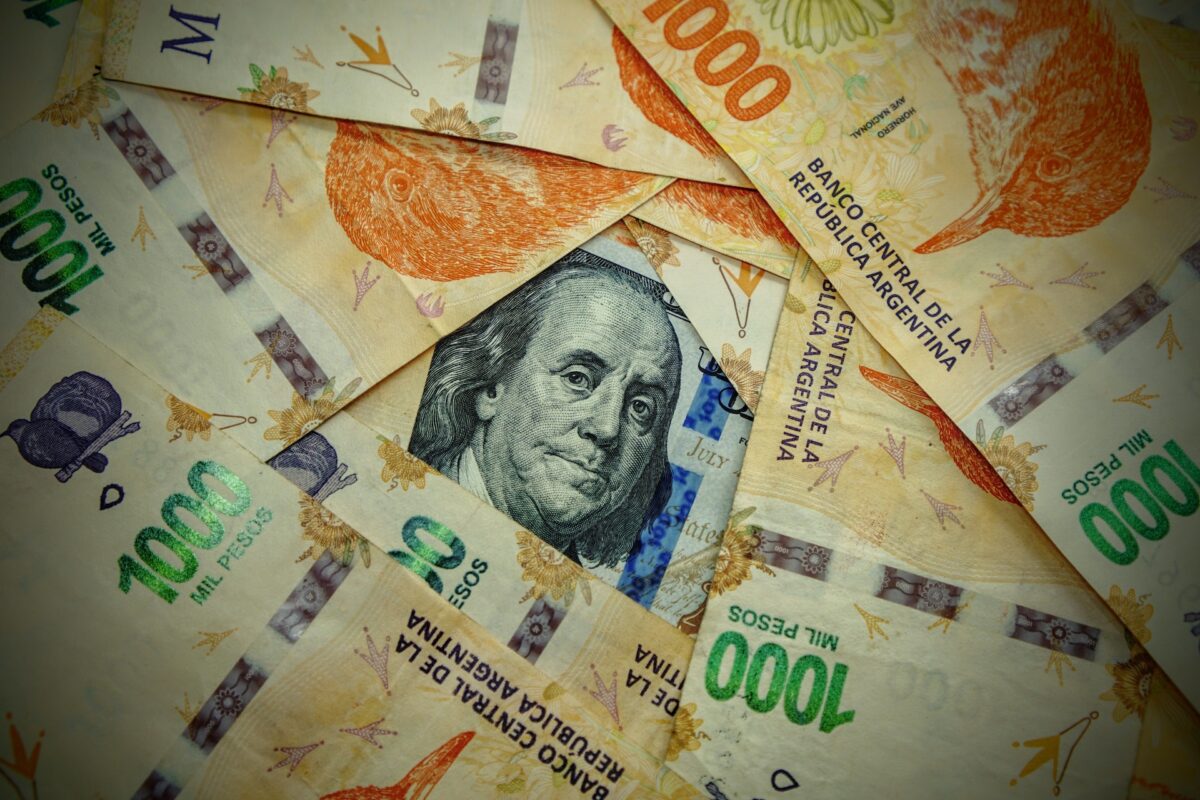
Javier Milei called the Argentine peso “excrement.” He described the central bank as a mechanism for state theft. He campaigned with a literal chainsaw as a prop, promised to dollarise the economy completely, and declared that the best currency was no currency at all. He won the presidency by a landslide in December 2023.
Two and a half years later, the peso is still legal tender. The central bank is still standing. And Milei, the self-described anarcho-capitalist who promised to blow up Argentina’s monetary system, is carefully managing a crawling exchange rate band and negotiating reserve targets with the IMF.
This is not a story about failure. It is actually more interesting than that.
A Country That Has Tried Everything
To understand why Milei’s currency radicalism resonated so deeply, you need to understand what Argentines have lived through. This is a country that has defaulted on its sovereign debt nine times. It had a currency peg to the dollar that collapsed catastrophically in 2001, wiping out middle-class savings overnight. It printed money so aggressively that inflation hit 211% annually by the time Milei took office. The peso has lost roughly 99% of its value against the dollar over the past two decades.
When your currency has performed like that, a politician promising to get rid of it entirely does not sound crazy. It sounds like the only honest conversation anyone has had about money in a generation.
The country’s relationship with the dollar has always been complicated. Ordinary Argentines have long held dollars at home as a store of value precisely because they do not trust their own currency. During the worst periods, there were multiple exchange rates operating simultaneously: the official rate, the black market “blue dollar” rate, the financial MEP rate, and various special rates for exporters. At one point, the gap between the official rate and the black market rate exceeded 170%. The peso was priced in pesos, but everything that mattered was priced in dollars.
What Milei Actually Did
When Milei took office, the immediate priority was not dollarisation. It was survival. Inflation at 211%, reserves nearly depleted, the IMF program badly off track. His first moves were brutal by design: a maxi-devaluation of the peso, severe cuts to government spending, elimination of subsidies, and a crawling peg that let the peso depreciate at 2% per month in a controlled way.
It was ugly. The recession in early 2024 hit ordinary Argentines hard. Poverty spiked to 52.9% in the first quarter of 2024 before the stabilisation began to take hold. But Milei held the line on the fiscal side in a way that no Argentine government had managed in decades, eliminating a budget deficit that had been running at around 5% of GDP.
By late 2025, the numbers looked genuinely remarkable.
Down from 211% at peak
Down from 52.9% in Q1 2024
Year-on-year 2025
Annual inflation had fallen to around 30% — still high by any normal standard, but a transformation from the hyperinflationary spiral of two years earlier. Poverty had dropped 27 percentage points. The economy was growing at 5.3% year-on-year. Exports hit an all-time high. The IMF called the stabilisation program one of the most successful in recent memory.
And the peso? Rather than abolishing it, Milei kept it on a very tight leash. The exchange rate has been managed within bands since April 2025, with the central bank buying and selling dollars to keep the peso inside a set range. From January 2026, those bands were adjusted to expand at the rate of the previous month’s inflation — a technocratic, careful system that would have been completely unrecognisable from the chainsaw-waving candidate of 2023.
The near-vertical lines on that chart tell you everything about what Argentine monetary policy felt like from the inside — sudden, violent, and unpredictable. The stabilisation since 2024 looks different: managed, gradual, and so far holding.
The Paradox Nobody Talks About
Here is where it gets genuinely interesting. Milei’s stated end goal remains full dollarisation — replacing the peso with the US dollar entirely, as Ecuador and El Salvador have done. He says so repeatedly. But economists who study this closely have identified a paradox at the heart of the plan.
If the stabilisation works — if inflation falls to single digits, if Argentines begin to trust their currency again, if the peso holds its value month after month — then the political and economic case for abolishing it weakens dramatically. Why give up your own currency when it finally works? The very success of the plan undermines its ultimate objective.
If Milei fixes the peso, nobody will want to abolish it. The man who called his own currency excrement might accidentally save it.
This is exactly what happened in Peru and Uruguay. Both countries went through periods of high dollarisation, where dollars were used for savings, prices, and large transactions. Both eventually rebuilt credibility in their own currencies through disciplined fiscal and monetary policy. The dollar’s role in their economies shrank naturally, without anyone forcing it. It is worth noting that the opposite problem exists elsewhere: Japan has spent decades with a currency that the central bank cannot weaken fast enough. We wrote about the yen’s structural dilemma here.
Argentina, under this scenario, might end up with a stronger, more trusted peso rather than no peso at all. The anarcho-capitalist who wanted to burn the central bank down might accidentally save it.
What the Peso’s History Actually Tells Us
There is a deeper lesson here for anyone interested in how currencies actually work. Currencies are not just exchange rate tables and inflation figures. They are confidence mechanisms. The peso failed not because it was intrinsically defective but because successive Argentine governments destroyed the trust that makes a currency function. Every time a government printed money to cover deficits, every time reserves were raided, every time capital controls were imposed and then lifted and then reimposed, the implicit contract between citizen and currency was broken a little further.
Milei understood this intuitively. His solution was radical — abolish the currency, import a credible one. But the actual policy has been more conventional: restore fiscal discipline, control the money supply, manage the exchange rate carefully, and let time do the rest. The rhetoric was anarcho-capitalist. The execution has been closer to orthodox IMF stabilisation.
| Period | ARS / USD | Annual Inflation | Context |
|---|---|---|---|
| 2019 | ~60 | 53% | Macri era ends, capital controls reintroduced |
| 2021 | ~100 | 51% | Peronist government, blue dollar gap widens |
| 2023 (pre-Milei) | ~800 | 211% | Crisis point. Peso collapses. Milei elected. |
| Early 2024 | ~1,000 | 290% | Maxi-devaluation, shock therapy begins |
| Late 2025 | ~1,100 | ~30% | Stabilisation takes hold. Bands introduced. |
| Mid 2026 | ~1,150 | ~25% | Managed band, reserves rebuilding, peso stable |
Is It Actually Working?
The honest answer is: more than most people expected, less than Milei would like, and more fragile than the cheerleaders admit.
The wins are real. Inflation down from 211% to 30% in under two years is an extraordinary achievement by any measure. Poverty falling 27 percentage points is not a statistic — it is millions of people’s lives changed. The economy is growing. Exports are at record highs. The Merval stock index has been one of the strongest performers in the world. Foreign investors who would not touch Argentina two years ago are paying attention again.
But the vulnerabilities are real too. Net international reserves remain thin. Argentina faces substantial external debt payments through 2026, and the math only works if the current account stays manageable and global capital markets remain open. Monthly inflation is still running at around 2-3% per month — which compounds to 25-40% annually. That is not price stability. It is more like price instability at a pace people can live with.
If This Works, the Peso Wins
The most likely path from here is not dramatic. Milei will probably continue managing the peso carefully, keeping inflation on a downward trajectory, and talking about dollarisation as a long-term goal while doing something quite different in practice. The bands may widen. Capital controls may ease further. The parallel rate gap, which once exceeded 170%, is now effectively zero — a genuine achievement that most analysts thought impossible without a brutal devaluation.
Full dollarisation is not happening in the near term. Milei himself has said so. The reserves simply are not there — you need enough dollars to buy back every peso in circulation at a credible rate, and Argentina is nowhere close. The plan, if it works, leads to a world where the peso is boring, stable, and trusted. Which, for Argentina, would be the most radical outcome of all.
My own view is that Argentina’s story is more instructive than it is exceptional. What Milei demonstrated — almost accidentally — is that the thing destroying the peso was never the currency itself. It was the fiscal behaviour that kept undermining it. Fix the deficit, control the money supply, and a currency that seemed beyond saving starts to look functional again. That lesson applies well beyond Argentina. The best currency is not necessarily no currency. Sometimes it is just a currency that a government finally decided to take seriously.
For live USD/ARS data and other forex pairs, visit the AllinAllSpace Market Watchlist. For more forex analysis, see our Forex Analysis section.
This article represents the opinion of the author and does not constitute financial advice. AllinAllSpace is not a registered investment advisor. Currency trading involves significant risk. All data correct as of July 2026.