
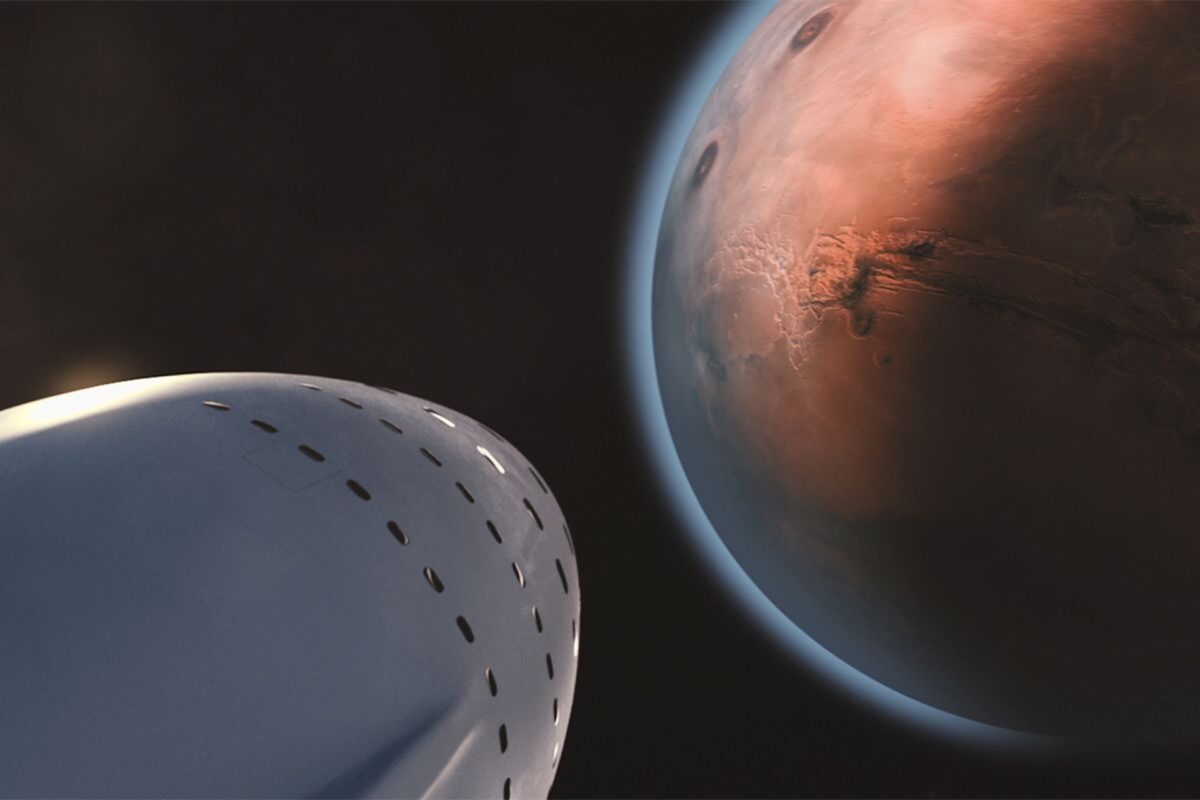
Let me be clear about what I am not saying. I am not questioning Elon Musk’s intelligence or ambition. This is not an attack on Elon Musk. I am not saying SpaceX has not achieved remarkable things — reusable rockets, the Falcon 9’s record launch cadence, the Starship programme itself. I am not even saying humans will never reach Mars. They probably will, eventually, in some form.
Here is what I will say first: Musk deserves real credit for putting Mars on the agenda in a serious way. Before SpaceX, Mars colonisation was the domain of science fiction and fringe aerospace enthusiasts. Musk made it a mainstream ambition, attracted billions in capital and some of the best engineering talent in the world, and built the rocket technology that makes any future Mars mission more plausible than it was twenty years ago. That is not nothing. That is actually remarkable. The vision itself — making humanity multiplanetary — is one of the most ambitious ideas anyone has put forward in modern times, and I genuinely admire him for pursuing it.
What I am saying is this: the specific version of that vision Musk has been selling for the past decade — a self-sustaining city of a million people on Mars within our lifetimes, the backup drive for human civilisation, the solution to existential risk — does not hold up when you examine the reality. Not technically. Not logistically. Not philosophically. And the fact that he has now, as of February 2026, quietly pivoted to the Moon without acknowledging a decade of missed deadlines tells you something important about how seriously we should take the next version of the vision.
I have been following this story for years. Here is why I do not buy it.
The Timeline Is a History of Broken Promises
The most straightforward argument against Musk’s Mars vision is simply the record. Not what he says he will do — what he has actually done, measured against what he said.
| Year | What Musk predicted | What happened |
|---|---|---|
| 2016 | Dragon capsule landing on Mars by 2018 | Never attempted |
| 2017 | “Fairly confident” Starship ready for Mars by 2022 | Starship still in test flights in 2026 |
| 2020 | “Highly confident” humans on Mars by 2026 | Pivoted to Moon in February 2026 |
| 2021 | “Be surprised if we’re not landing on Mars within five years” | No Mars landing in 2026 |
| 2025 | Unmanned Starship to Mars soon, crewed by 2029 or 2031 | Ongoing — to be verified |
| Feb 2026 | Shifted focus to Moon — “Moon is faster” | Mars deprioritised “5 to 7 years” |
Every single deadline has slipped. Every crewed mission date has been pushed. And in February 2026 — after years of Mars being the singular, defining mission of SpaceX — Musk announced on X that the company had “shifted focus” to building a city on the Moon instead. Mars, he said, was delayed by five to seven years.
No acknowledgement of the missed predictions. No accountability. Just a new vision, with a new timeline, for a different destination.
When every deadline slips and the destination changes, at some point you stop calling it a vision and start calling it a narrative.
The Technical Problems Are Not Details
Supporters of the Mars vision often wave away the technical challenges as “engineering problems” that will be solved in time. That is partly true. But some of the challenges are not minor engineering problems — they are fundamental constraints that no amount of iteration resolves quickly.
The return trip problem
Getting to Mars is hard. Getting back is harder. A return journey requires launching from Mars — something never attempted from interplanetary distances — plus another six-month transit, plus another controlled atmospheric entry and landing. The fuel for that return trip either has to be transported from Earth in advance (requiring many additional launches) or synthesised on Mars using the Sabatier reaction — converting subsurface water and atmospheric CO2 into methane. That technology has never been demonstrated at scale, let alone deployed on another planet.
The orbital refuelling problem
Starship cannot fly directly from Earth to Mars. It must refuel in orbit — a process that requires between 10 and 20 separate tanker launches per mission, transferring cryogenic propellant between spacecraft while in orbit. This has never been done. SpaceX transferred propellant between two internal tanks in a 2024 test. That is not the same thing. Nobody knows yet how much fuel will be lost to evaporation during actual orbital transfer, or how many additional tanker missions that might require.
The radiation problem
Mars has no global magnetic field and a thin atmosphere. Radiation exposure during the six-month transit and on the Martian surface is genuinely serious. A 2024 Nature study concluded that a crewed Mars mission using Starship’s current architecture is unworkable partly because of this — combined with the vehicle’s massive dry weight creating a severe fuel deficit for the return journey, and no demonstrated closed-loop life support system.
None of these are problems that Musk has publicly addressed in any technical detail. His response to the Nature study, as far as I can tell, was silence. His response to questions about radiation on Mars was to note that Optimus robots would go first. Which is a different answer to the question.
The Philosophical Problem Is Bigger Than the Technical One
Even granting that the technical problems get solved — even assuming Starship works, orbital refuelling works, radiation is managed, and humans eventually land on Mars — I still have a problem with the vision. And it is this: the premise is wrong.
Musk’s core argument for Mars colonisation is that it makes humanity “multiplanetary” — a backup drive for civilisation in case something catastrophic happens to Earth. An asteroid strike. A nuclear war. A pandemic that makes Covid look trivial. The logic is: don’t keep all your eggs in one basket.
On the surface this sounds reasonable. Looked at more carefully, it falls apart.
Any civilisation-ending event on Earth — an asteroid large enough to sterilise the surface, a nuclear exchange at scale, runaway climate change — would also make it functionally impossible to resupply, rescue, or maintain a Mars colony. A Mars colony in 2040 or 2050 will not be self-sustaining. It will be entirely dependent on Earth for components, medicine, food supplements, replacement parts, and personnel. Cut the supply line from Earth and the colony dies. The backup drive metaphor only works if the backup actually runs independently. Mars, for at least the first century of any realistic colony, would not.
Meanwhile, the resources required to build a Mars colony — the engineering talent, the capital, the political will — are finite. We are choosing to spend them on a project that helps humanity survive a small subset of existential risks, most of which would destroy the colony anyway, rather than on the risks that are actually most likely to harm us: climate change, pandemic preparedness, nuclear proliferation, inequality. These are problems we can solve on Earth. Mars does not help with any of them.
The Moon Pivot Tells You Everything
In February 2026, Musk announced that SpaceX had shifted its overriding priority from Mars to the Moon. “The Moon is faster,” he said. It is only possible to travel to Mars every 26 months, whereas SpaceX can launch to the Moon every 10 days.
This is a sensible operational decision. The Moon is closer, more accessible, and SpaceX already has a $3 billion NASA contract to build the Artemis lunar lander. It makes commercial sense. It makes engineering sense. It makes financial sense.
But notice what it is not: it is not a fulfilment of the vision. It is not “we solved the technical problems and we are ready for Mars.” It is a quiet acknowledgement that the timeline was wrong, that Mars is harder than advertised, and that a nearer-term goal is more achievable. The pivot to the Moon is, in its own way, an admission that the Mars vision was always more aspiration than plan.
I respect the aspiration. SpaceX has genuinely changed the economics of access to space. The Falcon 9 is a genuine engineering achievement. Reusability has lowered launch costs in ways that matter. These are real accomplishments that deserve real credit.
But the Mars vision — the million-person city, the backup drive for civilisation, the solution to existential risk — was always a story as much as it was a plan. A compelling story. An inspiring story. One that attracted talent, capital, and public imagination in ways that a more modest pitch never could have.
It just was not, and is not, a credible plan. And in 2026, with Mars quietly deprioritised for five to seven years and the Moon now the “overriding priority,” that is becoming harder to ignore.
I want humans to go to Mars. I find the idea genuinely exciting. But I want us to go for the right reasons, on a realistic timeline, with an honest accounting of the costs and the risks. What Musk has been selling is something different — a narrative of inevitability that papers over a decade of missed deadlines, unresolved engineering constraints, and a philosophical premise that does not withstand scrutiny.
The Moon pivot is not a failure. It is probably the right call. But it should prompt a reckoning with how seriously we take the next version of the vision — whatever destination it points to, and whatever deadline it sets.
For more on the space economy and what it means for investors, see our analysis of Virgin Galactic (SPCE) — the other public company that has built a brand around a space vision the financials cannot yet support. Our piece on how many satellites could be in space in the future covers the orbital congestion that is already making the space environment more complicated than Musk’s vision accounts for.
This article represents the editorial opinion of AllinAllSpace. The title reflects a genuine position — not that Mars colonisation is impossible, but that the current vision and timeline do not hold up to scrutiny. Sources include SpaceX public statements, Time Magazine, Scientific American, Nature (2024 feasibility study), Aerospace America, and Wikipedia’s SpaceX Mars Colonization Program page. Accurate as of June 2026.