InRento Review: Is Property-Backed Lending Worth the Risk?
A Lithuanian platform where you lend to real estate projects and earn fixed interest every month, secured by a mortgage on the property. We opened an account, went through the platform and read what investors and independent reviewers say about it. Here is how it works, what the returns look like and what the two late projects mean.

InRento lets you lend money to real estate projects. You pick a project, put in at least €500, and get paid fixed interest every month while a mortgage on the property backs your loan. When the project ends, you get your money back, and that really is the whole idea, which makes it easier to follow than most P2P platforms.
So is it any good? It is a tidy, regulated platform with fixed monthly interest at the higher end of what P2P lending pays, and you can always see what backs each loan. The catch is that you cannot easily get out early, independent tracking shows lower returns than the platform quotes, and two of its projects are now behind on payments, which is why we look at those closely below.
In This Review
Our Verdict
InRento does one job well: fixed monthly income from property-backed loans, with a regulator behind the platform. The projects we looked at pay between 7.75% and 10.5% a year in interest, plus an extra 1.5% a year at the end, and each one is secured by a first-ranking mortgage (we explain what that means below). That is a better rate than most savings products and in the same range as what Mintos targets.
We give it 3.9 out of 5, and here is why not higher. Getting out early depends on finding a buyer, so your money can feel stuck. Independent tracking of what investors actually received found about 8.8% a year, well below the 11.6% to 11.8% the platform and some reviewers quote, so it is hard to know what to expect. And in October it told investors that two Polish projects are behind on interest, while its statistics page still shows no defaults. None of that is a reason to avoid it, but all of it is a reason to start small.
Best for fixed monthly income from property-backed loans. Reported returns of about 8.8% to 11.8% a year, depending on the source.
Open an InRento Account →Capital at risk. Returns are not guaranteed, projects can be late, and InRento is not covered by a deposit guarantee scheme. We may earn a commission if you sign up.
What Is InRento?
InRento is a real estate crowdfunding platform, which simply means lots of people put in small amounts to fund a property project together. It is run by UAB InRento, a Lithuanian company, and it connects investors with real estate companies that need money to buy or renovate a building. You lend to one specific project, not to a pool of loans, and your loan is secured by a mortgage on that property. If you like the idea of your money sitting in something physical, forestry investing is another way to do it.
That is the big difference from a loan marketplace like Mintos, where your money is spread across many loans automatically. On InRento you choose each project yourself, which gives you more control and a bit more homework. The two projects we saw were in Latvia and Poland, and InRento says it covers several European countries.
Who is behind it? The company was founded by Gustas Germanavičius, with Bernardas Preikšaitis as CEO, and it has share capital of €694,673.74 (the money its owners put in to start it). InRento says its 2025 accounts were audited, with revenue of about €3.0M and a third profitable year in a row, but the auditor is not named and the reports sit behind the login, so we could not check them. As for how it earns, InRento gets paid by the borrowers, not by you, and we cover the fees below.
How InRento Works
So how does InRento work? Very simply. It is a web platform with everything you need in one place, so there is nothing to install and no app to learn. Once you create an account and log in, the first thing you will want is the Projects tab, which is split into three views: Funding, Funded and Realised.
Funding is the one that matters if you want to invest, because it shows the projects open for money right now. Funded shows projects that have already raised what they needed, and Realised shows the ones that have finished, so those two are a handy way to look at past projects before you decide. When we opened the Funding tab in November 2026, it listed two projects:
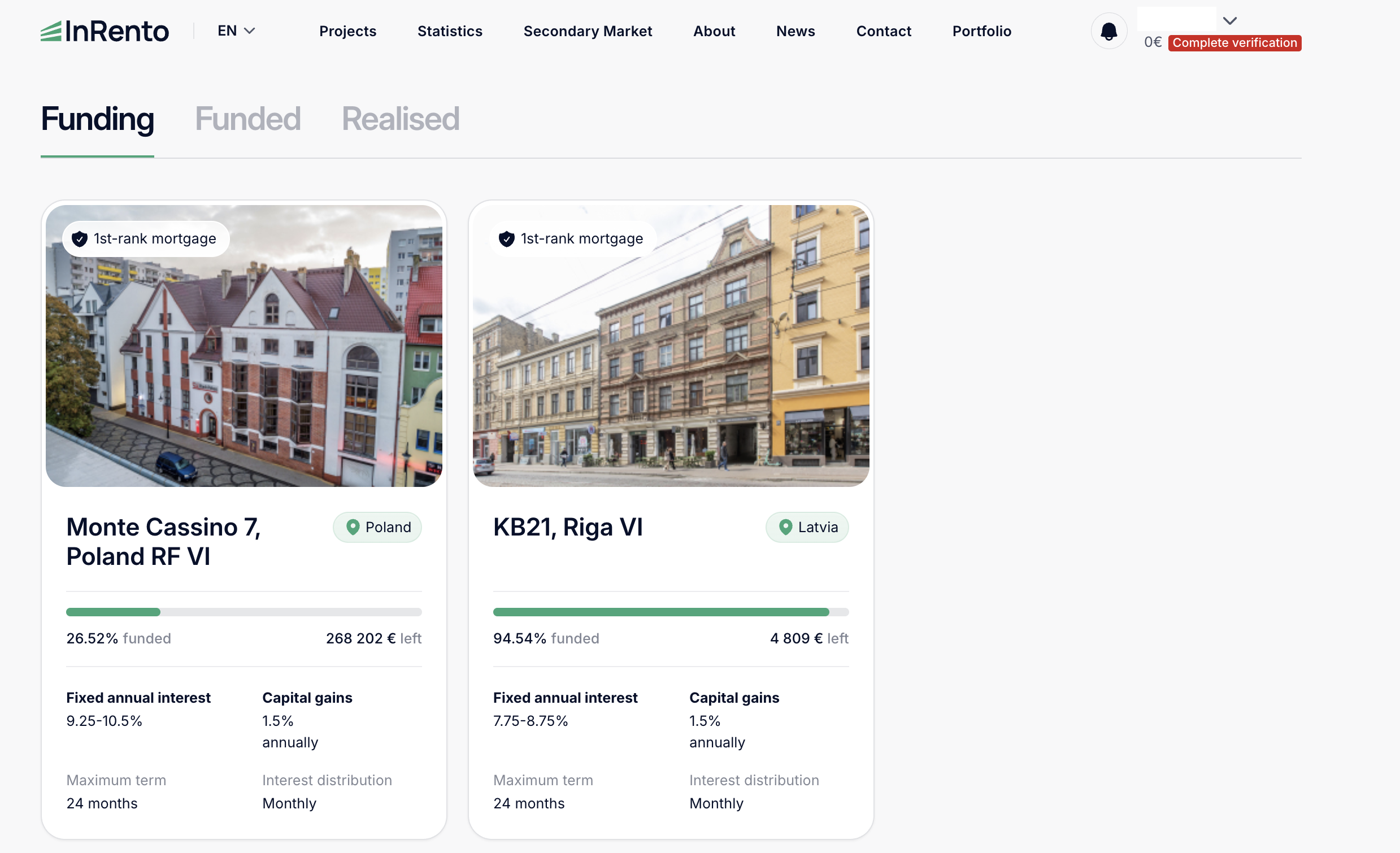
Each card shows the same handful of things, so comparing is easy: how much is funded and how much is left, the fixed yearly interest, an extra yearly gain, the longest the project can run, and how often interest is paid. The two projects differ more than you might expect, though. Monte Cassino 7 in Poland pays 9.25% to 10.5% interest, while KB21 in Riga pays 7.75% to 8.75%, and both add 1.5% a year extra, can run up to 24 months, pay monthly and are backed by a first-ranking mortgage.
A higher rate usually pays for a higher risk, and both of the late projects we cover below are in Poland. We cannot say that is the reason, but it is worth noticing.
Click a card and you land on the project page. This is where you find the photos, an investment deck (a short document explaining the deal), the rate, the extra gain, how many people have already invested and how much is still available. It is also where you type in the amount you want and press Invest. Here is KB21 when we opened it:
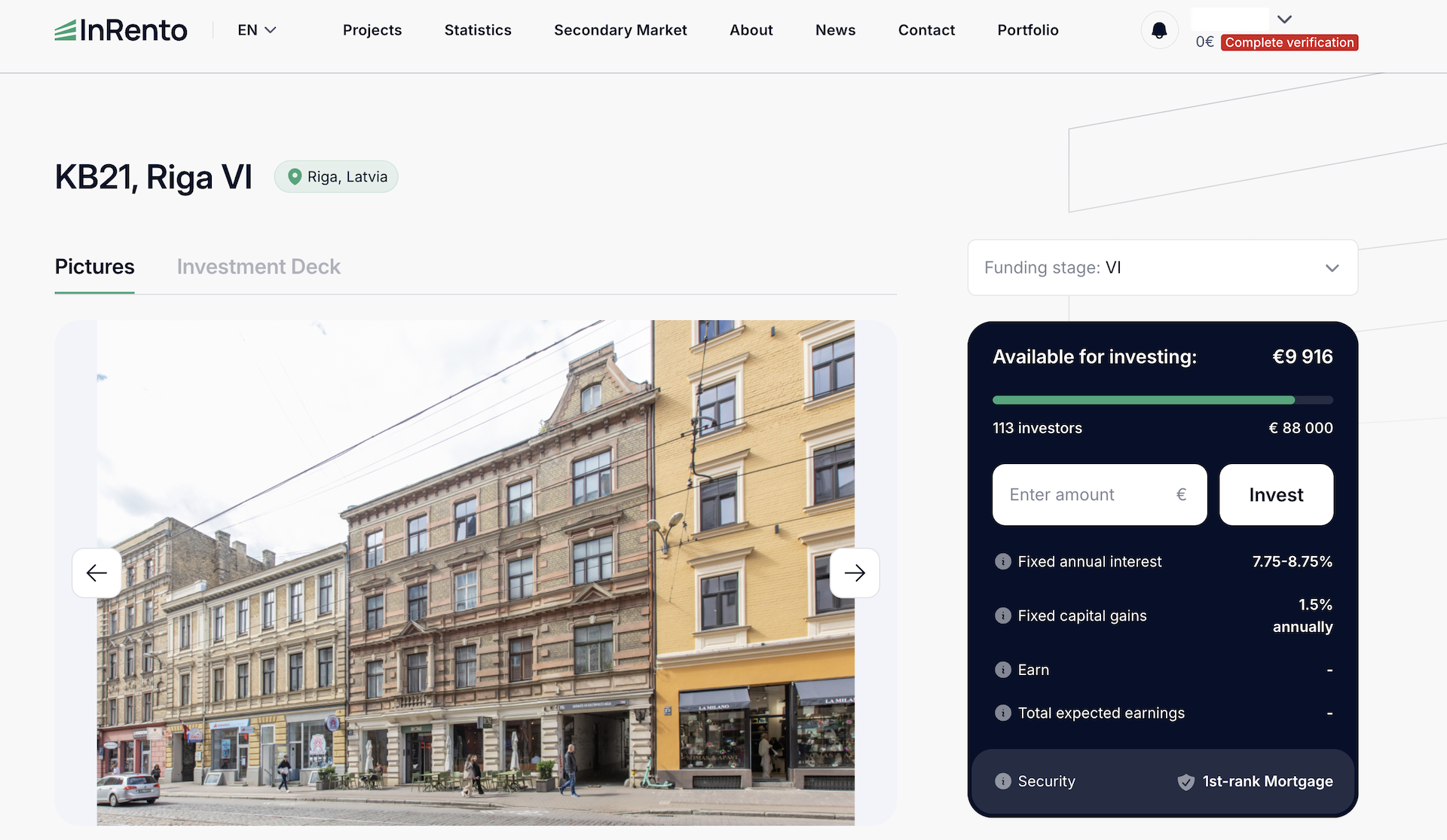
- Total to raise: €88,000, with 113 investors so far
- Funded when we opened it: 88.73%, with €9,916 left
- Fixed annual interest: 7.75–8.75%, paid monthly
- Extra gain: 1.5% a year (the page calls it capital gains)
- Maximum term: 24 months
- Security: first-rank mortgage
Projects also fill up fast: the Funding tab above shows KB21 at 94.54% funded, up from 88.73% when we opened its page. So what happens once you invest?
- You choose a project and invest from €500. Each project has its own rate, length and mortgage.
- Interest starts when your money reaches the project owner. It is paid every month into your InRento wallet.
- At the end, the loan is repaid together with any extra gain.
- The borrowers are real estate companies, not InRento itself.
What does a first-ranking mortgage mean? If the property has to be sold to repay debts, the holder of that mortgage gets paid before anyone else who lent against it. InRento registers the mortgage in its own name on behalf of all the investors in the project, and it says loans do not go above 70% of the property’s value at the start, based on an independent valuation. So, by our arithmetic, the property would have to lose roughly 30% of its value before the mortgage stopped covering the loan. Even so, InRento’s own FAQ says this security does not guarantee full repayment.
The extra 1.5% is the part that confused us. InRento’s FAQ says the extra gain can be fixed or linked to how the project performs, and that it arrives at the end with your capital, but it does not explain how the 1.5% builds up. So we would treat it as a bonus at the end, not as part of the monthly income.
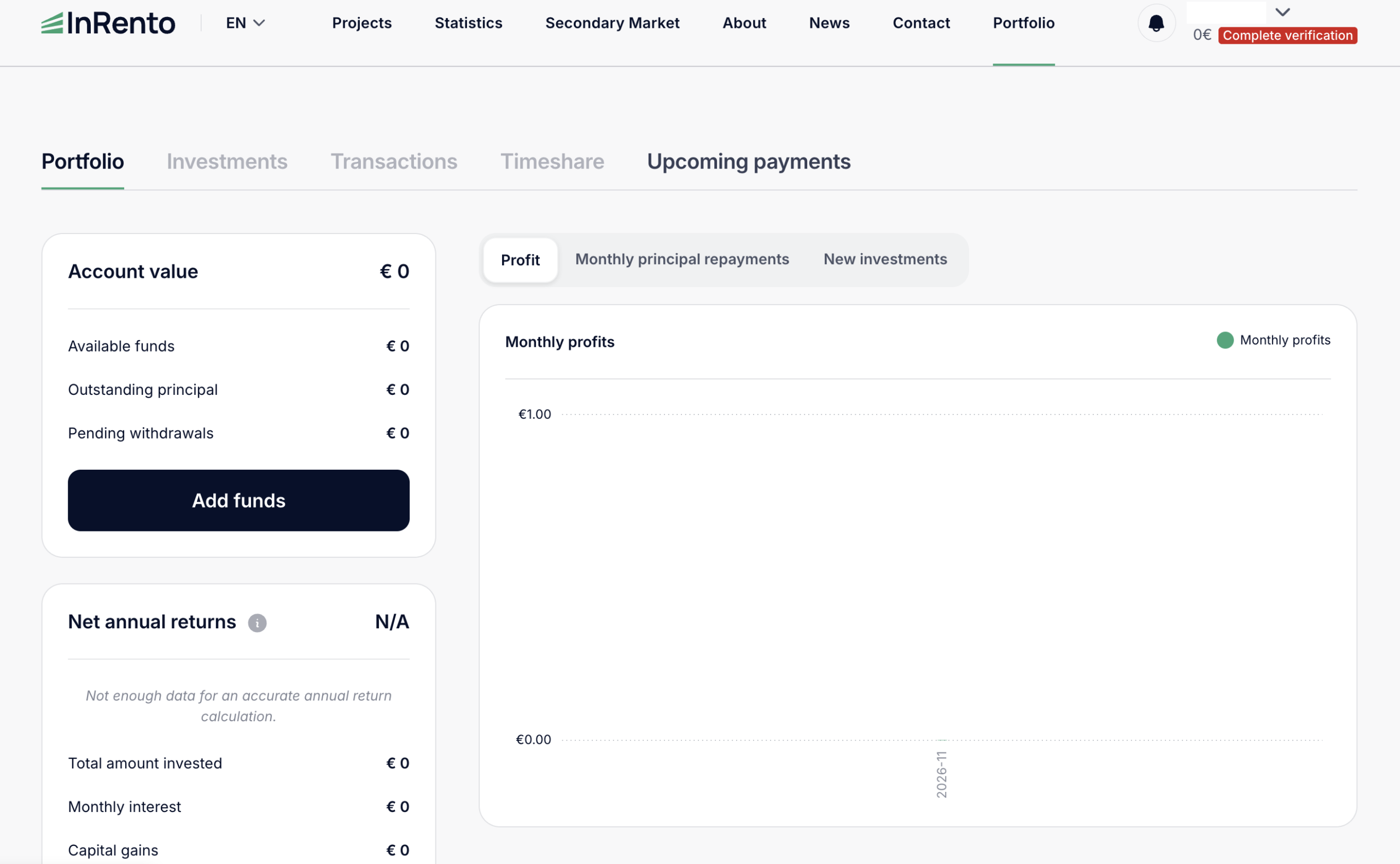
Once you have invested, everything is managed from the Portfolio tab. That is where you see your account value, available funds, outstanding principal (the part of your money still lent out), pending withdrawals, net annual returns, your investments, your transactions and your upcoming payments, plus charts for monthly profit, principal repayments and new investments. Ours is empty because we did not invest, but it shows how the page is laid out, and it looks clean rather than impressive, which suits a site whose job is to show you numbers.
Returns and Platform Performance
Let’s start with what the project cards promise. KB21 pays 7.75% to 8.75% interest plus 1.5% extra at the end, which adds up to about 9.25% to 10.25% a year before fees and tax, if everything is paid on time. Monte Cassino 7 pays 9.25% to 10.5% plus 1.5%, so about 10.75% to 12%. Those sums are our own calculation, and they only work if the extra gain is paid in full.
To see how the platform as a whole has done, InRento also publishes a public statistics page. This is its investor profit chart:
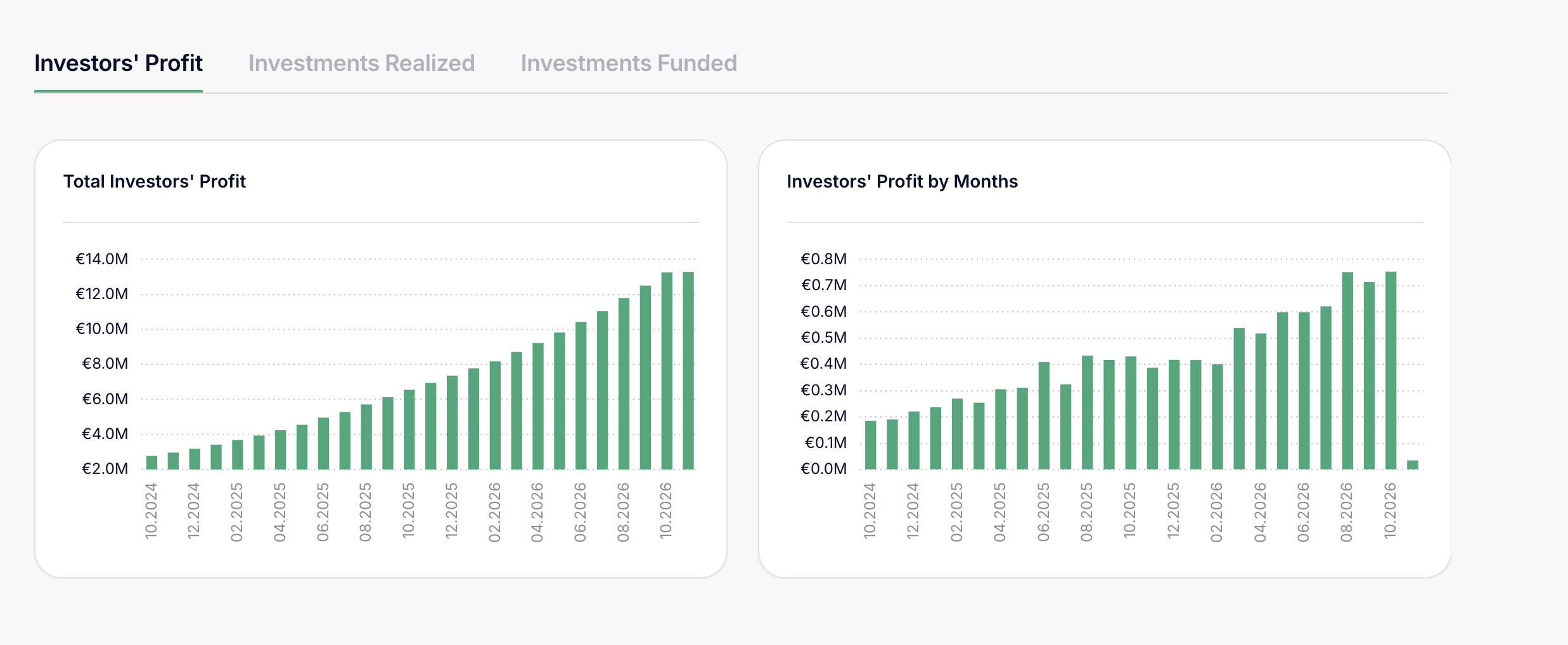
According to InRento, total investor profit is about €13.3M. Monthly profit has climbed from roughly €0.2M in late 2024 to about €0.7M to €0.75M in recent months, which fits a platform that keeps growing its loan book (the total amount it has lent out). InRento’s pages are not always updated together, so totals can differ a little from page to page (its Q1 update says €89.1M funded, its statistics page €137.5M), and it is worth treating any single total as approximate. The last bar is the current month, so it is still small. One warning, though: this chart shows how much investors earned, not how many projects ran into trouble, so read it together with the late-projects section below.
The return numbers you see elsewhere are higher than the project cards, and they depend on who you ask:
| Source | Reported return |
|---|---|
| The project cards we saw | 7.75–10.5% + 1.5% extra |
| Averages on finished projects, quoted by the platform and reviewers | About 11.6–11.8% |
| Independent tracking of what investors received | About 8.8% |
Source: InRento’s project cards and independent reviewers, read in November 2026. Figures are before tax.
So why the gap? The higher figures average over projects that have already finished. The lower one comes from independent tracking of what investors actually received. That means we cannot tell you which number you will get. If you plan around 8% to 9% a year and treat anything above that as a bonus, you are unlikely to be disappointed, but that is our view, not a promise.
One thing can pull your own return below the project rate: money waiting for the next project earns nothing. When we looked at the Funding tab only two projects were open, and projects fill fast, so that wait is realistic. That is our own observation, not a figure from InRento.
Here is a quick example. €1,000 at 8.25%, the middle of KB21’s range, earns €82.50 in interest over twelve months, and after a 15% withholding tax (we explain that below) you keep about €70. The extra gain comes on top. To see what a rate like this is worth after local inflation, try our real return calculator.
Fees
Fees are light for the investor. According to InRento’s price list, opening an account and investing cost nothing. You only pay if you deposit by card through Mangopay, if you sell a loan early, or if your Mangopay account sits unused for a long time.
- Account and investing: none
- Card deposit through Mangopay: 2%
- Selling on the secondary market: 2% of the sale price, paid by the seller
- Mangopay inactivity fee: €30 a year after two years of inactivity
The borrower, not you, pays InRento 3.5% to 9% of the money raised to list a project. That is where the platform earns its money, which means InRento is paid when projects are funded. That is normal for this kind of platform, but it is a good reason to read each project carefully before you invest.
Tax
How much of your interest do you keep? According to independent reviewers, InRento withholds 15% tax on interest for investors who are not Lithuanian residents (withholding means the tax is taken before the money reaches you). InRento’s FAQ says investors from some countries can pay a reduced rate by giving the platform a DAS-1 form and a certificate of residence, but it does not list the rates. So check what applies where you live, and whether you can claim the tax back. We are not tax advisers.
Regulation and Safety: What Protects Your Money
So what protects your money? InRento operates under the EU Crowdfunding Regulation (the EU rules for platforms like this), supervised by the Bank of Lithuania. We checked the official register in November 2026: UAB Inrento holds crowdfunding service provider licence No. 9, issued on 10 November 2023. It covers facilitating loans, running a bulletin board (the place where investors sell loans to each other), suggesting prices and interest rates, and applying credit scores to projects. InRento says client funds are held by the payment provider, Paysera or Mangopay, not by InRento itself. What you do not get is deposit protection, which is the big difference from a bank account, and the mortgage only protects you as far as the property can be sold for what it is worth, and how fast. If safety is your main concern, our guide to the safest P2P platform compares the options.
The Late Projects: What InRento Says and What Others Say
InRento’s homepage says 0% of its projects have defaulted (a default means the borrower has stopped paying and is unlikely to catch up). That is accurate on its own definition, but in October it told investors that two projects are behind on interest. Both are in Poland, like one of the two projects open when we looked. Here is where the sources stand:
| Source | What it says |
|---|---|
| InRento, Q3 2026 investor update (22 October) | Interest payment delays on Harfowa 10 (Warsaw) and J48 (Łódź). Harfowa 10: termination notice in September and possible mortgage enforcement. J48: formal recovery of overdue interest and penalties since 1 October. At 30 September: €0 defaulted principal, €44,007 late interest, €92.8M active portfolio. |
| InRento, statistics page (undated) | 0 of 209 loans defaulted, €0 in recovery, €58,755 late interest (0.06%). |
| An independent reviewer (mid-October) | Calls both projects defaulted under InRento’s own definition, mentions a court application on J48 on 12 October, and puts non-performing loans at about €1.8M of €90.6M, roughly 2%. The figures come from InRento, and the reviewer says it cannot verify them. Late interest rose from about €14,500 in August to about €44,000 in October. |
Late and default dates and amounts as published by each source in October and November 2026.
The key point is that late is not the same as default. InRento counts a payment as late after 14 days, and a loan as defaulted after 90 days past due or when the borrower is unlikely to pay without selling the collateral. So a project can be in trouble for weeks without showing up as a default. One independent reviewer reads the same facts more strictly than InRento does, and the Q3 update does not call either project a default, so we cannot tell you which label is right.
For scale, 2% of the loan book (an independent reviewer’s estimate, based on InRento’s figures) is not large, and the company is acting: a termination notice, formal recovery and possible mortgage enforcement. What matters now is how these end, meaning whether the mortgages cover the principal and how long it takes. InRento’s blog gives one earlier example, a project called M16, where the property sold at a loss and investors still received their principal and interest.
Secondary Market: Getting Out Early
What if you want out early? The secondary market is a bulletin board: you list your loan for sale and another investor can buy it, but there is no guarantee anyone will, and the seller pays 2% of the sale price. When we checked InRento’s page it showed no offers available. Independent reviewers describe the volume as low, and one count found 1,858 trades worth about €1.6M in 2024. Investors above €50,000 can also use a “Grand Sale” to sell in portions.
Before a project is funded, InRento says you can withdraw your offer within 4 calendar days. After that, your money stays lent until the project ends or someone buys your loan. So the rule is simple: only invest money you can leave for the full term, which can be 24 to 36 months.
What Users Say About InRento
What do other investors say? InRento has a small Trustpilot profile, which is worth a look for the pattern more than the score:
Trustpilot figures as of November 2026. About 8% of reviews are one-star, and only 8 reviews are from the last 12 months.
- Interest paid monthly
- An easy interface
- Responsive investor support
- Low minimum investment
- Verification that was hard to complete, with repeated resubmissions
- Slow or unhelpful support in some cases
- One withdrawal stuck for about ten months, and balances that did not add up
Read these with care. It is a small sample, Trustpilot notes that InRento has not invited reviews recently, and the newest review we saw is from July 2026, which is before the news about the late projects. InRento replies to most reviews, and several of the harshest complaints relate to EvoEstate, a platform InRento took over by merger, where one reviewer says old claims were not kept separate in the merged account.
Independent review sites rate InRento well, although two of the three we read were written before the October news about the late projects, so keep that in mind.
What You Need to Start With InRento
What do you need to start? Three things: a valid passport or ID, a phone for the selfie, and money for at least one €500 project. Everything happens online, and it goes like this:
- Check you can register. InRento’s FAQ says any adult or company with a payment account can sign up and does not list excluded countries, but we could not confirm every country, so check before you spend time on it.
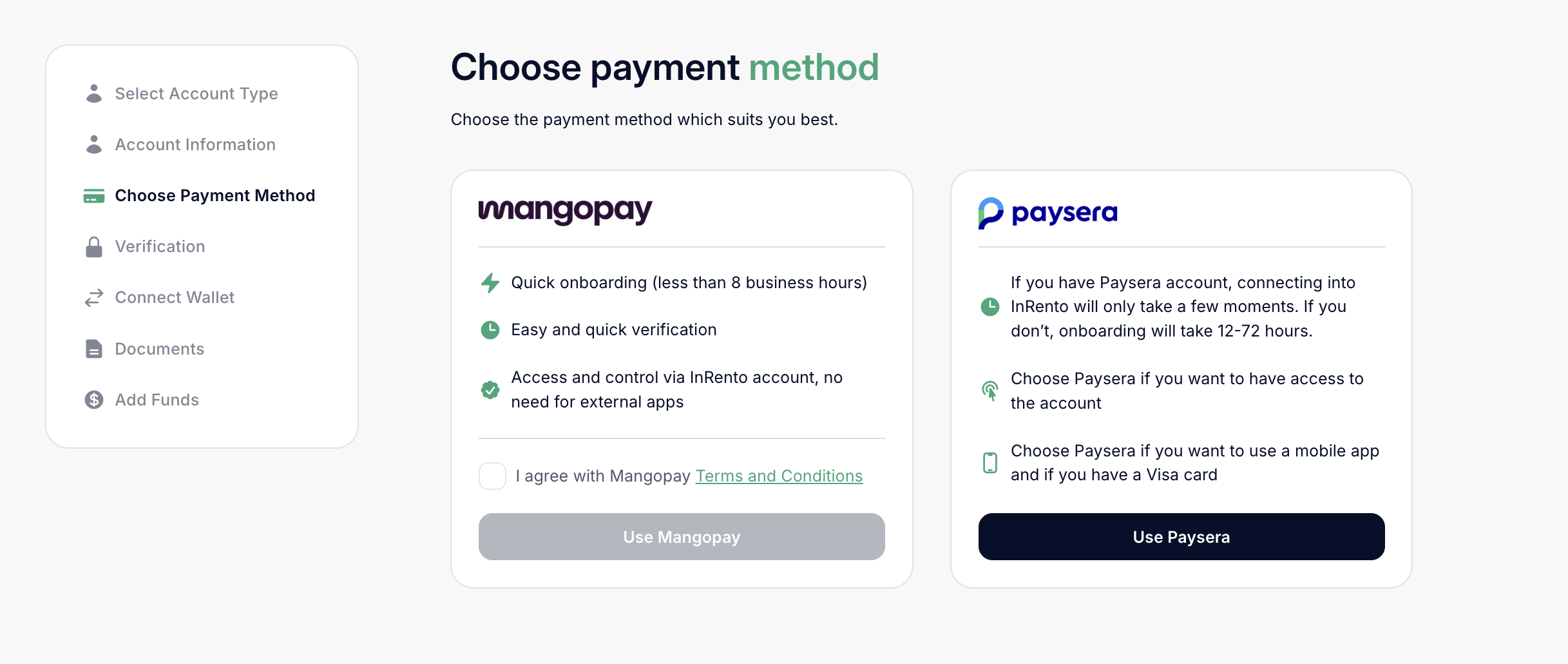
- Work through the seven sign-up steps: account type, your information, payment method, verification, wallet, documents and adding funds.
- Choose a payment provider, Mangopay or Paysera (more below).
- Complete verification. This is the heaviest step, covered next.
- Add funds and start small, with the €500 minimum in one project. Read its page first: the rate, the term, how much is funded and the mortgage.
The verification is the heavy part. It is a full identity check: you photograph your passport or ID, take a selfie and complete a documents step, and it felt like a lot, so allow some time and have everything to hand. Other reviewers say the ID check took them about a minute, while some Trustpilot reviewers describe repeated resubmissions, so experience seems to vary.
You also have to pick a payment provider, and there are only two: Mangopay or Paysera. Mangopay says onboarding takes less than 8 business hours, while Paysera takes a few moments if you already have an account and 12 to 72 hours if you do not, so it suits you best if you want a mobile app and a Visa card.
If you are new to this kind of lending, our P2P lending guide covers the risks and how to build a sensible allocation before you put in more than you would be comfortable losing.
Start with one project at the €500 minimum and read its page before you invest.
Open an InRento Account →Capital at risk. Returns are not guaranteed, projects can be late, and there is no deposit guarantee. We may earn a commission if you sign up.
Who InRento Is For
- Investors who want fixed monthly interest backed by property
- People comfortable lending for one to three years
- Anyone who already has savings and wants a property-backed slice
- Those who prefer a platform licensed under the EU crowdfunding rules
- Anyone who might need the money back quickly
- Anyone who wants deposit protection
- Investors who want automatic diversification (€500 a project means €5,000 for ten)
- Tax-sensitive investors, because of the 15% withholding
InRento vs Mintos, PeerBerry and Go & Grow: Which One?
So, should you go with InRento, or with one of the platforms we have already reviewed? It depends on what you are looking for, so here is the short version.
Go with InRento if you want fixed monthly interest backed by a mortgage on a specific property, you like choosing your own projects, and you can leave the money alone for one to three years.
Go with Mintos if you want your money spread across many loans automatically. It targets 9.1% to 12%+, is regulated under MiFID II (the EU rulebook for investment firms) and has a €20,000 investor compensation scheme. See our Mintos review.
Go with PeerBerry if you want a higher target of 10% to 11% on consumer and business loans, a record of repaying its war-affected loans in full, and a secondary market (a place to sell your loans to other investors) since January 2026. It has no property behind the loans and no EU investment-firm licence. See our PeerBerry review.
Go with Go & Grow if you want the simplest option: up to 6% a year, paid daily, with near-instant withdrawals. It is open to residents of the EU, Norway and Switzerland, but not the UK. See our Go & Grow review.
In short, pick InRento when you want to see exactly what backs your loan and can leave the money alone, and pick one of the others when you need flexibility, daily access or more spread.
The Bottom Line
InRento is a simple, regulated way to earn fixed monthly interest on property-backed loans, at rates near the top of what P2P pays. It is also tied up for the full term, independent tracking shows less than the headline rate, and two of its projects are late. Use it for money you can leave alone, start with one project, and do not treat “no defaults” as a promise.
Compare InRento With
Other platforms we have reviewed that readers often weigh against InRento.
Frequently Asked Questions
Is InRento safe?
It is licensed under the EU Crowdfunding Regulation by the Bank of Lithuania, and each loan is secured by a first-ranking mortgage. But it is not a bank deposit, there is no deposit guarantee, and two projects were late in October 2026. Your capital is at risk. See the safety section.
Has InRento ever had a default?
By its own count, no: its statistics page shows 0 of 209 loans defaulted. But in October 2026 it told investors that interest was late on two Polish projects, and one independent reviewer classes both as defaults under InRento’s own definition. See the late projects.
Can you lose money on InRento?
Yes. A mortgage lowers the risk but does not remove it. If a project fails and the property sells for less than the loan, investors can lose part of their capital. InRento’s FAQ says the security does not guarantee full repayment.
What is the minimum investment?
€500 per project, according to InRento’s FAQ.
How much can I earn with €1,000?
On the two projects we saw, 7.75–10.5% a year is €77.50–€105 in interest over twelve months, before tax. After a 15% withholding tax that is about €66–€89. The extra 1.5% (€15) comes at the end if it is paid in full. Rates differ by project, and none of this is guaranteed. To see what a return is worth after inflation, try our real return calculator.
What return do investors actually get?
The platform and some reviewers quote about 11.6% to 11.8% a year on finished projects. Independent tracking of what investors received found about 8.8%. We would plan around 8% to 9% before tax. See the returns section.
Can I withdraw my money at any time?
No. Your money is lent to a project until it is repaid, which can be 24–36 months. You can withdraw an offer within 4 calendar days on the primary market. After that, the only early exit is selling on the secondary market, which needs a buyer. See the secondary market.
How does the secondary market work?
It is a bulletin board where investors list loans for sale. There is no guaranteed buyer, and the seller pays 2% of the sale price. Reviewers describe volume as low, so plan to hold to the end of the term.
Is InRento regulated?
Yes, as a crowdfunding service provider under the EU Crowdfunding Regulation, supervised by the Bank of Lithuania. That is different from a bank licence, and it does not include deposit insurance.
How is InRento income taxed?
Independent reviews say InRento withholds 15% on interest for non-Lithuanian residents, and the FAQ says a reduced rate may be available with a DAS-1 form and a certificate of residence. Rules differ by country, so check where you live. See the tax section.
Which countries can invest?
InRento’s FAQ says any adult or company with a payment account can register, and it does not list excluded countries. We could not confirm availability for every country, so check at sign-up before you rely on it.
A quick note: if you open an InRento account through our links, we may earn a commission. It does not change our rating or what we write. We went through the platform but did not invest our own money. InRento is not a bank, there is no deposit guarantee, returns are not guaranteed and projects can be late or fail, so only put in what you can afford to leave alone. Figures are as we saw them in November 2026 and may have changed. This is our opinion, not financial advice.