ETFs for Beginners: What They Are, How to Buy One and What They Really Cost
An ETF is a basket of investments you buy like a single share. This guide explains what you actually buy, how the price and quantity work, every fee you pay and how to buy one step by step, wherever in the world you invest.
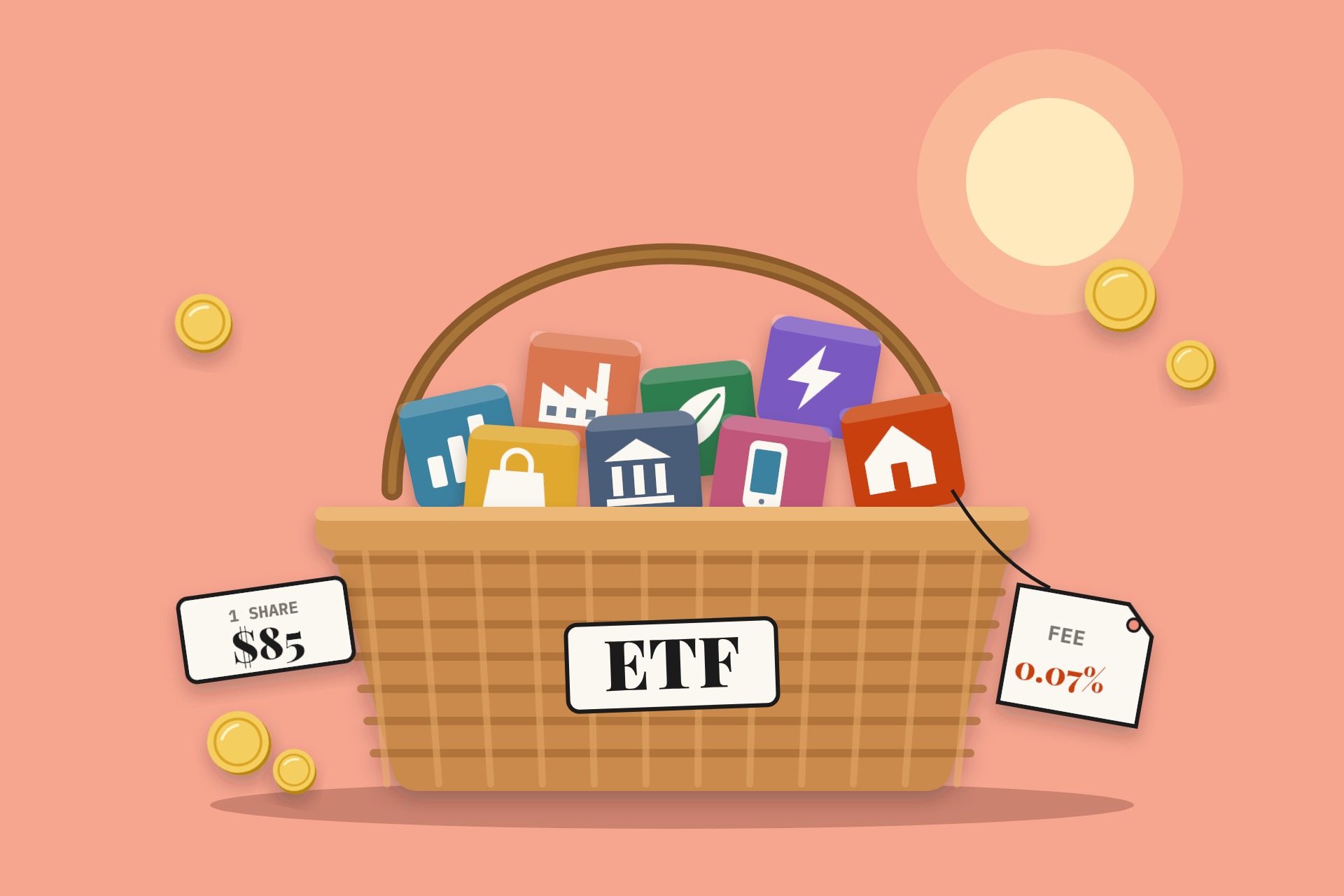

Let me tell you something. I know the markets. I know how to buy a stock, how to size a position, and what leverage does to a trade that goes wrong. And yet ETFs confused me.
Not the idea. The idea is simple enough: a basket of investments you can buy in one click. What confused me was everything around the click. What exactly do I buy? What is the price, and is an ETF at $85 cheaper than one at $500? How many do I buy? And the fees, which seemed to be everywhere and nowhere at the same time. Who charges them, where, and how much?
When I finally worked it out, I realized nobody explains it in the order a beginner needs. So this guide does. It covers what an ETF is, how the price works, what you really pay, how to buy one step by step, and what changes depending on where in the world you live. ETFs trade in 65 countries, so we look beyond one market, though the US is where most of the action is. To skip ahead, try the ETF finder or the ETF cost calculator.
In This Guide
ETF Finder: Find an ETF by Market and Type
Not sure where to start? Tell the finder where you live and what you want to own, and it lists the matching ETFs from a hand-checked list of 53. Each result shows what the ETF holds, what it charges a year and where it is sold. Your home country matters because it decides which ETFs your broker can sell you. If you live in Europe or the UK, choose Europe or UK, because many US ETFs are not offered to everyday investors there.
Choose from the menus and press Find ETFs. The list is a starting point for your own research, not a recommendation.
Fees are the yearly figures published by each issuer (Vanguard, iShares, State Street, Invesco and Schwab), checked in November 2026. Holdings counts are from the same pages. Fees change, so check the issuer’s page before you buy. The same European ETF has a different ticker on each exchange and currency, so confirm the ISIN, the 12-character ID, with your broker.
| VTVanguard Total World Stock ETF | Stocks from around the world, US included10,185 holdings | 0.06% | US |
| VWRL / VWRPVanguard FTSE All-World UCITS ETF | Large and mid-sized companies worldwide, emerging markets included3,574 holdings | 0.14% | Europe and UKVWRL pays out, VWRP reinvests |
| IWDA / SWDAiShares Core MSCI World UCITS ETF | Large and mid-sized companies in developed countries1,249 holdings | 0.20% | Europe and UKReinvests |
| VXUSVanguard Total International Stock ETF | Stocks outside the US8,901 holdings | 0.05% | US |
| VEAVanguard FTSE Developed Markets ETF | Companies in developed countries outside the US3,903 holdings | 0.03% | US |
| VOOVanguard S&P 500 ETF | The 500 largest US companies (S&P 500)505 holdings | 0.03% | US |
| IVViShares Core S&P 500 ETF | The 500 largest US companies (S&P 500)505 holdings | 0.03% | US |
| SPYSPDR S&P 500 ETF Trust | The 500 largest US companies (S&P 500)504 holdings | 0.09% | US |
| VTIVanguard Total Stock Market ETF | The whole US stock market, from large to small companies3,519 holdings | 0.03% | US |
| CSPX / SXR8iShares Core S&P 500 UCITS ETF | The 500 largest US companies (S&P 500)504 holdings | 0.07% | Europe and UKReinvests |
| VUSA / VUAAVanguard S&P 500 UCITS ETF | The 500 largest US companies (S&P 500)504 holdings | 0.07% | Europe and UKVUSA pays out, VUAA reinvests |
| QQQInvesco QQQ Trust | About 100 of the largest non-financial companies on the NasdaqAbout 100 holdings | 0.18% | US |
| EQQQInvesco EQQQ Nasdaq-100 UCITS ETF | About 100 of the largest non-financial companies on the Nasdaq102 holdings | 0.30% | Europe and UKPays out |
| XLKTechnology Select Sector SPDR ETF | US technology companies from the S&P 50076 holdings | 0.08% | US |
| VUGVanguard Growth ETF | Large US companies expected to grow faster than the market135 holdings | 0.03% | US |
| SCHGSchwab US Large-Cap Growth ETF | Large US companies expected to grow faster than the market189 holdings | 0.04% | US |
| SOXXiShares Semiconductor ETF | 30 large US-listed chip companies30 holdings | 0.33% | US |
| VWOVanguard FTSE Emerging Markets ETF | Companies in emerging markets such as China, India and Brazil6,507 holdings | 0.06% | US |
| EIMIiShares Core MSCI EM IMI UCITS ETF | Companies of all sizes in emerging markets2,952 holdings | 0.18% | Europe and UKReinvests |
| VFEMVanguard FTSE Emerging Markets UCITS ETF | Large and mid-sized companies in emerging markets2,304 holdings | 0.17% | Europe and UKPays out |
| VGKVanguard FTSE Europe ETF | Companies in developed Europe, UK included1,243 holdings | 0.06% | US |
| VEURVanguard FTSE Developed Europe UCITS ETF | Large and mid-sized companies in developed Europe, UK included507 holdings | 0.10% | Europe and UKPays out |
| ISFiShares Core FTSE 100 UCITS ETF | The 100 largest companies listed in London (FTSE 100)101 holdings | 0.07% | Europe and UKPays out |
| EWJiShares MSCI Japan ETF | Large and mid-sized Japanese companies167 holdings | 0.49% | US |
| SJPA / IJPAiShares Core MSCI Japan IMI UCITS ETF | Japanese companies of all sizes928 holdings | 0.12% | Europe and UKReinvests |
| INDAiShares MSCI India ETF | Large and mid-sized Indian companies165 holdings | 0.61% | US |
| NDIAiShares MSCI India UCITS ETF | Large and mid-sized Indian companies165 holdings | 0.65% | Europe and UKReinvests |
| MCHIiShares MSCI China ETF | Large and mid-sized Chinese companies577 holdings | 0.59% | US |
| VBVanguard Small-Cap ETF | Smaller US companies1,301 holdings | 0.03% | US |
| WLDS / IUSNiShares MSCI World Small Cap UCITS ETF | Smaller companies in developed countries3,591 holdings | 0.35% | Europe and UKReinvests |
| XLVHealth Care Select Sector SPDR ETF | US health care companies from the S&P 50061 holdings | 0.08% | US |
| XLEEnergy Select Sector SPDR ETF | US energy companies from the S&P 50021 holdings | 0.08% | US |
| XLFFinancial Select Sector SPDR ETF | US banks and financial companies from the S&P 50076 holdings | 0.08% | US |
| IUHCiShares S&P 500 Health Care Sector UCITS ETF | US health care companies from the S&P 50061 holdings | 0.15% | Europe and UKReinvests |
| IUESiShares S&P 500 Energy Sector UCITS ETF | US energy companies from the S&P 50021 holdings | 0.15% | Europe and UKReinvests |
| IUFSiShares S&P 500 Financials Sector UCITS ETF | US banks and financial companies from the S&P 50076 holdings | 0.15% | Europe and UKReinvests |
| SCHDSchwab US Dividend Equity ETF | 100 US companies with strong dividend records102 holdings | 0.06% | US |
| VYMVanguard High Dividend Yield ETF | US companies that pay higher dividends593 holdings | 0.04% | US |
| VIGVanguard Dividend Appreciation ETF | US companies that have raised their dividends for years333 holdings | 0.04% | US |
| VHYLVanguard FTSE All-World High Dividend Yield UCITS ETF | Companies worldwide that pay higher dividends2,432 holdings | 0.29% | Europe and UKPays out |
| BNDVanguard Total Bond Market ETF | US government and company bonds11,000+ holdings | 0.03% | US |
| AGGiShares Core US Aggregate Bond ETF | US government and company bonds13,546 holdings | 0.03% | US |
| AGGGiShares Core Global Aggregate Bond UCITS ETF | Government and company bonds from around the world19,976 holdings | 0.10% | Europe and UKPays out |
| VAGSVanguard Global Aggregate Bond UCITS ETF (GBP hedged) | Government and company bonds worldwide, hedged to pounds12,757 holdings | 0.08% | Europe and UKReinvests |
| IEFiShares 7-10 Year Treasury Bond ETF | US government bonds that mature in 7 to 10 years | 0.15% | US |
| SHYiShares 1-3 Year Treasury Bond ETF | US government bonds that mature in 1 to 3 years89 holdings | 0.15% | US |
| TIPiShares TIPS Bond ETF | US government bonds that rise with inflation48 holdings | 0.18% | US |
| IBTMiShares $ Treasury Bond 7-10yr UCITS ETF | US government bonds that mature in 7 to 10 years13 holdings | 0.07% | Europe and UKPays out |
| IBTSiShares $ Treasury Bond 1-3yr UCITS ETF | US government bonds that mature in 1 to 3 years93 holdings | 0.07% | Europe and UKPays out |
| VNQVanguard Real Estate ETF | US real estate companies139 holdings | 0.13% | US |
| GLDSPDR Gold Shares | Physical gold bars | 0.40% | US |
| IAUiShares Gold Trust | Physical gold bars | 0.25% | US |
| IGLN / SGLNiShares Physical Gold ETC | Physical gold bars. An ETC, not a UCITS fund | 0.12% | Europe and UKNo income |
What Is an ETF?
An ETF, short for exchange-traded fund, is a fund that holds a collection of investments, such as stocks or bonds, and is bought and sold on a stock exchange like a single share. Buy one share of an S&P 500 ETF and you own a tiny slice of about 500 of the largest US companies, in one purchase.
Fund, explained. A fund pools money from many investors and uses it to buy a basket of assets. Each investor owns a share of the pool, so you get the basket without having to buy every item in it yourself.
Most ETFs follow an index. Index, explained. An index is a list of companies or bonds put together by a data company, such as the S&P 500 (500 large US companies) or MSCI World (large companies across developed countries). An index ETF simply buys whatever is on the list. It needs no star fund manager choosing winners, which is why it can be so cheap.
That mix of simplicity and low cost is why ETFs have gone mainstream. According to the data firm ETFGI, global ETF assets stood at $23.91 trillion at the end of September 2026, spread across 17,989 ETFs listed on 83 exchanges in 65 countries. People also poured a record $2.24 trillion into ETFs in the first nine months of the year. In other words, whichever country you live in, you are very likely to meet an ETF.
An ETF is a basket of investments that you buy in one go, priced and traded like a share. Most simply copy an index.
How Does an ETF Actually Work?
An ETF has two prices, and it helps to know the difference. The first is the net asset value (NAV), which is the value of everything the fund holds, divided by the number of ETF shares in existence. The second is the market price, which is what you actually pay when you buy on the exchange. The two are usually very close, but the US Securities and Exchange Commission (SEC) points out that the market price can sit slightly above or below NAV, so you may pay a little more or get a little less than the basket is worth.
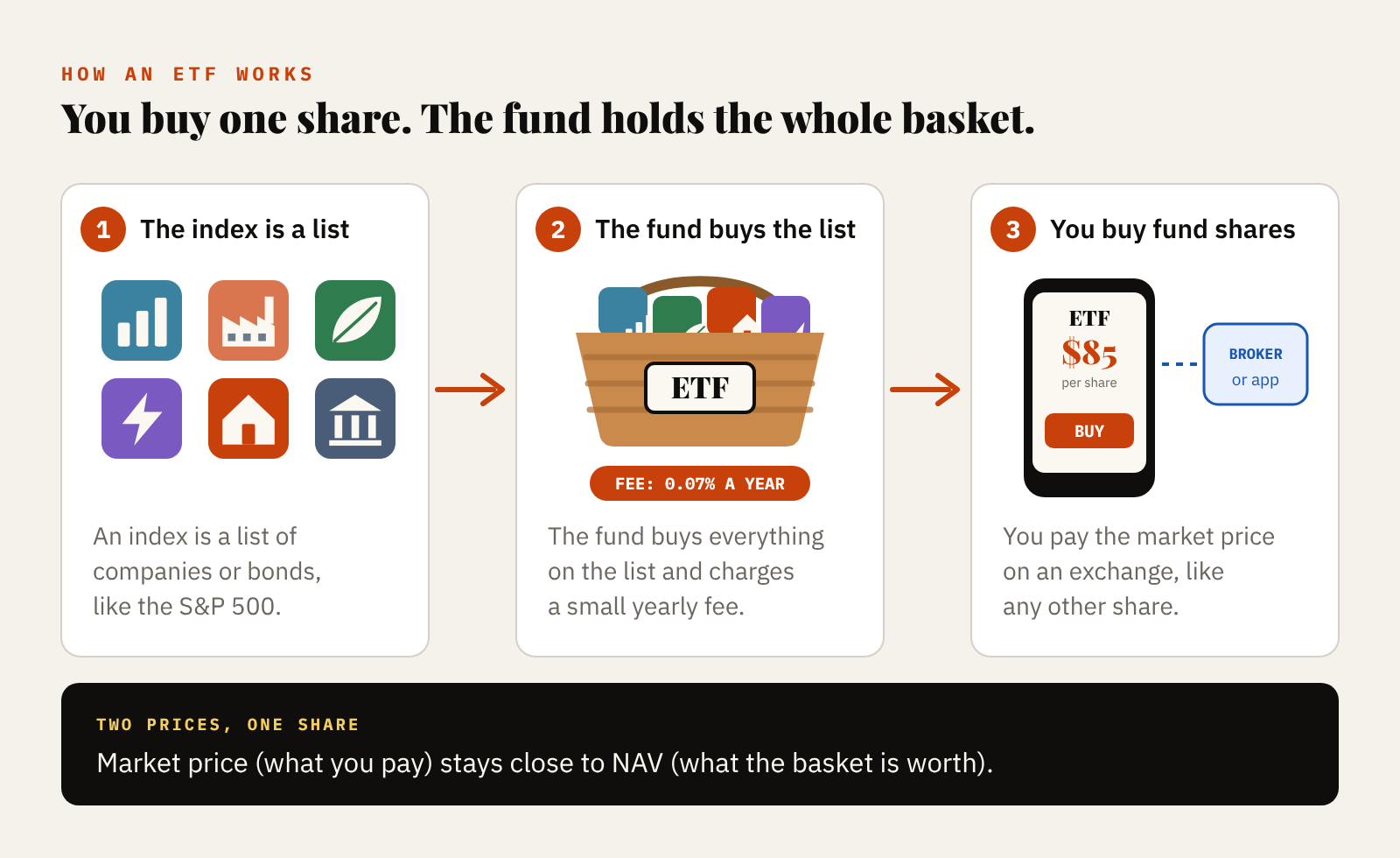
What keeps them close? Large financial firms called authorized participants can create new ETF shares by handing the fund the underlying assets, or cash them in by handing shares back. If the ETF price drifts too far from its NAV, they step in and make a small profit by closing the gap, which pulls the price back. You will never see this happening, but it is the reason an ETF trades close to what it holds.
Because an ETF trades on an exchange, you can buy or sell it at the market price whenever the exchange is open, just like a stock. That is different from a traditional mutual fund, which is usually priced once a day after the market closes.
The company that runs the fund is called the issuer. Three of them dominate: iShares, Vanguard and State Street SPDR together hold 58.3% of all global ETF assets, according to ETFGI at the end of September 2026. A big issuer is not automatically better, but it does mean there is plenty of choice, and the biggest funds tend to be the easiest to trade.
What Is the Price, and How Many Do You Buy?
This was the question that stopped me, so let me answer it plainly. The price of an ETF share is just the fund’s value divided by the number of shares the issuer chose to create. It tells you nothing about whether the ETF is cheap or expensive. An ETF at $85 a share is not a bargain compared with one at $500. What matters is what it holds and what it charges, not the price of one share.
So how many do you buy? Divide the amount you want to invest by the share price, and round down to a whole number, unless your broker allows fractional shares, which let you buy a slice of a share. Here is what $1,000 looks like:
| Share price | Whole shares you can buy | Money invested | Cash left over |
|---|---|---|---|
| $85 | 11 | $935 | $65 |
| $500 | 2 | $1,000 | $0 |
| $500, with fractional shares | 2.00 | $1,000 | $0 |
In both cases you own $1,000 worth of the same sort of basket. Fractional shares are common at US brokers and are becoming more common elsewhere, but not every broker offers them, so check before you pick one if you plan to invest small amounts regularly.
One more thing from the trading side. When you place an order you can choose a market order, which buys right away at the best available price, or a limit order, which sets the highest price you are willing to pay. For ETFs that trade less often, a limit order protects you from paying more than you meant to. The gap between buying and selling prices, called the spread, also tends to be widest right after the market opens, so many investors wait a little before placing an order.
Types of ETFs
Not all ETFs are the same, and the label does not tell you how risky one is. Some hold the whole market and some hold a single idea. Here are the main types.
| Type | What it holds | Often used for | Main thing to watch |
|---|---|---|---|
| Broad index | A whole market, such as the S&P 500 or the world’s large companies | The core of a long-term portfolio | Falls when the market falls |
| Bond | Government or company bonds | Income and a steadier ride | Prices fall when interest rates rise |
| Sector or thematic | One slice, such as technology, clean energy or AI | Backing a specific idea | Concentrated, so swings can be large |
| Commodity | Gold, oil or other raw materials, held directly or through futures | Diversifying away from shares | Pays no income, structure varies |
| Actively managed | Whatever a manager chooses | Trying to beat an index | Higher fees, no guarantee of beating it |
| Leveraged and inverse | Contracts that aim for 2x or 3x, or the opposite, of one day’s index move | Short-term trading | Resets daily, not for holding |
If you already trade with leverage, be careful here, because a leveraged ETF is not the same as borrowing to buy more. It resets every day, so over longer periods the result can drift far from what you expect. The SEC and FINRA, the US brokers’ regulator, gave an example in their investor alert: over four months an index rose 2%, yet a 2x leveraged ETF on it fell 6% and a 2x inverse ETF fell 25%. They describe these products as generally not suitable for buy-and-hold investors.
Accumulating and distributing, explained. Funds earn dividends or interest from what they hold. A distributing ETF pays that out to you as cash. An accumulating ETF reinvests it inside the fund, so the price creeps up instead. US ETFs mostly distribute, while accumulating versions are common in Europe. Neither is better, but the choice changes how and when you are taxed in many countries.
Physical and synthetic, explained. A physical ETF buys the actual shares or bonds in its index. A synthetic ETF, which is mainly found in Europe, uses a contract with a bank to deliver the index return instead. Physical is easier to understand, and you should read the fund’s documents before buying a synthetic one.
Bond ETFs, explained. A bond ETF holds loans to governments or companies and pays you the interest. Its price usually moves the opposite way to interest rates, which is the “watch” in the table above. To compare bond funds side by side, try our fixed income fund screener, and to see what governments around the world currently pay, see our global bond yields page.
ETFs vs Stocks and Mutual Funds
People often ask how an ETF differs from the things they already know. Think of it as sitting between a single stock and a traditional fund.
| ETF | Single stock | Mutual fund | |
|---|---|---|---|
| What you own | A slice of a basket | A slice of one company | A slice of a basket |
| How you buy | On an exchange, any time it is open | On an exchange, any time it is open | Through the fund company, priced once a day |
| Diversification | Built in | None | Built in |
| Fund fee | Yes, the expense ratio | None | Yes, often higher for active funds |
| Trading costs | Spread, and maybe commission | Spread, and maybe commission | Usually none to buy, but some charge |
An index fund is simply a fund, either an ETF or a mutual fund, that follows an index. So an index ETF and an index mutual fund can track exactly the same list of companies. The difference is how you buy them and what they cost, which brings us to the part that confused me most.
ETF Fees: What You Actually Pay
Cost is one of the most important parts of holding an ETF. Most people choose an ETF because it is cheap, and the fee comes out of your money every year, whether the fund rises or falls. Over decades that adds up, which is why what an ETF costs matters almost as much as what it holds.
Tax is the other reason some investors pick ETFs. In the US, ETFs can be more tax-efficient than traditional mutual funds. The SEC explains that many ETFs swap assets in kind instead of selling them for cash, which typically means fewer capital gains payouts, so you often owe less tax along the way. That is mostly a delay in tax rather than an escape from it, and it makes no difference inside a retirement account such as an IRA or 401(k). In Europe, many investors choose accumulating ETFs, which reinvest dividends instead of paying them out, and in several countries ETFs can sit inside a tax-advantaged account such as an ISA in the UK. How all of this is taxed depends on your country, so check your own rules.
The reason ETF fees feel confusing is that there is no single fee. Your total cost is built from several layers, charged by different companies in different places. Here they all are.
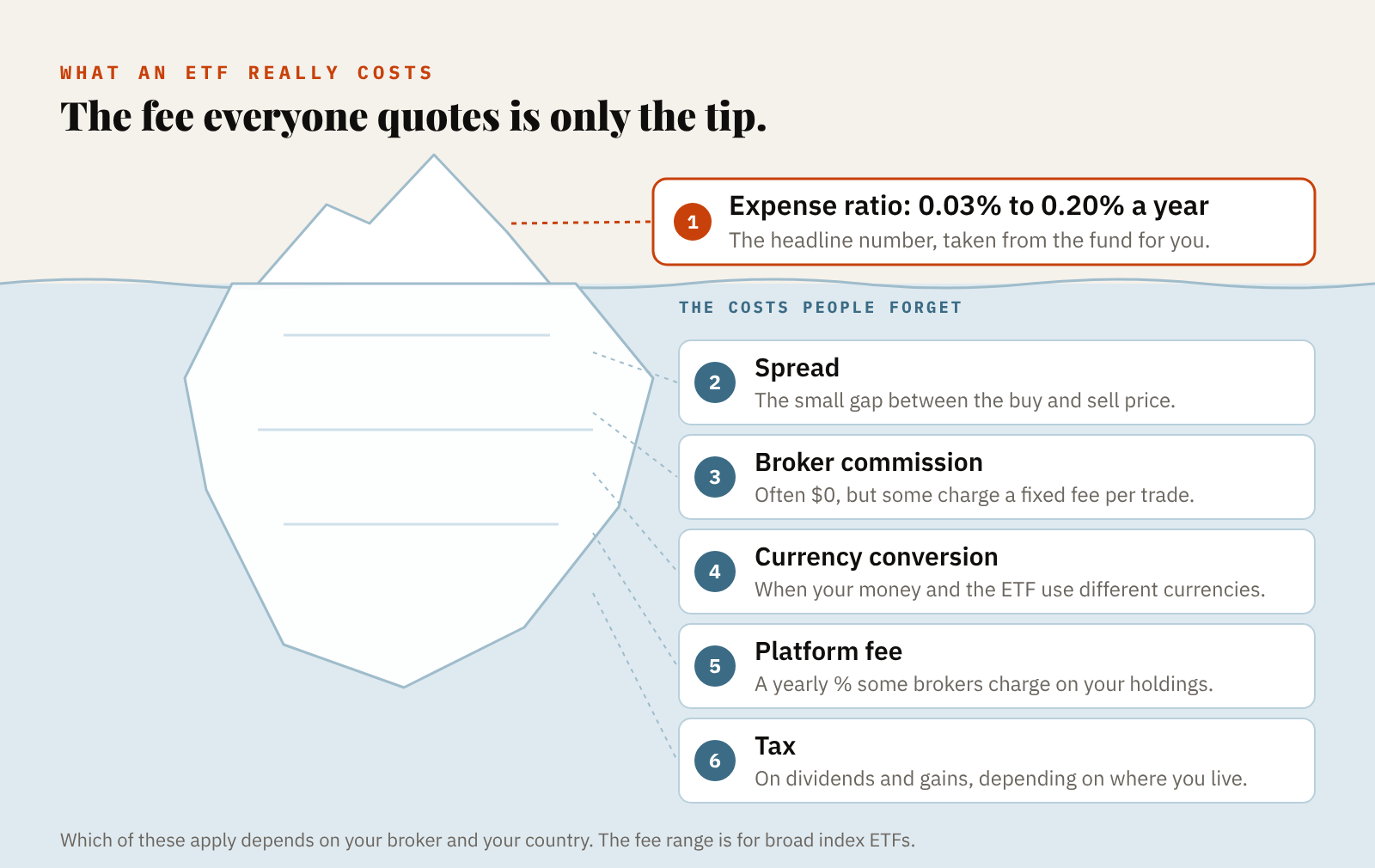
The iceberg shows the idea: only the first cost is quoted up front, and the rest depend on who you buy through and where you live. The table below breaks each layer down, with who charges it and where to look it up, so you can check every one yourself before you buy.
| Cost | What it is | Who charges it | Where to find it |
|---|---|---|---|
| Expense ratio | A yearly percentage taken from the fund’s value to run it. Called TER in Europe and MER in Canada | The ETF issuer | The fund’s factsheet or key information document |
| Spread | The gap between the buy and sell price. You pay it each time you buy or sell | The market | Live on your broker’s screen |
| Commission | A fee per trade, either a fixed amount or a percentage. Many brokers charge none | Your broker | The broker’s fee page |
| Currency conversion | A charge to swap your money into the ETF’s currency | Your broker | The broker’s fee page |
| Platform fee | A yearly percentage or flat fee for holding your investments | Your broker | The broker’s fee page |
| Tracking difference | How far the ETF’s return lags its index, which includes the expense ratio | No one, it is a result | The fund’s annual report |
| Tax | Tax on dividends and gains, including tax taken at source on foreign dividends | Governments | Your local tax rules |
The expense ratio is the one everyone focuses on, so let us put a size on it. A fee of 0.03% costs $3 a year on every $10,000 you hold, while 0.75% costs $75. Two of Vanguard’s biggest US index ETFs, VOO and VTI, charge about 0.03%, according to a July 2026 comparison of the firm’s own figures. Published fee tables from brokers in October 2026 put broad index ETFs at roughly 0.03% to 0.20% for US-listed funds and 0.07% to 0.25% for Ireland-based funds sold across Europe. Thematic and actively managed ETFs often charge several times that.
That gap looks tiny in any single year, but the SEC reminds investors that even small differences in fees can add up to large differences in returns over time, because fees come out every year on a balance that is supposed to be growing. As a quick example from our own calculator below, $5,000 invested now plus $200 a month for 20 years, with a steady 6% return before costs, grows to about $106,200 in an ETF charging 0.07% and about $100,700 in one charging 0.50%. That is a difference of about $5,500, from fees alone. The return is our own assumption, not a forecast.
There is no single ETF fee. Add up the expense ratio, the spread, your broker’s charges and any currency fee, because the cheapest fund can cost you more if the broker takes a big cut around it.
ETF Cost Calculator: What Will Fees Really Cost You?
Our ETF cost calculator takes two ETFs that earn the same return before costs and shows what a fee gap does to your money over time. It also lets you add the costs people usually forget: the spread, a broker commission, a currency conversion fee and a platform fee.
To use it, enter what you plan to invest and for how long, then the yearly fee of each ETF. Under the extra assumptions you can add your broker’s charges. Try setting the pricier ETF to 0.20%, 0.50% and 0.75% to see how quickly the gap grows. If your broker charges a fixed commission on every purchase, add it and watch what it does to a plan of small monthly top-ups.
Compare two ETFs that hold the same thing but charge different fees, and see what the difference costs you over time. Results update as you type.
More assumptions (trading costs and platform fee)
ETF A leaves you about $5,491 better off after 20 years.
Same investment, same return before costs. The only difference is a fee gap of 0.43% a year, which costs ETF B about $5,491 more over the period.
- Fund fee on $10,000 invested, per year$7 vs $50
- Total paid in$53,000
- Value with no costs at all$107,165
- Costs over 20 years, A vs B$979 vs $6,470
- Share of your growth lost to costs, A vs B1.8% vs 11.9%
Year-by-year table
| Year | You have paid in | ETF A | ETF B |
|---|---|---|---|
| 1 | $7,400 | $7,769 | $7,742 |
| 2 | $9,800 | $10,705 | $10,638 |
| 3 | $12,200 | $13,815 | $13,692 |
| 4 | $14,600 | $17,109 | $16,915 |
| 5 | $17,000 | $20,599 | $20,315 |
| 6 | $19,400 | $24,296 | $23,902 |
| 7 | $21,800 | $28,212 | $27,686 |
| 8 | $24,200 | $32,360 | $31,679 |
| 9 | $26,600 | $36,754 | $35,891 |
| 10 | $29,000 | $41,409 | $40,334 |
| 11 | $31,400 | $46,339 | $45,023 |
| 12 | $33,800 | $51,562 | $49,968 |
| 13 | $36,200 | $57,095 | $55,186 |
| 14 | $38,600 | $62,956 | $60,691 |
| 15 | $41,000 | $69,165 | $66,499 |
| 16 | $43,400 | $75,741 | $72,626 |
| 17 | $45,800 | $82,708 | $79,090 |
| 18 | $48,200 | $90,088 | $85,910 |
| 19 | $50,600 | $97,905 | $93,105 |
| 20 | $53,000 | $106,186 | $100,695 |
How the calculator works and what it assumes
We grow your money month by month at the return you enter, then take costs off in four places. We run it twice, once for each ETF, and once more with no costs at all so we can show how much the costs took.
- Expense ratio. The yearly fee the fund charges, shown as a percentage. It is taken out of the fund’s value a little each day, so we subtract it from your return.
- Spread. The small gap between the price you pay to buy and the price you could sell at. We charge it once on every purchase, including each monthly top-up.
- Commission and currency conversion. Any fixed fee your broker charges per trade, and any percentage it charges to convert your money into the ETF’s currency. Many brokers charge nothing for one and something for the other, so check both.
- Platform fee. A yearly percentage some brokers charge on everything you hold. We take it off monthly.
What it assumes and leaves out:
- One steady return. We use a single yearly return before costs, so both ETFs earn the same. Real returns rise and fall, and a single bad year can change the picture. The default of 6% is our own illustration, not a forecast.
- The two ETFs differ only in fees. In real life a pricier ETF may track a different index or hold different assets. This tool isolates the cost, so it shows what a fee gap alone does to the same investment.
- Tracking difference. How far an ETF’s actual return falls behind its index can be larger or smaller than the expense ratio. We do not model it separately.
- Selling costs and tax. We assume you hold and do not sell. Selling usually costs a spread and possibly commission again, and tax on gains or dividends depends on where you live. Neither is included.
- Currency moves. We use the symbol you pick for display only. If you buy an ETF priced in another currency, exchange-rate moves can raise or lower your result and are not modelled.
An illustration, not a forecast or financial advice. Investments can fall as well as rise, and you can get back less than you put in.
Fees are only one drag on your money. Inflation is another, because prices rise while your money sits invested. Our real return calculator shows what your gains are worth after inflation, and our savings growth calculator lets you test how regular monthly saving adds up over time.
How to Buy an ETF: Three Ways
Where you buy decides what you pay and what you own. There are three ways: an investment app, a brokerage account, or a CFD broker. The first two buy the real ETF for you on the stock exchange, so you own it. The third does not. Below is how each one works, with two examples of each. Fees and plans change, so confirm them on the provider’s own page for your country, and note that none of these is available everywhere.
Way 1: Investment app
An investment app is the easiest way in. You open an account on your phone, add money and buy the ETF through the app, usually with no commission. You own the ETF, so you pay its yearly fee, but any dividends it pays are paid to you. The catch is usually currency conversion and limits on free trades. It suits beginners investing small amounts.
eToro
A social investing app with no commission on ordinary ETF purchases. Short and leveraged positions are CFDs, so check your order screen. Currency conversion is the fee to watch.
Revolut
A banking app with investing built in and no custody fees. Free trades depend on your plan and country, so check your plan table.
Way 2: Brokerage account
A brokerage account is the traditional route. The broker places your order on the stock exchange and holds the ETF in your name. Many banks offer the same thing through their share dealing service, often called a dealing room, but their commissions can be higher, so compare before you use one. You own the ETF, pay its fee plus the broker’s charges, and receive dividends if the ETF pays any. It suits people who want more markets or lower costs.
Interactive Brokers
A full broker with access to many stock exchanges and no account minimum. The $0 Lite plan is for US residents. Elsewhere, Pro charges per share.
EXANTE
A broker built for professionals that also takes individuals. No custody fees on ETFs, but you need 10,000 EUR to start. Not open to US residents.
Way 3: CFD broker
A CFD broker is the alternative. A contract for difference pays or charges you the change in the ETF’s price, so you never own the ETF. You are trading its price, usually with borrowed money, which magnifies losses as well as gains. Some brokers credit or charge a dividend adjustment instead of paying you a dividend, and the amount depends on the broker. It is a short-term trading tool, not a way to hold an ETF for years.
Pepperstone
The CFD broker we would look at first. You trade the ETF’s price, own nothing and pay overnight financing. Its own warning says 73.6% to 76.1% of retail accounts lose money.
NAGA
A CFD broker that offers ETFs in its apps. You own nothing and pay overnight swaps. Its own warning says 77.41% of retail accounts lose money. EEA only, not for US residents.
If you buy the ETF itself, through an app, a broker or a bank, the steps are the same almost everywhere. Here is the order I would follow.
- Decide what the money is for. ETFs can fall in value, so they suit money you will not need for several years. Money for next year’s rent belongs in cash.
- Open an account with an app or a broker. Check whether your country has a tax-advantaged account for investing, such as an ISA in the UK, an IRA or 401(k) in the US or a TFSA in Canada. Using one can save tax, so it is worth checking before you open an ordinary account.
- Fund the account. A bank transfer is usually free. If you send a different currency from your account’s currency, watch for a conversion fee here too.
- Find the ETF. Search by its ticker, a short code such as VOO, or by its ISIN, a 12-character international ID. Check the exchange and the currency as well, because the same ETF can be listed on several exchanges in different currencies, with different spreads.
- Check three numbers. Look at the expense ratio, the size of the fund (bigger is generally easier to trade) and the spread. If the spread looks wide, try a more popular ETF on the same index.
- Work out how many to buy. Divide your amount by the share price, as in the table earlier, or use fractional shares if your broker offers them.
- Place the order. Use a limit order if you want to control the price you pay. Check the total, including any commission, and confirm. Make sure the order is for the ETF itself and not a CFD.
- Set up regular investing and leave it alone. Many brokers let you buy automatically each month. Investing a fixed amount on a schedule spares you from guessing the best moment and keeps costs low, as long as your broker does not charge a fixed fee on each purchase.
If you are still comparing options, our guides on investment apps vs brokers and our investment apps hub cover the differences and the costs.
How to Choose an ETF
Choosing an ETF is mostly a matter of working through a short checklist. These are the questions to ask, in this order. They are examples of how to compare funds, not recommendations of any particular one.
- What does it track? Read the index name and make sure it matches what you want, such as US large companies, the whole world or government bonds. A name can be misleading, so read the description.
- What is the expense ratio? For the same index, the lower fee is usually the better buy.
- How big and how old is the fund? Very small funds are more likely to be closed by the issuer, and they often have wider spreads.
- Where is it based? This decides which tax rules and protections apply. US-listed ETFs and Ireland-based or Luxembourg-based ETFs are treated differently, which we cover below.
- Does it pay out or reinvest? Choose distributing or accumulating based on how you want to be taxed and whether you want income.
- Does it overlap with what you own? Two ETFs can hold mostly the same stocks. A July 2026 comparison found that roughly 85% of VTI by weight is the same companies as VOO, so owning both adds little.
- How closely does it follow its index? Look at the tracking difference in the annual report. A fund with a low fee that tracks poorly is not really cheap.
Want ideas beyond the biggest names? Our look at under-the-radar ETFs for long-term investors covers funds that get less attention. Treat it as a starting point for your own research, not a recommendation.
Buying ETFs Around the World
ETFs are listed in 65 countries, and the United States is by far the most active market, so most of the biggest and cheapest funds are American. But that does not mean every investor can or should buy them. What you can buy usually depends on where you live and on what your broker offers.
| Where you live | What brokers usually offer | What to check |
|---|---|---|
| United States | US-listed ETFs from any broker, often with no commission | Using retirement accounts such as an IRA or 401(k), and how dividends and gains are taxed |
| Europe | Mostly UCITS ETFs, the European fund standard, based in Ireland or Luxembourg | Many US-listed ETFs are not offered to retail investors because they lack a key information document |
| United Kingdom | UCITS ETFs listed in London, inside accounts such as an ISA or SIPP | Whether your broker offers US-listed ETFs, since disclosure rules are being rewritten |
| Canada, Australia, Asia and elsewhere | Local ETFs on your home exchange, and sometimes US-listed ETFs through international brokers | Withholding tax and estate tax when you hold US-listed funds from abroad |
If you are outside the US and thinking of buying US-listed ETFs, two taxes are worth understanding before you do. Withholding tax, explained. This is tax taken at source before dividends reach you. The default US rate for non-US investors is 30%, which can fall under a tax treaty between the US and your country. One published treaty table, based on US tax authority data, listed 15% for the UK, Germany, France and Australia, 10% for Japan, and no treaty rate for Singapore or Hong Kong. Rates change, so check yours.
Funds based in Ireland often get a 15% US rate at the fund level, which is one reason many non-US investors prefer them. Estate tax, explained. The US can charge estate tax on US assets owned by a non-US person when they die. Tax advisers’ guides put the threshold at just $60,000, with rates up to 40%, and say that US-listed ETFs count as US assets while Ireland-based and Luxembourg-based ETFs generally do not. That is general information, not tax advice, and the rules differ from country to country, so check with a local adviser.
We keep this section short on purpose, because it is the part of ETF investing where the rules change most from one country to the next. If you only remember one thing, remember this: the best ETF on paper is not always the best one for where you live.
The Risks Nobody Puts in the Headline
ETFs are not insured or guaranteed. As the SEC puts it for US funds, you can lose some or all of the money you invest. Here is where the risk usually hides.
Market risk. A broad ETF spreads your money across many companies, which protects you from one company failing, but not from the whole market falling. In a bad year the whole basket drops.
Concentration. A thematic ETF with only a few dozen holdings, or one dominated by a handful of big names, can swing a lot more than the market. Look at the top ten holdings before you buy.
Overlap. Owning three ETFs that all hold the same big companies feels like diversification and is not. Check the holdings rather than the names.
Leveraged and inverse products. These reset daily, so holding them longer than a day or two can produce results far from what you expect, as the regulators’ example above shows.
Liquidity and closures. Small ETFs can have wide spreads and are more likely to be shut down. If a fund closes you normally get your money back, but it can force a sale at a time you did not choose, and it may be taxable.
Currency. If an ETF holds assets in other currencies, or is priced in a currency that is not yours, exchange-rate moves can raise or lower your return.
You. Because ETFs trade like shares, it is easy to trade them too often. A cheap fund is no help if you keep buying and selling it.
Our Verdict: Keep It Simple and Watch the Costs
Once you see what an ETF is, the things that confused me stop being confusing. It is a basket you buy through a broker, priced like a share. The price per share is just a number, so ignore it and focus on what the basket holds. And the fees are not hiding, they are in five or six places, and now you know where to look.
For most people starting out, the sensible route is a broad, low-cost index ETF from a large issuer, bought regularly through a broker with low trading costs, held for years, in a tax-advantaged account if you have one. Use the calculator above to test your own numbers, and check what applies where you live before you buy a fund listed somewhere else. This is not advice on what to buy, only how to compare.
If you are choosing where to buy, start with our investment app vs broker guide and the investment apps hub. Once your core holding is in place, the next sensible question is how much cash to keep outside the market, which our high-yield savings guide covers.
Frequently Asked Questions
What is an ETF in simple terms?
An ETF, or exchange-traded fund, is a basket of investments such as stocks or bonds that you can buy and sell on a stock exchange like a single share. Buying one share gives you a small slice of everything in the basket, so you are spread across many companies without buying each one separately.
How much money do I need to buy an ETF?
You need enough to buy at least one share, or less if your broker offers fractional shares. Share prices range from a few dollars to several hundred, and many brokers let you invest small amounts regularly. The more useful question is how much you can invest steadily over time, and what your broker charges on small trades.
Is an ETF safe?
ETFs are not insured or guaranteed, and you can lose some or all of the money you invest. A broad index ETF is less risky than a single stock because it holds many companies, but it still falls when the market falls. Leveraged and inverse ETFs are much riskier and are generally not meant to be held for long.
What is the difference between an ETF and an index fund?
An index fund is any fund that follows an index, and it can be either an ETF or a mutual fund. An ETF trades on an exchange throughout the day, while a mutual fund is usually priced once a day. Both can track the same index, so compare their fees and your broker’s charges rather than the label.
What is a good expense ratio for an ETF?
For broad index ETFs, published fee tables in late 2026 show roughly 0.03% to 0.20% for US-listed funds and 0.07% to 0.25% for Ireland-based funds sold in Europe. Thematic and actively managed ETFs often charge more. For the same index, a lower fee is usually the better buy, but also check the spread and your broker’s costs.
What is the difference between accumulating and distributing ETFs?
A distributing ETF pays the dividends or interest it earns out to you as cash. An accumulating ETF reinvests them inside the fund, so the share price rises instead. Both give the same underlying return, but they can be taxed differently depending on where you live, and accumulating funds are more common in Europe.
How are ETFs taxed?
It depends on where you live. Most countries tax dividends and any gain when you sell, though tax-advantaged accounts such as an ISA, IRA or TFSA can shield some or all of it. If you hold US-listed ETFs from abroad, US tax may be taken from dividends at source and US estate tax may apply, so check your own rules with a local tax adviser.
Is buying an ETF through a CFD the same as owning it?
No. A CFD, or contract for difference, lets you trade the price of an ETF without owning it, usually with borrowed money. You get no ownership of the ETF or what it holds, you pay financing for each night you keep a position open, and losses can be larger than your deposit in some cases. Brokers publish the share of retail accounts that lose money on CFDs, and the figures are high. Some brokers credit a dividend adjustment to long CFD positions and charge it on short ones, but that is not the same as receiving a dividend, and the rules differ by broker, so check the terms. For long-term investing, buy the ETF itself through an investment app, a brokerage account or your bank.
Do I need a broker to buy ETFs?
Yes. You buy ETFs through a broker or investment app that gives you access to the exchange. Compare commissions, currency conversion fees, platform fees and which ETFs are on offer. Our investment app vs broker guide explains the differences.
Disclosure: AllinAllSpace may earn a commission when you open an account through links on this page. This does not affect our ratings or editorial independence. Global ETF figures are from ETFGI’s release on September 2026 data. Definitions and the leveraged ETF example follow the US Securities and Exchange Commission and FINRA investor materials. Fee ranges come from published comparisons in July and October 2026, and the ETF finder uses each issuer’s own fee figures checked in November 2026. Broker details come from each broker’s own fee and risk pages (eToro and Interactive Brokers in November 2026, Revolut’s UK page as of February 2026, EXANTE and NAGA in November 2026, Pepperstone’s risk warning for October to December 2026) and change often. Tax details are summaries from published tax guides, so check them with the fund issuer and a local tax adviser. The calculator uses a steady return that you enter and is an illustration, not a forecast. CFDs are complex and carry a high risk of losing money quickly. Investments can fall as well as rise, and you may get back less than you invest. This is not financial advice.