
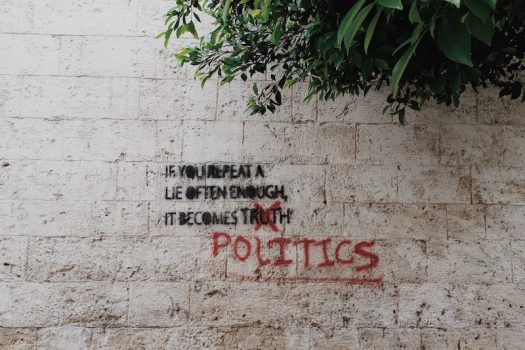
Politics has been here for quite some time now and is an integral part of our social life and the order implemented in our societies. It has been said that politics is an inevitable feature of running the human race — that it aims to find the balance in social and economic activity, that without it we would have chaos, and that imperfect as it is, no viable alternative has ever lasted.
But in 2026, that assumption is being tested more seriously than at any point in living memory. Trust in governments is at historic lows across virtually every democracy. The rise of what can only be called the entertainisation of politics — where spectacle, personality, and outrage replace policy — has made traditional democratic governance feel increasingly unreliable and broken. And for the first time, technology is offering not just a critique of the political system but actual, functioning alternatives that have been tested in the real world.
This is not an abstract philosophical question anymore. The system is visibly struggling. Here is what people are actually trying instead.
“Politicians have the power to make tiny changes. But ultimately, individuals — and increasingly, technology — are those who can make the real change.”
Why Is Politics a Dirty Game?
In simple terms, politics is a set of activities associated with making decisions in a group and distributing resources. It was forced into the mainstream and, at least in my view, was largely corrupted over the past century. Politics has been described for years as a struggle for power — and across the world, trust in governments is at all-time lows.
While parliamentary elections have become an entertaining event and a symbol of democracy, for many people they feel like an embarrassing occurrence. The anticipation of a messiah — a US president, a Prime Minister, a charismatic leader who will make a drastic change — has become an absurd phenomenon. Leaders promise transformation, deliver incremental adjustments, and blame everything outside their control for the gap between the two.
The hierarchy of politics is also increasingly perceived as an unequal system — particularly with the growing movement of anarchist political philosophy, which is deeply sceptical of state authority and the legitimacy of the hierarchy itself. And in all democratic political governments, one ruler — PM, president, or king — supposedly has the power to make crucial decisions, while the idea of genuine democracy remains unclear. It would be more than reasonable to try a system where an assembly of distributed leaders takes decisions collectively and is held accountable for running them — more like a courthouse than a parliament.
But the more interesting question is not what’s wrong with politics. It is what comes next.
“Across the world, trust in governments is at historic lows. The entertainisation of politics is not a bug — it has become the feature.”
The Alternatives Being Tested Right Now
What was theoretical in 2021 has real-world examples in 2026. The alternatives to traditional political governance are no longer just academic proposals — they are being implemented, tested, and in some cases scaled. Here are the most significant experiments.
Digital Democracy and vTaiwan
Taiwan’s vTaiwan platform uses a tool called Pol.is to facilitate large-scale public deliberation on policy questions. Rather than voting yes or no, citizens express nuanced views and the system identifies areas of genuine consensus that cut across political divides. The platform has been used to reach workable agreements on contentious issues including the regulation of Uber and alcohol sales — issues that traditional legislative processes had gridlocked. It is arguably the most successful working experiment in digital direct democracy anywhere in the world.
Digital Government — The Most Advanced in the World
Estonia has built the most digitally integrated government on the planet. Over 99% of government services are available online. Citizens can vote, file taxes, access medical records, register a company, and sign legal documents digitally using a national e-identity system. The Estonian model demonstrates that much of what politicians claim requires political negotiation can be delivered efficiently through well-designed digital infrastructure — removing human friction, corruption, and delay from the process. Several other countries have begun adopting elements of the Estonian model.
The World’s First Minister of Artificial Intelligence
In 2017, the UAE appointed Omar Al Olama as the world’s first Minister of State for Artificial Intelligence. The role is not symbolic — it has driven a national AI strategy that includes integrating AI tools into government services, education, and economic planning. While the UAE is not a democracy and the appointment says nothing about democratic governance, it is a concrete example of a government deliberately transferring decision-making authority and capacity to AI-assisted processes rather than purely to political appointees.
DOGE — AI in Federal Governance
In 2025, Elon Musk’s Department of Government Efficiency used AI tools to analyse federal spending, identify redundancies, and propose budget cuts at a scale and speed that would have been impossible through traditional bureaucratic review. Whatever you think of its political context, DOGE represented the first large-scale deployment of AI-assisted governance analysis in the world’s largest government. The results were contested and the process was controversial — but the experiment demonstrated that AI can process and identify inefficiencies in government at a scale no human team could match.
César Hidalgo’s Idea — Replace Politicians With AI
The most radical academic proposal for political reform in recent years came from César Hidalgo, a physicist and complexity scientist at MIT. Hidalgo’s idea is straightforward: rather than electing politicians who claim to represent your views and then make decisions you have no control over, your political preferences could be modelled by an AI agent that votes on your behalf on every piece of legislation — a perfect proxy for your actual views rather than a fallible human approximation of them.
The objections are obvious and real: who controls the AI? Who audits it? What happens when it is hacked, manipulated, or captures the preferences of a population that has been algorithmically radicalised? Hidalgo’s proposal is not a blueprint — it is a provocation designed to force the question of why we accept the current system’s failures as inevitable when alternatives are imaginable.
In 2026, with large language models demonstrating the ability to process complex policy documents, identify contradictions in legislation, and model the likely outcomes of policy choices, Hidalgo’s provocation feels less science-fictional than it did when he first proposed it.
David Friedman and Feud Law
A different tradition of political alternative comes from David Friedman — economist, physicist, and son of Milton Friedman — who has written extensively about anarcho-capitalism and what he calls Feud Law: a system of private, competing legal institutions rather than a state monopoly on law and enforcement. In Friedman’s framework, the problem with government is not that it is run by bad people but that it is a monopoly — and monopolies, whether in commerce or governance, tend toward inefficiency, corruption, and unresponsiveness to their users.
Friedman’s ideas remain far outside the mainstream. But the broader principle — that competition between governance models, rather than a single state monopoly, might produce better outcomes — has found surprising real-world expression in charter cities, special economic zones, and the ongoing experiment of jurisdictional arbitrage that the digital economy has enabled.
Futuristic Government Systems — From Theory to Practice
Governance by Experts
COVID-19 transferred enormous power to scientists, epidemiologists, and public health officials — a real-world technocracy experiment that ran for two years. The results were mixed: expert governance delivered vaccines but also generated significant public backlash and revealed the limits of purely technical decision-making on questions with deep value dimensions.
Random Selection
Demarchy proposes replacing elected politicians with randomly selected citizens — similar to jury duty. Several European countries have run “citizens’ assemblies” using this method, including Ireland’s constitutional assembly that led to the legalisation of same-sex marriage and abortion. The results consistently outperform what professional politicians achieve on the same questions.
Governance by Prediction Markets
Proposed by economist Robin Hanson: vote on values, bet on beliefs. Citizens would define what outcomes they want (prosperity, health, freedom) and prediction markets would determine which policies are most likely to achieve them. Decision-making power would follow the money, not the vote. Experimental, but gaining interest as prediction markets demonstrate surprising accuracy.
Delegated Voting
In liquid democracy, citizens can vote directly on any issue or delegate their vote to a trusted person on specific topics — an expert on healthcare for health legislation, a friend for education policy. Your vote flows where your expertise directs it. The Pirate Party in Germany used a version of this internally and found it dramatically increased meaningful participation.
When Will Politics Be Moral?
This is the question that underlies all the others. The alternatives listed above are not primarily about efficiency — though most of them are more efficient than the current system. They are about morality. About whether a system that consistently produces outcomes most of its participants find unjust, dishonest, and unrepresentative can be called legitimate.
Realistically, politics will remain part of our social system for the foreseeable future. The alternatives are not ready to replace it — they are ready to challenge it, to demonstrate that specific functions of government can be done differently, and to expand the imagination of what governance could look like.
The most honest answer to “when will politics be moral?” is: when enough people demand it consistently enough that the incentives facing politicians change. That has happened before in history — the abolition of slavery, universal suffrage, the welfare state — and each time it happened it seemed impossible until it didn’t.
The technology now exists to build more honest, more participatory, more accountable political systems. The question is not whether the tools are available. It is whether the political will to use them exists — which is, somewhat ironically, itself a political question.