
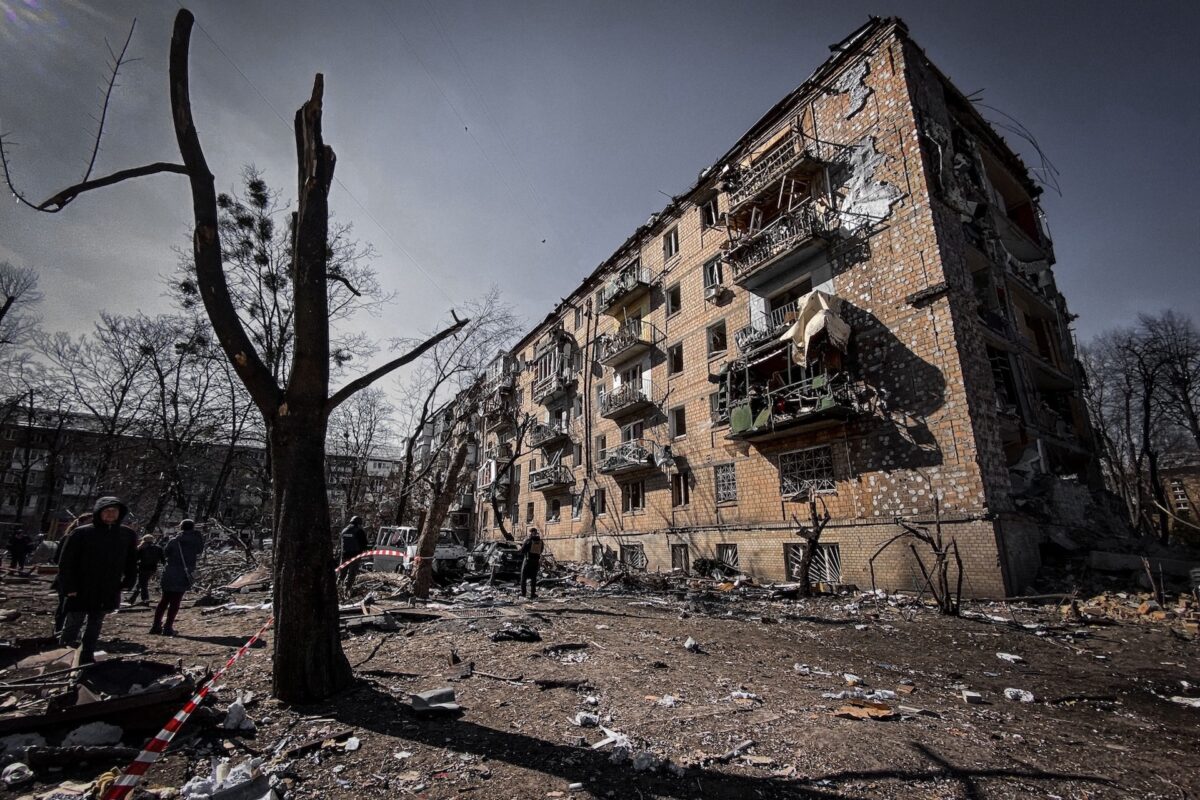
A few days ago a post popped up in my feed saying you wouldn’t believe how many casualties the Russia-Ukraine war has. I clicked, and when I saw the numbers I was shocked. Ukraine’s General Staff says more than 1.5 million Russian soldiers have been killed or wounded, and the most careful independent estimate, from the Center for Strategic and International Studies, puts Ukraine’s own losses at 500,000 to 600,000. And yet, when did you last see this war lead a news bulletin?
The fighting has not slowed. The war has slid down the page, pushed aside by the Iran war, Gaza, the war in Yemen, elections and plain fatigue. This article looks at where the war stands today, what the casualty figures really mean, how they compare with other wars, Gaza included, and why you hear so little about it.
Table of contents
Russia-Ukraine War Today: What Is Going On?
So where do things stand right now? Here is what each side wants, and why this has become a war with no real solution on the horizon.
First, Russia. Basically, Russia wants all of Donetsk, Luhansk, Zaporizhzhia and Kherson, plus Crimea, according to the AP. Putin calls the Donbas, the industrial east made up of Donetsk and Luhansk, historically Russian land. Moscow also wants Ukraine to give up on NATO, shrink its army, and ease limits on the Russian language and the church tied to Moscow. It has shown little willingness to give anything back: it rejects a temporary ceasefire and wants a final deal first, and so far its only concessions are agreeing to talks and a few short local truces.
Ukraine, obviously, has its own demands. Ukraine will not hand over land it still holds, and it wants the fighting frozen along the current line. Where it has shown some flexibility is on how it gets protected. NATO membership is its first choice, but it is discussing a US guarantee modeled on NATO’s Article 5 (an attack on one is an attack on all) or a European-led force instead, and Zelenskyy has said he would discuss a buffer zone on both sides of the front. That is the sticking point: Russia wants land first, Ukraine wants guarantees before giving up anything, and a US plan for a demilitarized zone in the Donbas failed when Putin insisted Moscow control it, according to the Kyiv Independent. Separately, Ukraine also wants to join the European Union, a different path to security and the economy that we explain in our piece on the pros and cons of EU expansion.
On the battlefield, the fighting has not paused for any of this. On the night of November 2 to 3 Russia fired 289 drones, 17 ballistic missiles and 59 cruise missiles, mostly at power stations in nine regions, and Reuters reported at least 73 people injured when a Kharkiv hospital was hit. A day earlier a strike on a school used for handing out aid in Zaporizhzhia region killed at least 40 people, according to Ukrainian officials, and Ukraine hit back at a refinery in Yaroslavl. The front line itself has barely moved: the Institute for the Study of War saw no advances by either side on November 3, and in eastern Donetsk Ukraine says it has retaken about 275 square kilometers since August, which fits with Al Jazeera’s conclusion that Russian gains in 2026 are close to nil.
October was mostly about energy. Trump declared an energy ceasefire on October 11, but within three days Russia launched about 850 drones and 39 missiles at 30 energy sites, and Ukraine resumed striking Russian refineries. Diplomacy picked up late in the month, with envoy Steve Witkoff meeting both Zelenskyy and Putin, and the result is three-way talks in Abu Dhabi on November 10 and 11, the first since February.
Russia-Ukraine War Map: How Much of Ukraine Does Russia Control?
As of writing, Russia controls about 19 to 20% of Ukraine, and the front line has moved very little this year. That is roughly 120,000 square kilometers, an area about the size of Pennsylvania, or a little smaller than England. The estimates differ slightly, with the think tank CSIS putting it at roughly 120,000 square kilometers and the news agency AFP, using data from the Institute for the Study of War, saying just over 19% including Crimea, but a gap that small is normal when the front line shifts every day and some areas are contested.
The most important part of that territory is the Donbas, the industrial east made up of the Donetsk and Luhansk regions. Russia holds all of Luhansk, and Ukraine still holds about 19% of Donetsk, according to the Council on Foreign Relations, which means the fight there has come down to one last stretch around the cities of Sloviansk and Kramatorsk. That is the land Moscow keeps demanding in peace talks, which is why this corner of the map matters more than any other.
Here is what the map looks like as of November 4, 2026. The shaded area is Russian-held territory, and it includes Crimea, which Russia took in 2014, along with the parts of the Donbas and the south it has captured since.
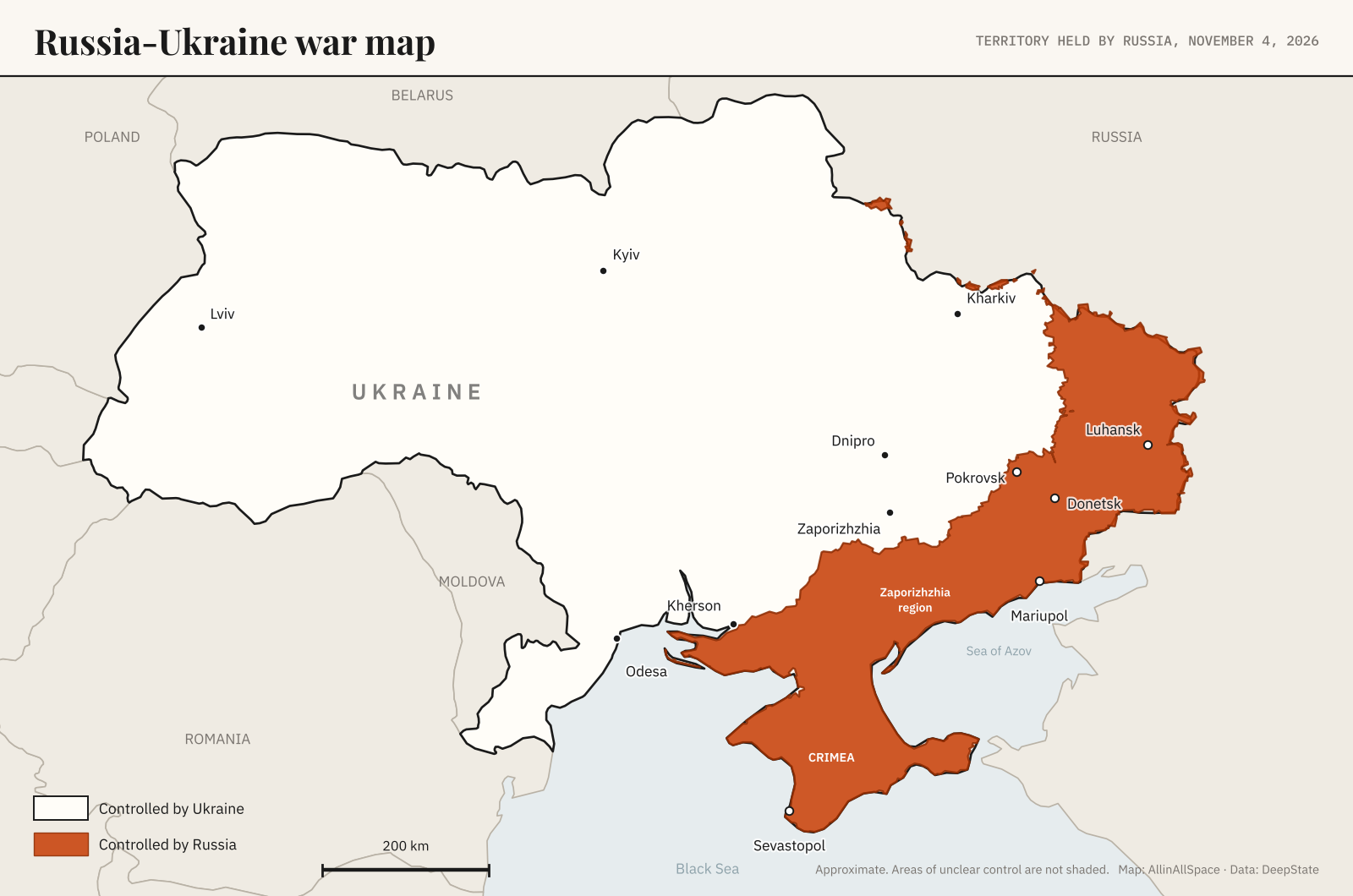
The pace of Russia’s advance has slowed sharply, which is why the map has barely changed. In 2025 Russia took about 4,800 square kilometers, or 0.8% of Ukraine, according to CSIS, which works out to roughly 400 square kilometers a month after a year of heavy fighting. This year has been slower still, with the Ukrainian monitor DeepState counting 245 square kilometers in January and 126 in February, the smallest monthly gain since July 2024. Then in April, AFP’s analysis found that Russia lost about 120 square kilometers on net, the first monthly net loss since mid-2023, which means Ukraine took back more ground than it lost that month.
The simple arithmetic shows why a quick Russian victory looks unlikely. At 2025’s pace of about 0.8% of Ukraine a year, taking the remaining 80% would take roughly a century, and 2026 has been slower. That is our own calculation, not a forecast, because wars rarely move at a steady speed, but it shows how far Russia is from its goals.
Russia-Ukraine War Casualties: The Death Count
So these are the figures that caught my attention. More accurately, they blew my mind. The truth is that nobody outside the militaries knows the exact count, so the right way to read them is as a range with a label on each number. There are three kinds of figures: claims by a country at war, independent estimates, and counts of named individuals.
Ukraine’s General Staff reports Russian losses of killed and wounded together. By its count the total passed 1.5 million, and it says October 2026 set a monthly record of over 49,000. That is a claim from one side of the war, and Kyiv has every reason to publish large numbers.
The most cited independent estimate comes from CSIS, a Washington think tank. It put Russian casualties at about 1.2 million through December 2025, including killed, wounded and missing, of which 275,000 to 325,000 were deaths. For Ukraine, CSIS estimates 500,000 to 600,000 casualties and 100,000 to 140,000 deaths. President Zelenskyy has given a lower figure of 55,000 Ukrainian soldiers killed.
Civilians are counted separately. The UN’s monitoring mission has recorded more than 15,000 civilians killed since the invasion began, and 2026 has already become the deadliest year for them: 2,570 were killed and 15,211 injured from January to September, more than the 2,526 killed in all of 2025. That tells us the war is hitting cities harder even while the front line barely moves, which fits the long-range strikes on power stations and cities described above.
How much is Russia losing every month? Ukraine claims about 32,000 killed and wounded on average, per its commander-in-chief. Independent analyst Janis Kluge estimates roughly 9,000 Russian soldiers are killed each month, with the caveat that the estimate is uncertain.
Russia: about 1.2 to 1.5 million casualties, of which 275,000 to 325,000 are deaths.
Ukraine: about 500,000 to 600,000 casualties, of which 100,000 to 140,000 are deaths.
This is our own sum, not a count from any one source. The low end uses the CSIS estimates, which run to December 2025. The high end replaces CSIS’s Russian figure with Ukraine’s General Staff claim of over 1.5 million killed and wounded, which runs to late 2026 and comes from a party to the war.
How the Numbers Compare With Other Wars
Ukraine is the deadliest war in the world right now, and by a wide margin. The Uppsala Conflict Data Program, a Swedish university project that counts war deaths worldwide, recorded at least 94,700 deaths in the war in 2025, about 62% of all battle deaths on earth that year, which means almost two out of every three people killed in fighting anywhere died in this war. A full count for 2026 will not exist until next June, when the program publishes its yearly data, but the UN’s figures for civilians suggest the war is not easing.
Zooming out to all wars together, the same program counted about 244,600 people killed in organized violence worldwide in 2025, including attacks on civilians. That makes it the second-bloodiest year since the 1994 Rwandan genocide, and a big jump from nearly 160,000 in 2024. By our calculation, Ukraine alone accounts for about 39% of that total. The number of wars is rising too: the program counted 65 conflicts involving a state in 2025, the most since its records began in 1946, and conflicts between two countries went from 2 in 2023 to 8 in 2025, the highest level since World War II.
Now to the wars themselves. The table shows the total number of people killed in each one since it began, and next to it the latest 2026 figure we could find.
| War | Total deaths since it began | Latest 2026 figure | Where the figures come from |
|---|---|---|---|
| Russia-UkraineFeb 2022 to Dec 2025, soldiers on both sides | 375,000 to 465,000 | 2,570 civilians killed, Jan to Septmore than in all of 2025 | Our sum of the CSIS ranges; UN monitoring mission |
| Yemen2015 to 2026 | 160,000+ in fighting377,000 including hunger and disease, to 2021 | At least 1,500 killed and 6,900 injured since fighting flared in August | ACLED; UN estimate for the broader figure; WHO for 2026 |
| SudanApr 2023 to 2026 | Estimates up to 150,000not firmly verified | At least 880 killed by drone strikes, Jan to Apr | 2026 Global Peace Index estimate; UN estimate |
| GazaOct 2023 to Oct 2026 | 73,651as of Sept 5, 2026 | 1,583 killed since the October 2025 ceasefire, to end of October | Gaza Health Ministry |
| Iran wardeaths in Iran only, 2026 to April | About 3,400 to 3,600 | Same period | Iranian officials and the HRANA monitor; not independently verified |
Periods, methods and definitions differ, so read these as orders of magnitude, and note that the 2026 figures cover different stretches of time for each war. The Russia-Ukraine total counts military deaths only, while the 2026 figure counts civilians only. Sources named in the text; figures current as of November 5, 2026.
Two things stand out. Russia-Ukraine has killed the most people by a wide margin, and the two wars that come next, Yemen and Sudan, rarely lead the news. In Yemen, fighting flared again in August, and the World Health Organization reported at least 1,500 people killed and more than 6,900 injured by late October. The UN says at least 11,300 civilians were killed in Sudan in 2025, and drone strikes alone killed at least 880 people there in the first four months of 2026.
The Iran war shows the other side of it. Its reported death toll, as of April, is a small fraction of the others, yet it took over the news. Attention does not follow deaths. It follows geography, politics, oil and who is involved. Counting the dead is not a way of ranking suffering, but it does show how far the coverage has drifted from the scale of what is happening.
Why the Russia-Ukraine War Has Been Pushed to the Sides
A bigger and newer story took over. When the Iran war began in 2026, the AP reported that it had deflected global attention from Ukraine, and NPR’s Ukraine correspondent said the war no longer leads newscasts. Gaza, Yemen and the wider Middle East had already taken much of the space before that.
A stalemate is also hard to cover. A front line that moves by a few hundred square kilometers a month has no clear daily story, and the same headline about drones and missiles repeats every week. After almost five years, people stop reacting to numbers, even enormous ones.
The fatigue is on both sides. A Levada Center poll in February found that a record 56% of Russians follow the war little or not at all, and 67% support peace talks.
This is not only about headlines, because attention moves weapons and money. The AP reported that American Patriot air-defense missiles were shifted from Europe toward the Middle East, and that a 90-billion-euro EU loan for Ukraine was being held up by Hungary. Ukraine’s president said the US produces 60 to 65 Patriot missiles a month, while 803 were used on the first day of the Middle East war.
Is Russia’s Army Weakening? How Much Military Does Russia Have Left?
One of the questions that could prove critical to this war is how much military strength Russia has left. So yes, Russia’s army is under strain, but there is no sign yet that it is about to break. The clearest pressure point is manpower. Finance Ministry data analysed by Janis Kluge show Russia signed up 71,216 new contract soldiers in the first quarter of 2026, the lowest in three years and down from 89,601 a year earlier. Regional data suggest recruitment of about 1,000 a day, or 30,000 a month, in the second quarter.
That matters because losses have caught up. Analyst Michael Kofman says that in December 2025, killed and seriously wounded soldiers outnumbered new recruits for the first time. Western officials told Bloomberg in February that losses had exceeded recruitment for three months in a row, which makes a major new offensive unlikely in the near term.
Money is tighter too. SIPRI puts Russian military spending at $149 billion in 2024, and Reuters reporting points to defense cuts of at least 7% in 2026. CSIS estimates Russia spends about half its budget on the military, security and debt.
Russia-Ukraine War: Who Is Winning, and Is Russia Likely to Lose?
Neither side is winning, and the evidence points to a grinding stalemate that favors whoever can last longer. Russia holds about a fifth of Ukraine but is gaining little, and it pays for every kilometer in lives. Ukraine has held the line but depends on outside money and air defense, which is exactly where lost attention hurts.
Is Russia likely to lose the war? On the evidence we found, a Russian collapse is unlikely in the near term, and so is a Russian victory. The more realistic outcomes are a negotiated settlement or a long war of attrition. Russian public opinion is a small signal here: in Levada’s February poll, support for continuing the invasion fell to 24%, the lowest since February 2022, though 82% still approve of Putin.
The war is being decided less by the front line than by three things: whether Russia can keep recruiting, whether Europe can keep funding Ukraine, and whether Washington stays engaged.
Russia-Ukraine War Ceasefire: Where Talks Stand
There is no ceasefire, and few people expect a breakthrough. US envoys Steve Witkoff and Jared Kushner will lead working-level talks with Russian and Ukrainian delegations in Abu Dhabi on November 10 and 11, according to Radio Free Europe. The agenda covers post-war security arrangements, de-escalation and humanitarian issues, and European security guarantees will be discussed separately in Brussels the same week. The last round of three-way talks was in February.
The obstacle is the order of events. Putin says a comprehensive peace agreement must come before the fighting stops. The two sides also remain split on territory and security guarantees.
Short truces have not lasted. A 32-hour Orthodox Easter truce in April ended with Ukraine reporting 469 violations, and a three-day ceasefire in May unraveled quickly. The local Oleshky truce in late October, which let aid in, has already ended.
This article is opinion and analysis for informational purposes only. Casualty figures in wars are estimates, often claims by parties to the conflict, and may change as better data appears. Figures come from the organizations named in the text and are accurate as of November 5, 2026; definitions of “casualties” and “deaths” differ by source. The views expressed are our editorial opinion.