
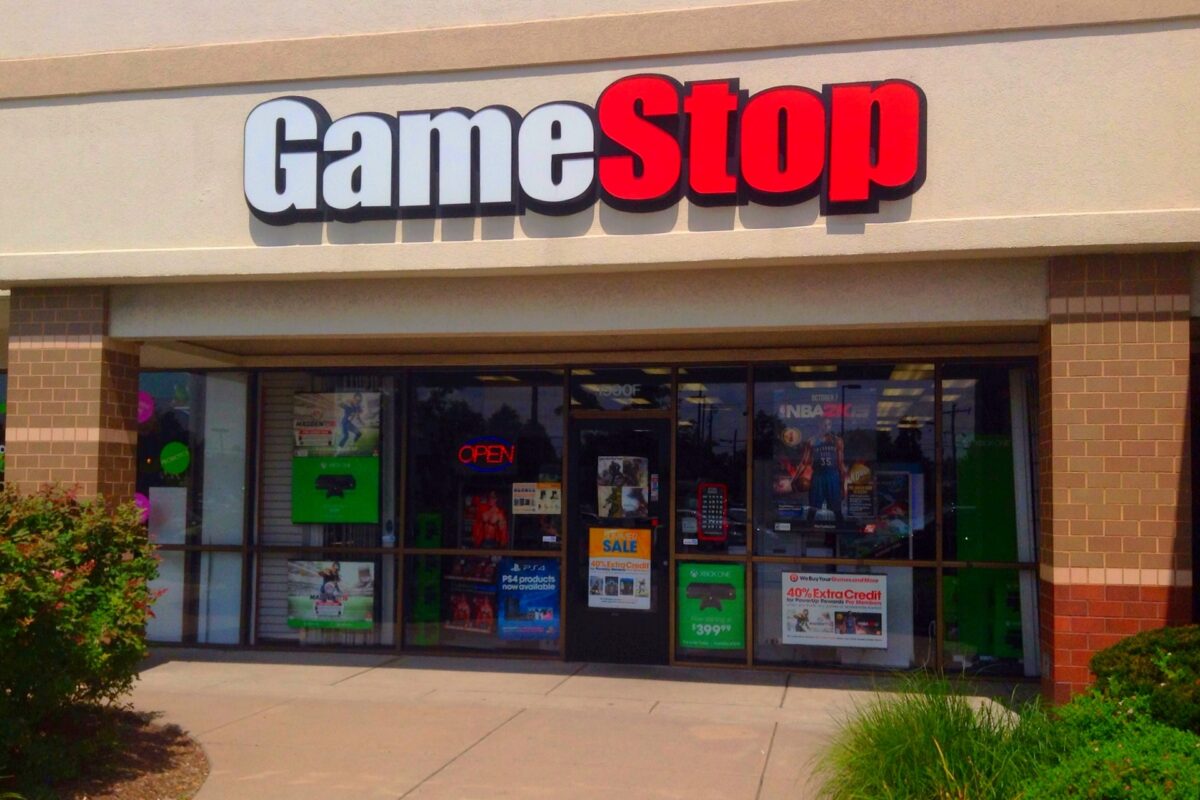
GameStop is back in the headlines — but not for the reasons that made it famous. You can track GME alongside other notable movers in our 52-week high/low scanner. The meme stock era of early 2021, when retail investors coordinated a historic short squeeze that briefly sent the stock to $483, feels like ancient history now. Today, GameStop is down roughly 32% from its 52-week high, trading near $19, and the company’s headline story is a failed $56 billion bid for eBay that collapsed before it began. What is actually happening to GME stock right now, what the fundamentals say, and what to watch before the September 8 earnings report — this is the full picture.
The eBay Saga — What Just Happened
The big story this week is the collapse of GameStop’s attempted acquisition of eBay. In May 2026, CEO Ryan Cohen made an unsolicited $56 billion bid for eBay — $125 per share, half cash and half GameStop stock. eBay’s board rejected it within a week, calling the offer “neither credible nor attractive.” The board cited uncertainty around financing, operational execution risks, and concerns about GameStop’s governance and CEO incentive structure. Cohen had offered to give up a $35 billion pay package to pursue the deal, which did little to address eBay’s concerns.
As of today, Bloomberg reports that Cohen is now considering withdrawing the bid entirely and proposing a commercial partnership instead — letting eBay leverage GameStop’s roughly 1,600 US retail stores to sell higher-margin trading cards and collectibles. GameStop would seek board seats at eBay in return.
The eBay episode illuminates something important about where GameStop stands today. The company is cash-rich but strategically adrift. Cohen turned GameStop profitable and rebuilt the balance sheet — a genuine achievement from where the company was in 2021. But the core business of video game retail is structurally challenged. The collectibles pivot is working: trading cards and collectibles made up 41.8% of Q1 revenue this year, up from 28.9% a year earlier. The question is whether that is enough to build a meaningful growth story, or whether it is a managed decline with a strong cash cushion.
The Short Squeeze — A Brief History
No GME analysis is complete without acknowledging the story that made the ticker famous. In January 2021, retail investors on Reddit’s WallStreetBets coordinated a buying campaign in GameStop stock, which was heavily shorted by hedge funds betting on the company’s decline. The result was one of the most dramatic short squeezes in market history: GME went from under $20 to an intraday high of $483 in a matter of days, forcing hedge funds to cover their positions at enormous losses and briefly making GameStop the most traded stock in the world.
The episode put names like Roaring Kitty (Keith Gill) and short-seller Melvin Capital permanently into financial market vocabulary. It also fundamentally changed how retail investors engage with markets. But the stock did not stay at $483. It crashed back to earth, and GameStop’s underlying business — brick-and-mortar video game retail in an increasingly digital world — never changed. The 2021 squeeze was a market event, not a business transformation. The business transformation came later, under Cohen. For a broader look at the structural forces reshaping the sector, our analysis of how to invest in the video game industry covers the shift from physical to digital and what it means for the companies still operating retail stores.
The Fundamentals: Profitable, But the Revenue Trend Is Concerning
Here is the part that gets lost in the meme stock narrative: GameStop is actually profitable. The company has turned around its financials significantly under Ryan Cohen. But the revenue picture is more complicated, and the most recent quarterly results show a tension that matters heading into September 8.
| Metric | Q1 FY2026 (May 2026) | Q1 FY2025 (May 2025) | Change YoY |
|---|---|---|---|
| Revenue | $732.4M | $881.8M | -16.9% YoY |
| EPS | $0.17 | -$0.12 | Beat by $0.13 |
| Gross margin | 34.4% | Lower | Expanding |
| Collectibles revenue share | 41.8% | 28.9% | +12.9pp YoY |
| Digital revenue | +53% YoY | — | Strong growth |
| Cash & investments | $8.4B | — | — |
The earnings beat was significant — $0.17 actual versus $0.04 consensus, a beat of $0.13. That reflects the shift toward higher-margin collectibles and digital products. But the revenue decline of 16.9% year-over-year is real and structural: physical video game retail is shrinking as consumers shift to digital downloads and subscription services. GameStop’s stores are selling more collectibles and fewer games, which helps margins but does not solve the volume problem.
What to Watch Before September 8
The next earnings report is September 8, 2026 — less than four weeks away. Here is what matters heading into it.
| What to Watch | Why It Matters |
|---|---|
| eBay partnership resolution | Does Cohen formally pull the acquisition bid and propose a partnership? A clean pivot could remove uncertainty. A prolonged standoff adds noise. |
| Revenue trend | Can collectibles growth offset continued software and hardware declines? The mix shift is working — but top-line growth requires volume, not just margin. |
| EPS vs consensus | Wedbush raised Q2 EPS estimate to $0.19. The stock has form for beating low bar consensus estimates — another large beat would be notable. |
| Cash deployment commentary | $8.4B in cash sitting idle is a question on every earnings call. How Cohen frames the capital allocation plan — eBay, Bitcoin, buybacks, other acquisitions — moves the stock. |
| Store count | GameStop continues to close underperforming stores. The pace of closures signals management’s view on the physical retail footprint. |
The Bitcoin Factor
Worth mentioning separately: GameStop holds Bitcoin on its balance sheet alongside its cash position. In March 2026, the company disclosed approximately $519 million in Bitcoin holdings. This is not a central part of the GME thesis, but it adds a layer of volatility — the balance sheet now moves with crypto prices as well as operating results. Cohen has been associated with a range of unconventional capital allocation moves, and the Bitcoin position is consistent with that pattern. Whether it is strategic or speculative depends largely on your prior view of Cohen as an allocator.
Analyst Sentiment — Mostly Bearish on Valuation
Wall Street is not enthusiastic about GME at current prices. For an AI-driven breakdown of GameStop’s fundamentals and technical indicators, our AI stock analysis tool gives a data-driven perspective alongside the analyst commentary below. Wedbush carries an Underperform rating with a $13.50 price target — implying roughly 30% downside from the current price. The consensus view is that GameStop’s equity is expensive relative to its business prospects, even after accounting for the cash cushion. The argument is straightforward: strip out the $8.4 billion in cash and the operating business is valued at essentially zero — or negative, depending on how you calculate it. But a business with declining revenue, no clear growth catalyst, and a CEO whose biggest strategic swing just fell apart is not obviously worth more than its cash.
The counter-argument — and it is a real one — is that Cohen has proven capable of surprising the market before. He turned a dying company profitable. The collectibles business is growing. And a partnership with eBay, even if smaller than an acquisition, could meaningfully expand GameStop’s addressable market in high-margin physical goods without the debt load that doomed the buyout attempt.
The $8.4 Billion Question — What Can Cohen Actually Do With It?
The most important number in GameStop’s story right now is not the stock price or the revenue figure. It is the $8.4 billion in cash sitting on the balance sheet — and what Ryan Cohen decides to do with it. At a market cap of roughly $8.6 billion, the equity barely clears the cash position. Strip out the cash and the market is valuing GameStop’s operating business at essentially zero.
That is actually the core of the bull argument. Cohen has four realistic options for deploying that capital, and each carries a different implication for the stock:
| Capital Allocation Option | Potential Impact on GME | Probability |
|---|---|---|
| eBay partnership (revised) | Board seats, collectibles expansion via eBay’s platform — strategic but no immediate cash deployment | High — Bloomberg reporting today |
| Share buybacks | Buying stock near cash value would be accretive — reduces share count, signals confidence | Moderate |
| Different acquisition | Cohen has signalled ambition for M&A — a smaller, more credible target than eBay could re-rate the stock | Moderate |
| Bitcoin / alternative assets | Already holds ~$519M in Bitcoin — could expand this position. Speculative but consistent with Cohen’s pattern | Low-moderate |
| Special dividend | Returning cash directly to shareholders. Unlikely given Cohen’s capital allocation philosophy | Low |
Analyst estimates for where the stock could go with a credible capital deployment have ranged from $24 (TradingKey, based on a trendline breakout and cash floor thesis) to $13.50 on the downside (Wedbush Underperform). The range tells you everything about how divided opinion is: one camp says the cash creates a valuation floor that makes the stock interesting; the other says a declining retail business is worth less than its cash if management cannot deploy it productively. The eBay episode has, fairly or not, made the bears’ case easier.
GME is one of the most sentiment-driven stocks in the market. The fundamentals are genuinely mixed — profitability improving, revenue declining, cash pile enormous relative to equity value, strategic direction unclear. The eBay bid failure removes what was, briefly, the most exciting growth narrative the stock had. What replaces it matters a great deal.
The September 8 earnings report is the next meaningful data point. If Cohen uses the call to announce a clean pivot — formal withdrawal of the eBay bid, a concrete partnership structure, and a disciplined plan for the $8.4B in cash — the stock could find a floor. If the call is another exercise in studied ambiguity, the pressure continues. The stock is down 32% from its 52-week high and approaching its 52-week low. At these prices, the cash backing provides some floor — but “not worth less than its cash” is a low bar for a company that spent the last three months trying to buy eBay.
For traders, September 8 is a hard catalyst date. For long-term investors, the question is simpler: do you believe Ryan Cohen has a plan for that $8.4 billion that creates shareholder value? The eBay episode suggests the ambition is there. Whether the execution follows is still an open question.
This article is for informational and educational purposes only and does not constitute financial or investment advice. GME is a highly volatile, sentiment-driven stock. Data sourced from GameStop SEC filings, Bloomberg, Yahoo Finance, Morningstar, MarketBeat, and TheStreet. Accurate as of August 11, 2026. The eBay partnership discussion is based on Bloomberg reporting and has not been confirmed by GameStop.