
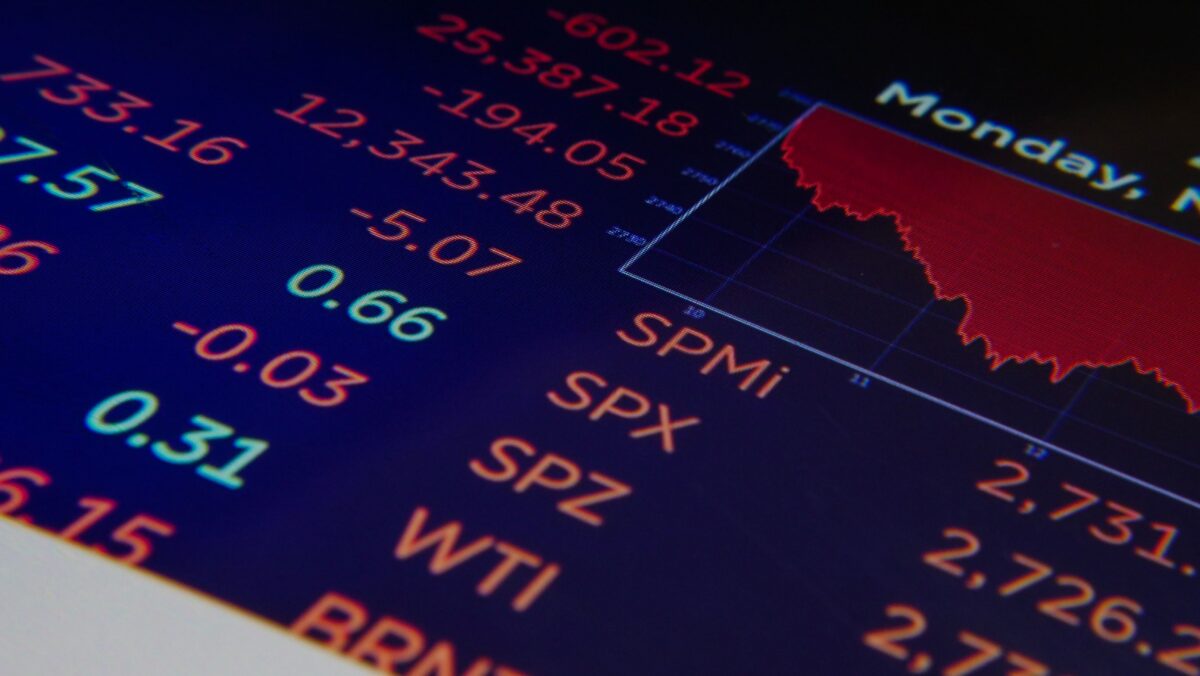
The S&P 500 has had a rough few weeks. From a high of nearly 7,600, the index has pulled back to around 7,266 as of writing — a decline of roughly 4.4% in a short stretch. That is not a crash. It is not even technically a correction yet. But it is the kind of move that starts people asking the question: is this the beginning of something bigger?
The honest answer is: probably not a crash. But the conditions for sustained downside pressure are genuinely building — and for the first time in a while, several of them are arriving at the same time. This piece walks through what is driving the current weakness, why it might persist for a few more weeks, and why there is no reason to reach for the panic button just yet.
What Is Actually Driving This Selloff
The current weakness is not driven by one thing. It is the convergence of several pressures that have been building independently — and that have now arrived in the same window. Understanding each one separately is the starting point for assessing how serious the overall picture is.
- 01Inflation re-accelerating — and nobody expected it. The May CPI print came in at 4.2% year-on-year — the highest reading since April 2023, and well above the Fed’s 2% target. The monthly print was 0.5%. These numbers were not expected. Markets had been operating on the assumption that inflation was gradually coming under control. That assumption is now under serious question.
- 02A jobs market that won’t cool down. May’s Non-Farm Payrolls report added 172,000 jobs — nearly double the 85,000 the market had expected, and up from April’s revised 179,000. A strong jobs market is normally good news. In this environment, it is a complication: it removes the Fed’s primary justification for cutting rates, and raises the real possibility that the next move is a hike, not a cut.
- 03Rate hike expectations are back on the table. Following the NFP and CPI prints, the CME FedWatch Tool moved to price approximately a 70% probability of at least one 25 basis point rate hike by year end — with a 38% chance it comes as early as September. The June meeting is almost certainly a hold (96.5% probability), but the conversation has shifted from “when do they cut” to “are they about to hike.” That is a meaningful psychological shift for equity markets.
- 04US-Iran tensions and the Strait of Hormuz. The geopolitical backdrop has not improved. US-Iran tensions remain elevated following the conflict earlier this year, with ongoing concerns about the Strait of Hormuz — through which roughly 20% of global oil supply passes. Oil price spikes are inflationary by nature, creating a feedback loop that makes the Fed’s job harder and adds another layer of uncertainty for equity investors.
- 05AI and semiconductor stocks losing momentum. The sector that drove a significant portion of the S&P 500’s gains over the past two years — AI infrastructure, semiconductors, the Nvidia trade — has shown visible fatigue. When the high-multiple, high-momentum names that led the market higher start to roll over, the index tends to follow. The AI trade is not dead, but it is no longer the one-way momentum play it was through 2024 and early 2025.
“The problem is not any one of these factors in isolation. It is that all of them are pointing in the same direction at the same time.”
This Is Not a Crash — But a Correction Might Be What the Market Needs
Before addressing what might happen next, it is worth being honest about where we started. As we wrote in our piece on US market valuations, the S&P 500 entered 2026 at historically stretched levels — price-to-earnings ratios that were pricing in near-perfection. When you are priced for perfection, imperfect data hurts more than it normally would.
A 4–5% pullback from those levels is not a crisis. It is, if anything, a healthy exhale — the kind of reset that historically provides better entry points for long-term investors and takes some of the speculative froth out of the most expensive parts of the market. Markets that go up in a straight line for too long tend to correct harder when the correction eventually arrives. A gradual, moderate pullback now is preferable to a violent repricing later.
No Panic — But Some Caution Is Warranted
There is no credible catalyst on the horizon for a full stock market crash in the near term. That is an important distinction. A crash requires either a systemic financial shock — a Lehman-style event, a sovereign debt crisis, a major bank failure — or a fundamental collapse in earnings expectations. None of those conditions are currently present.
What is present is a set of conditions that could sustain downside pressure for several more weeks:
- The June CPI print — due in July — will be closely watched. A second consecutive hot number would significantly increase the probability of a September hike and likely push equities lower
- The June 17 FOMC meeting may shift language in a hawkish direction even without a rate change — removing easing bias language would be enough to spook markets
- Any further escalation in the Middle East affecting oil prices would compound the inflation problem
- If AI earnings disappoint in the next reporting season, the sector rotation away from high-multiple tech could accelerate
None of these is a certainty. But the balance of risks feels skewed to the downside in the near term in a way it has not for most of the past two years. The market has been pricing in rate cuts. It is now having to reprice the possibility of a hike. That repricing process is rarely smooth or quick.
The Bottom Line
The S&P 500 is pulling back from elevated levels, driven by a confluence of inflationary data, a resilient labour market, rising rate hike expectations, geopolitical uncertainty, and fading momentum in the AI trade. The pullback feels overdue — markets priced for perfection rarely survive imperfect data intact.
But this is not the beginning of a crash. It is, more likely, the kind of healthy correction that sets up the next leg higher — provided the inflation data starts to cooperate, the Fed stays on hold, and the geopolitical situation does not materially deteriorate. The conditions for a real bear market are not in place. The conditions for a choppy, uncertain few weeks very much are.
For long-term investors, corrections are not emergencies. They are opportunities — if you have the patience to sit through the noise and the conviction to act when others are retreating. For traders, the current environment rewards caution and selectivity over aggression. The easy money has been made. What comes next will require more care.
This article represents the opinion of the AllinAllSpace editorial team and does not constitute financial advice. All market data referenced is as of June 11, 2026 and subject to change. Past market performance is not indicative of future results. Always conduct your own research before making investment decisions.