ISA vs SIPP: Which Should You Open First?
Both are tax-efficient wrappers for UK investors. Both offer tax-free growth. But they work very differently, and opening the wrong one first can cost you years of compounding in the wrong place. Use our free calculator below to see which wins for your salary.
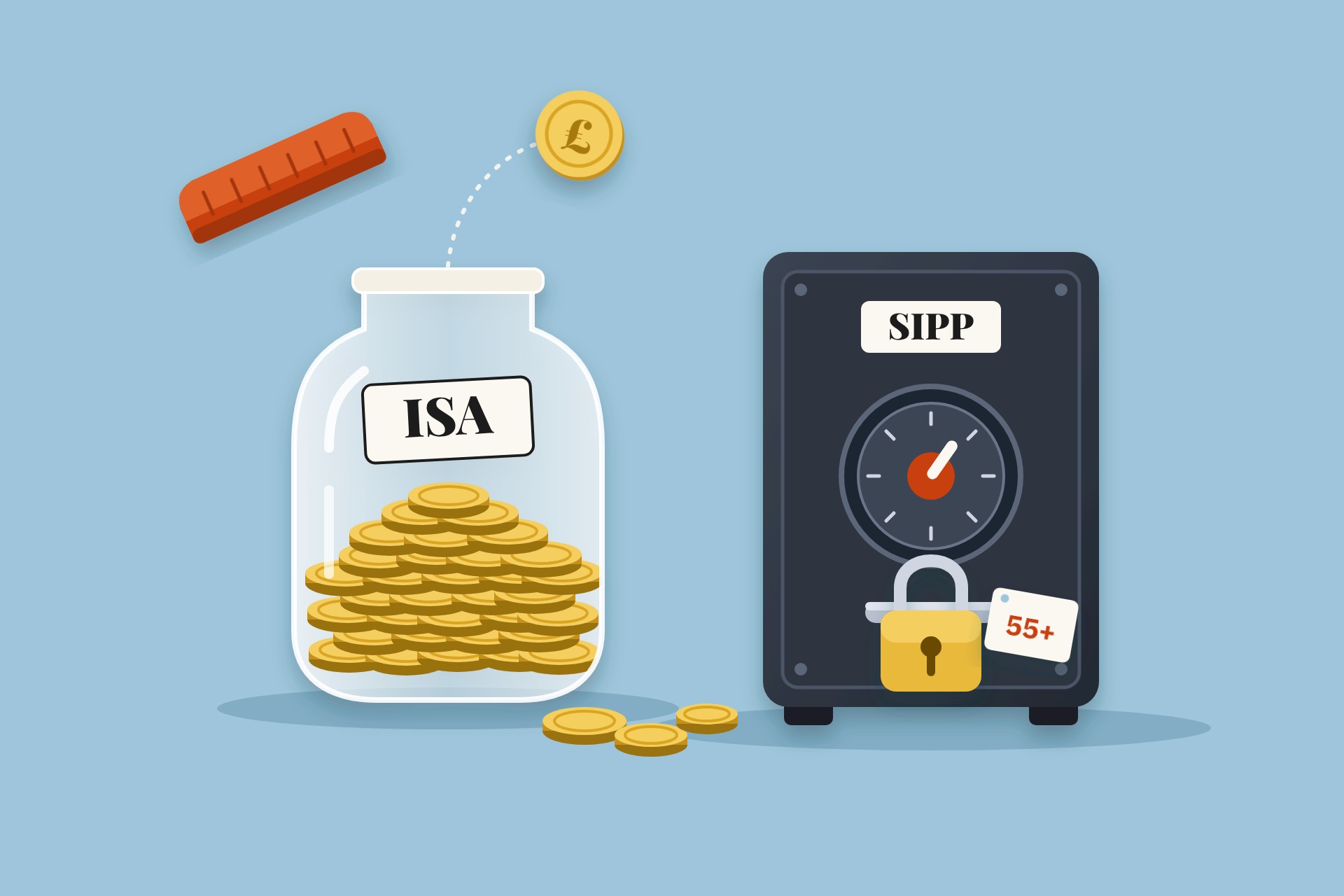

Most UK investors ask which to open first, when the better question is what the money is for. An ISA and a SIPP both shelter your investments from tax, but they do it in opposite ways.
This guide explains the actual difference, who each is designed for, and how to decide which to open first, based on your age, income and when you need the money.
In This Guide
The Simple Answer
If you need flexibility and might want your money before retirement — open an ISA first. If you are a taxpayer who is confident the money is for retirement — open a SIPP first and claim the tax relief. Most people should eventually use both.
The ISA gives you tax-free growth and completely unrestricted access at any time. The SIPP gives you tax relief on the way in, which is valuable, especially for higher-rate taxpayers, but locks your money away until you are at least 55 (rising to 57 in April 2028).
That lock-in is the central trade-off. The SIPP’s upfront tax relief is one of the best deals available to UK investors, but you are committing that capital to retirement. If there is any meaningful chance you will need the money sooner, start with the ISA.
The ISA vs SIPP question is not either/or for most investors. The usual approach for working-age UK investors is to fill the SIPP up to your employer match (if you have one), then use the ISA for everything you want flexible access to. Once you have reached your ISA limit, return to the SIPP. The two accounts serve different purposes and complement each other.
Key takeaway. ISA = flexibility, with tax-free withdrawals any time. SIPP = better tax treatment on the way in, but locked until retirement age. The right answer depends on when you need the money.
ISA vs SIPP Calculator: Which Wins for You?
The quickest way to answer the question for your own situation is to run the numbers. Enter your salary and how much you can invest, and the calculator shows which account leaves you with more after tax. Read the sections below for the reasoning behind the result.
Enter your details to see which account leaves you with more money after tax, for the same cost to your take-home pay. Results update as you type.
More assumptions
The SIPP comes out about £135,078 ahead.
That is 65% more than the ISA, after paying tax on your withdrawals. Both cost you £6,000 a year from take-home pay, over 25 years, in today’s money.
- You pay each year (take-home)£6,000
- Goes into your SIPP each year£9,933
- Tax relief on that£3,933 (40%)
- Tax-free lump sum (25%)£86,204
- Tax on the rest£1,442 (0.4% of pot)
- SIPP wins if withdrawal tax is below40% of the pot
Year-by-year table
| Year | You have paid in | ISA pot | SIPP pot (before tax) |
|---|---|---|---|
| 1 | £6,000 | £6,146 | £10,175 |
| 2 | £12,000 | £12,443 | £20,598 |
| 3 | £18,000 | £18,892 | £31,275 |
| 4 | £24,000 | £25,500 | £42,212 |
| 5 | £30,000 | £32,268 | £53,417 |
| 6 | £36,000 | £39,201 | £64,894 |
| 7 | £42,000 | £46,304 | £76,652 |
| 8 | £48,000 | £53,579 | £88,696 |
| 9 | £54,000 | £61,033 | £101,034 |
| 10 | £60,000 | £68,667 | £113,673 |
| 11 | £66,000 | £76,489 | £126,621 |
| 12 | £72,000 | £84,501 | £139,884 |
| 13 | £78,000 | £92,708 | £153,470 |
| 14 | £84,000 | £101,115 | £167,388 |
| 15 | £90,000 | £109,728 | £181,645 |
| 16 | £96,000 | £118,551 | £196,251 |
| 17 | £102,000 | £127,588 | £211,212 |
| 18 | £108,000 | £136,847 | £226,538 |
| 19 | £114,000 | £146,331 | £242,238 |
| 20 | £120,000 | £156,046 | £258,321 |
| 21 | £126,000 | £165,998 | £274,797 |
| 22 | £132,000 | £176,194 | £291,674 |
| 23 | £138,000 | £186,637 | £308,962 |
| 24 | £144,000 | £197,336 | £326,673 |
| 25 | £150,000 | £208,295 | £344,815 |
How the calculator works and what it assumes
The ISA side is simple: your money goes in after tax, grows, and comes out with no tax at all. The SIPP side has three steps.
- Relief going in. We work out your income tax on your salary with and without the pension contribution. The difference is your tax relief, which is why a £6,000 cost can put around £10,000 into a higher-rate taxpayer’s pension. Basic-rate relief of 20% is always added, even for people who pay little tax.
- Growth. Both pots grow at the same rate, after fees and after inflation, so the only difference between them is tax.
- Tax coming out. A quarter of the pot is tax-free (up to the £268,275 lump sum allowance) and the rest is taxed as income. We spread it over the years you choose and add it to any other income you entered.
Because the same take-home cost buys a bigger pot in the SIPP, the SIPP wins whenever the tax you pay on the way out is lower than the relief you got on the way in. That break-even point is shown in your results.
What it assumes and leaves out:
- Tax bands. England, Wales and Northern Ireland income tax for 2026/27: £12,570 personal allowance, 20% up to £50,270, 40% up to £125,140 and 45% above, with the allowance withdrawn between £100,000 and £125,140. Scottish rates differ, so Scottish results are approximate.
- Today’s money. Tax bands and allowances are assumed to rise with inflation, and your monthly amount is assumed to keep its buying power.
- Timing. Contributions are made at the start of each year, and there is no growth during the withdrawal years.
- Employer contributions. Not included. If your employer matches your pension payments, take that first.
- Inheritance tax. Not modelled. From 6 April 2027 both ISAs and most unused pension funds count towards your estate.
- Other rules. The Lifetime ISA bonus, National Insurance, salary sacrifice, the tapered annual allowance above £260,000 and the Money Purchase Annual Allowance are not included.
All figures are in today’s money (inflation removed) and use 2026/27 income tax bands for England, Wales and Northern Ireland. This is an illustration, not financial advice.
What an ISA Actually Is
An ISA (Individual Savings Account) is a tax wrapper that shields your investments from UK income tax and capital gains tax. You contribute from income that has already been taxed, so there is no tax relief on the way in. But everything that grows inside the ISA, and everything you withdraw from it, is completely tax-free, with no limit on gains.
The annual ISA allowance for 2026/27 is £20,000. It is a use-it-or-lose-it allowance: any unused portion expires at the end of the tax year (5 April) and cannot be carried forward. You can hold several ISA types at once as long as you stay within the overall £20,000 limit.
Stocks and Shares ISA, explained. A Stocks and Shares ISA lets you invest in shares, ETFs, bonds and funds inside the tax-free wrapper. Dividends, interest and capital gains are all free from UK tax, and you can withdraw money at any time without tax consequences. It is the most relevant ISA type for anyone building a long-term portfolio.
There are four main ISA types:
- Stocks and Shares ISA — invest in stocks, ETFs and funds tax-free. The most relevant for long-term investors
- Cash ISA — earn interest on savings tax-free. Counts toward the £20,000 annual limit
- Lifetime ISA (LISA) — for 18-39 year olds, up to £4,000 a year with a 25% government bonus (maximum £1,000 a year). Can only be used to buy a first home or accessed from age 60. Counts toward the overall £20,000 allowance
- Innovative Finance ISA — holds peer-to-peer loans within a tax wrapper. Higher risk and less widely used
Cash ISA change from April 2027. Following the 2025 Autumn Budget, the Cash ISA allowance for savers under 65 drops from £20,000 to £12,000 from April 2027. The Stocks and Shares ISA allowance is unaffected and stays at £20,000. If you hold significant cash in an ISA, plan for this before the change takes effect.
Key takeaway. The ISA’s defining feature is complete flexibility. No tax on growth, no tax on withdrawal, access whenever you want. The trade-off: no upfront tax relief, because you invest money that has already been taxed.
What a SIPP Actually Is
A SIPP (Self-Invested Personal Pension) is a pension wrapper that gives you tax relief on contributions and tax-free growth inside the account, but restricts access until you reach the minimum pension age (currently 55, rising to 57 from April 2028). When you withdraw, 25% is tax-free and the remaining 75% is taxed as income in the year you take it.
The annual allowance for 2026/27 is £60,000, or 100% of your UK earnings, whichever is lower. High earners above £260,000 adjusted income face a tapered allowance, which falls by £1 for every £2 of income above that level, down to a floor of £10,000. Unused allowance can be carried forward from the previous three tax years.
Tax relief, explained. When you contribute to a SIPP, HMRC effectively refunds the income tax you paid on that money. A basic-rate taxpayer pays in £800 and the government tops it up to £1,000 automatically. Higher and additional-rate taxpayers claim the extra relief through Self Assessment, so the same £1,000 in the pension costs them less:
| Your tax rate | Relief | Cost of £1,000 in your pension |
|---|---|---|
| Basic rate (20%) | 20% | £800 |
| Higher rate (40%) | 40% | £600 |
| Additional rate (45%) | 45% | £550 |
Inheritance tax change from April 2027. Until now, SIPPs have sat outside your estate for inheritance tax. That ends on 6 April 2027: under the Finance Act 2026, most unused pension funds and death benefits will count towards your estate for deaths from that date. Pensions passed to a spouse or civil partner remain exempt. This removes most of the SIPP’s old inheritance tax advantage over an ISA, so it is no longer a good reason on its own to choose a SIPP. Check with a financial adviser if estate planning is part of your decision.
The access age is rising. The minimum pension access age is currently 55 and is legislated to rise to 57 from 6 April 2028. If you plan to access your SIPP in your mid-50s, factor that in. Some savers with a “protected pension age” may keep access at 55, so check with your provider if you think this applies to you.
Key takeaway. The SIPP’s defining feature is the upfront tax relief, one of the best deals available to UK savers. The cost: your money is locked away until at least 55, and 75% of withdrawals are taxed as income. It is designed for retirement, not flexibility.
The Key Differences at a Glance
The two accounts solve different problems. Both give you tax-free growth, so the differences come down to what happens when money goes in, and when and how it comes out.
| ISA | SIPP | |
|---|---|---|
| Annual allowance | £20,000 | £60,000 (or 100% of earnings) |
| Tax relief on contributions | None, paid from taxed income | Yes: 20%, 40% or 45% |
| Tax on withdrawals | None | 25% tax-free, 75% taxed as income |
| When can you access it? | Any time | Age 55 (57 from April 2028) |
| Inheritance tax | Part of your estate | Part of your estate for deaths from 6 April 2027 |
| Employer contributions | Not possible | Yes, your employer can pay in directly |
Key takeaway. The SIPP wins on tax treatment: relief going in, employer contributions, and the ability to carry forward unused allowance. The ISA wins on flexibility: access any time, withdrawals always tax-free, no restrictions. Neither is objectively better. The right choice depends on your situation.
Who Should Open an ISA First
The ISA is the right starting point if any of these apply. Flexibility is the core argument: if there is any meaningful chance you will need the money before retirement, the ISA is not a compromise, it is the correct product.
Open an ISA First If…
- You might need the money before age 55
- You are saving for a medium-term goal (house deposit, career break, children’s education)
- You are a basic-rate taxpayer and the SIPP relief is less compelling
- You are aged 18-39 and qualify for a Lifetime ISA with its 25% bonus
- You have not yet built a financial safety net
- You want to invest but are not certain you can commit the money to retirement
- You already have a workplace pension through your employer
The ISA Drawbacks to Know
- No upfront tax relief, so you invest already-taxed income
- Lower annual allowance (£20,000 vs £60,000)
- No employer contributions possible
- Cannot carry forward unused allowance
- Included in your estate for inheritance tax purposes
- Cash ISA allowance for under-65s reducing to £12,000 from April 2027
Example: a basic-rate taxpayer, 30, saving for a house. James earns £35,000 and wants to save £500 a month. He plans to buy a house in 5 years. A SIPP is the wrong product because he cannot access the money before 55. He should open a Lifetime ISA (25% government bonus on up to £4,000 a year, usable for a first home) and a Stocks and Shares ISA for anything above the LISA limit. The SIPP can wait until his house purchase is complete and retirement savings become the priority.
Who Should Open a SIPP First
The SIPP’s tax relief is compelling enough that for the right investor, it should come before the ISA. The key conditions: you are confident the money is for retirement, you pay income tax (especially at the higher rate), and you are not already capturing employer contributions through a workplace pension.
Open a SIPP First If…
- You are a higher or additional-rate taxpayer (40-45% relief is exceptional)
- The money is definitely for retirement and you will not need it earlier
- You are self-employed with no workplace pension
- You have already built a sufficient emergency fund and ISA
- You are in the £100-125k income band (SIPP contributions reduce your adjusted net income, restoring the personal allowance)
- You have unused carry-forward allowance from previous years
The SIPP Drawbacks to Know
- No access until age 55 (57 from April 2028)
- 75% of withdrawals taxed as income
- Complex rules around the tapered allowance for high earners
- Money Purchase Annual Allowance (£10,000) triggered once you flexibly access the SIPP
- Employer contributions count toward the £60,000 annual allowance
Example: a higher-rate taxpayer, 42, no workplace pension. Sarah earns £65,000 as a self-employed consultant. Every £1,000 she puts in a SIPP costs her only £600 after 40% tax relief. She already has an emergency fund and a Stocks and Shares ISA. For her, maximising the SIPP first makes clear financial sense: she captures 40% relief immediately, the money is for retirement 13+ years away, and her ISA covers any shorter-term needs. Whatever is left after maximising the SIPP can top up the ISA.
The £100,000 income trap. If your adjusted income is between £100,000 and £125,140, you lose £1 of personal allowance for every £2 earned above £100,000, which creates an effective tax rate of 60% on that slice of income. SIPP contributions reduce your adjusted net income, which can bring you back below £100,000 and restore the allowance. For anyone in this bracket, SIPP contributions are especially valuable.
The Case for Using Both
For most UK investors with a stable income and retirement more than a decade away, the best strategy is not ISA or SIPP. It is ISA and SIPP, in the right order. A practical framework for most working-age investors:
- Capture the employer match. Contribute enough to your workplace pension to get any employer match in full. That is a 100% immediate return on that portion of your contribution, and nothing in the ISA matches it
- Build an emergency fund. Keep it outside any tax wrapper before committing to either an ISA or a SIPP
- Open a Stocks and Shares ISA. Use it for flexibility, medium-term goals, and as a buffer alongside retirement savings
- Open or increase a SIPP. Use it for purely retirement-focused capital. Higher-rate taxpayers should prioritise this step given the 40% relief
- Fill both. Once both are funded to your satisfaction, max out the ISA first (it is use-it-or-lose-it), then add to the SIPP using carry-forward
Key takeaway. The ISA and SIPP are not competing products. The ISA protects flexibility. The SIPP protects retirement savings and maximises tax efficiency. Most investors who ask “which should I open first?” should plan to open both, and the question is just the order.
The Lifetime ISA: Worth Mentioning Separately
If you are between 18 and 39, the Lifetime ISA deserves specific attention. It adds a 25% government bonus on up to £4,000 contributed per year, a maximum of £1,000 a year in free money from HMRC. The LISA allowance counts within your overall £20,000 ISA limit.
The catch: withdrawals are only penalty-free for two purposes, buying your first home (on properties up to £450,000) or accessing the account from age 60. Any other withdrawal incurs a 25% penalty that claws back the government bonus and more. So a LISA is not a flexible account. It is a dedicated vehicle for a first home or late retirement savings, with an attractive bonus for committing to those purposes.
For under-40s who are not yet homeowners, the LISA is worth opening alongside a Stocks and Shares ISA and a SIPP. The 25% bonus is too good to ignore if either qualifying purpose applies to you.
Our Verdict: Which Should You Open First?
For most UK investors, open the ISA first unless you are a higher-rate taxpayer who is certain the money is for retirement. The ISA’s flexibility is underrated. Being able to access your invested capital without penalty at any point is valuable, particularly earlier in your investing life when circumstances are less predictable.
For higher-rate taxpayers who are self-employed or have no workplace pension, prioritise the SIPP. The 40% tax relief on contributions is one of the best guaranteed returns available anywhere, and it should be captured before filling the ISA. Open the ISA alongside it for shorter-term flexibility, but lean into the SIPP while the relief is available at that rate.
For everyone else, build both. Capture any employer match in your workplace pension first, then fund an ISA up to £20,000, then direct anything additional into a SIPP, using carry-forward if available. The two accounts serve different time horizons and different purposes. Using both is not overcomplicating things. It is the correct approach.
For platforms that offer ISAs and SIPPs, see our investment app reviews and our Investing & Savings hub.
Frequently Asked Questions
Is a SIPP or an ISA the better place for my money?
It depends on your tax band now, your tax band in retirement, and when you will need the money. Higher and additional-rate taxpayers usually come out ahead with a SIPP, because 40% or 45% relief on the way in is worth more than the tax paid on the way out. For basic-rate taxpayers the SIPP’s lead is smaller and the ISA’s flexibility counts for more. The calculator above shows the result for your own numbers, and most people end up using both.
What are the downsides of a SIPP?
The biggest is access: you cannot touch a SIPP until 55 (57 from April 2028), so it is the wrong home for money you might need sooner. Three quarters of what you withdraw is taxed as income. Once you start taking flexible income, the Money Purchase Annual Allowance cuts what you can pay in to £10,000 a year. From 6 April 2027, most unused pension funds will also count towards your estate for inheritance tax. And as with any investment, the value can fall, you are responsible for choosing what to invest in, and platform and fund fees apply. Pension rules also change often, which is a risk for money locked away for decades.
I am 50. Should I save into a pension or an ISA?
At 50 you have about seven years before a SIPP opens (57 from April 2028), so the question is whether you need money before then. If you plan to keep working into your late 50s or beyond, a pension is often the stronger tool: you get tax relief, any employer match, and carry forward, which lets you use unused allowance from the last three years to catch up. If you might retire early, or want a bridge until the pension opens, an ISA fills that gap and its withdrawals are tax-free. Many people in their 50s do both, putting money into the pension first up to the employer match and the point where the relief is worth most, then using the ISA for flexibility. A Lifetime ISA is no longer an option, as you must open one before turning 40.
How does the three-year rule for SIPP contributions work?
This usually means carry forward. You can pay in more than this year’s £60,000 allowance by using unused allowance from the previous three tax years. You must have been a member of a registered pension scheme in those years (even if you paid nothing in), and you use the current year’s allowance first, then the oldest of the three years. Tax relief is still limited to 100% of your UK earnings in the year you pay, so carry forward mainly helps people with a big income in one year, such as a bonus. For 2026/27, if you used none of the past three years’ allowance, you could in theory pay in up to £240,000, which is this year’s £60,000 plus £60,000 for each of 2023/24, 2024/25 and 2025/26, but only as far as your earnings cover it.
How big does an ISA need to be to pay me £1,000 a month?
£1,000 a month is £12,000 a year, so it comes down to the yearly withdrawal rate you are comfortable with. At 4% a year you would need about £300,000, at 5% about £240,000, and at 3% about £400,000. The 4% figure is a common rule of thumb for long-term withdrawals, not a guarantee, and a portfolio can fall in value as well as rise. The good news is that ISA withdrawals are tax-free, so £1,000 a month means £1,000 in your pocket, with no income tax or capital gains tax to take off.
How much could £20,000 in an ISA earn in a year?
It depends on what the ISA is invested in. At illustrative rates, £20,000 would earn about £800 at 4%, £1,000 at 5% and £1,400 at 7%. In a Cash ISA the provider sets the interest rate, so the figure is fairly predictable. In a Stocks and Shares ISA the return changes from year to year and some years are negative, so the same £20,000 could end a year well above or below where it started. Either way, none of the interest, dividends or gains is taxed. Remember that £20,000 is also the most you can pay into ISAs in a tax year.
What happens to my ISA and SIPP when I die?
ISAs are included in your estate for inheritance tax purposes. However, a spouse or civil partner can inherit your ISA as an “Additional Permitted Subscription” (APS), allowing them to add the value of your ISA to their own allowance without it counting against their annual limit. SIPPs have sat outside your estate until now, but under the Finance Act 2026 most unused pension funds and death benefits will count towards your estate for deaths from 6 April 2027. Pensions passed to a spouse or civil partner remain exempt. You can still nominate beneficiaries through an “expression of wishes” form with your SIPP provider, and the trustees will consider it when distributing the funds. Rules on pension inheritance have changed recently, so verify the current treatment with your provider or a financial adviser.
Disclosure: This guide is for informational purposes only and does not constitute financial advice. Tax rules and allowances are correct as of November 2026 (2026/27 tax year) and are subject to change. The SIPP access age is rising to 57 from 6 April 2028 under existing legislation. Individual circumstances vary significantly — consult a qualified financial adviser before making pension or ISA decisions. AllinAllSpace is not a regulated financial adviser. Capital at risk. The value of investments can go down as well as up.